




Maltose on treatment with dilute HCl gives:
(A) D-Galactose
(B) D-Glucose
(C) D-Glucose and D-Fructose
(D) D-Fructose
Answer
 Verified
617.1k+ views
Hint: Reaction with dilute HCl is hydrolysis reaction so hydrolysis of maltose should be done. Hydrolysis is done in the presence of water or dilute acid.
Complete answer:
Reaction of Maltose to glucose is:
${C_{12}}{H_{22}}{O_{11}} + {H_2}O\xrightarrow{{maltose}}2{C_6}{H_{12}}{O_6}$
Maltose ${C_{12}}{H_{22}}{O_{11}}$ is a disaccharide. Disaccharides are carbohydrates which on hydrolysis give two same or different monosaccharides. They are made up of two molecules of monosaccharides linked to each other by condensation reaction. During condensation reaction one molecule of water is eliminated.
Monosaccharides units are linked to each other through oxygen atoms by a bond called glycosidic linkage.
One mole of maltose on hydrolysis gives two moles of $\alpha - D - $ glucose.
Maltose is composed of two $\alpha - D - $ glucose units which are condensed together through ${C_1}$ of one unit and ${C_4}$ of other units. Both glucose units are in pyranose form.
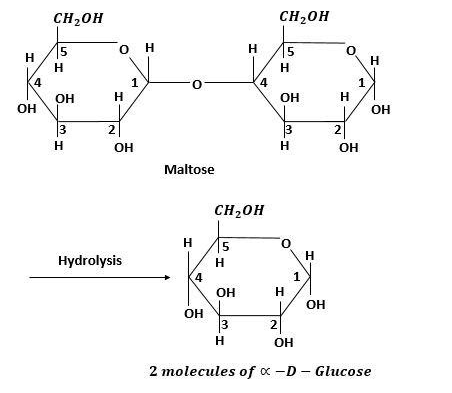
In hydrolysis it breaks at ${C_1}$ and ${C_4}$ positions and forms $\alpha - D - $ glucose.
Additional information: Condensation reaction: It is a reaction in which two molecules combine to form a larger molecule while leaving water or other smaller molecule as a byproduct.
Hydrolysis: It is the chemical breakdown of a compound due to reaction with water.
Monosaccharides: They are simple sugars which contain one oxygen and two hydrogen atoms for each carbon atom present in the compound.
Note: In organic chemistry, reaction with mineral acids like dilute ${H_2}S{O_4}$, dilute HCl is called hydrolysis reaction. Reaction with concentrated ${H_2}S{O_4}$ is called dehydration reaction. They do not form sulphates or chlorides.
Complete answer:
Reaction of Maltose to glucose is:
${C_{12}}{H_{22}}{O_{11}} + {H_2}O\xrightarrow{{maltose}}2{C_6}{H_{12}}{O_6}$
Maltose ${C_{12}}{H_{22}}{O_{11}}$ is a disaccharide. Disaccharides are carbohydrates which on hydrolysis give two same or different monosaccharides. They are made up of two molecules of monosaccharides linked to each other by condensation reaction. During condensation reaction one molecule of water is eliminated.
Monosaccharides units are linked to each other through oxygen atoms by a bond called glycosidic linkage.
One mole of maltose on hydrolysis gives two moles of $\alpha - D - $ glucose.
Maltose is composed of two $\alpha - D - $ glucose units which are condensed together through ${C_1}$ of one unit and ${C_4}$ of other units. Both glucose units are in pyranose form.
In hydrolysis it breaks at ${C_1}$ and ${C_4}$ positions and forms $\alpha - D - $ glucose.
Additional information: Condensation reaction: It is a reaction in which two molecules combine to form a larger molecule while leaving water or other smaller molecule as a byproduct.
Hydrolysis: It is the chemical breakdown of a compound due to reaction with water.
Monosaccharides: They are simple sugars which contain one oxygen and two hydrogen atoms for each carbon atom present in the compound.
Note: In organic chemistry, reaction with mineral acids like dilute ${H_2}S{O_4}$, dilute HCl is called hydrolysis reaction. Reaction with concentrated ${H_2}S{O_4}$ is called dehydration reaction. They do not form sulphates or chlorides.
Recently Updated Pages
Master Class 12 Business Studies: Engaging Questions & Answers for Success

Master Class 12 Chemistry: Engaging Questions & Answers for Success
Master Class 12 Biology: Engaging Questions & Answers for Success
Class 12 Question and Answer - Your Ultimate Solutions Guide
Master Class 11 English: Engaging Questions & Answers for Success
Master Class 11 Social Science: Engaging Questions & Answers for Success
Trending doubts
Which are the Top 10 Largest Countries of the World?
Draw a labelled sketch of the human eye class 12 physics CBSE
The end of compass needle which points towards north class 12 physics CBSE
Differentiate between homogeneous and heterogeneous class 12 chemistry CBSE
Why is the cell called the structural and functional class 12 biology CBSE
When was the first election held in India a 194748 class 12 sst CBSE