




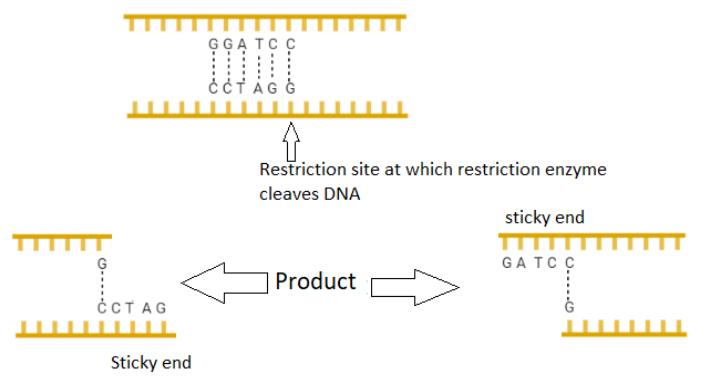
Make a chart (with diagrammatic representation) showing a restriction enzyme, the substrate DNA on which it acts, the site at which it cuts DNA and the product is produced.
Answer
 Verified
594k+ views
Hint: The nucleic acid present in the cell is called DNA. It is the genetic material of an organism. The enzyme which cleaves the DNA into fragments at a particular restriction site is called a restriction enzyme. Restriction enzymes are also called endonuclease or restrictase.
Complete answer: The term DNA stands for deoxyribonucleic acid. The structure of DNA is coiled helical in shape which consists of two polynucleotide chains. DNA carries the genetic instruction for the functioning, development, reproduction, and growth of all known organisms and also many viruses. Therefore, DNA is considered the genetic material of an organism. The whole DNA molecule is cleaved or broken into small fragments at a particular site called a restriction site. The enzyme that is used for the purpose of cleavage is called a restriction enzyme. Types of restriction enzymes are type I, type II, type III, type IV, and type V. Artificial restriction enzymes are also available. Restriction site is the particular site on DNA molecules that contains specific sequences of nucleotides. These nucleotides are recognized by the restriction enzymes. Restriction enzymes make two incisions to cut the DNA molecule on each strand of the sugar-phosphate backbone. Recognition sequences are further classified depending on the number of bases in its recognition site which is usually between 4 and 8 bases. Here in the given diagram restriction enzyme, BamH1 is used to cleave DNA at the GGATCC restriction site. After cleaving the DNA at the G nitrogen base of the restriction site, sticky ends of DNA substrate are formed.
Note: Restriction site is also called a restriction recognition site. Restriction sites are generally palindromic sequences. Isolated restriction enzymes are used for the purpose of DNA manipulation. During the process of gene cloning, restriction enzymes are used for inserting the gene into the cloning vector.
Complete answer: The term DNA stands for deoxyribonucleic acid. The structure of DNA is coiled helical in shape which consists of two polynucleotide chains. DNA carries the genetic instruction for the functioning, development, reproduction, and growth of all known organisms and also many viruses. Therefore, DNA is considered the genetic material of an organism. The whole DNA molecule is cleaved or broken into small fragments at a particular site called a restriction site. The enzyme that is used for the purpose of cleavage is called a restriction enzyme. Types of restriction enzymes are type I, type II, type III, type IV, and type V. Artificial restriction enzymes are also available. Restriction site is the particular site on DNA molecules that contains specific sequences of nucleotides. These nucleotides are recognized by the restriction enzymes. Restriction enzymes make two incisions to cut the DNA molecule on each strand of the sugar-phosphate backbone. Recognition sequences are further classified depending on the number of bases in its recognition site which is usually between 4 and 8 bases. Here in the given diagram restriction enzyme, BamH1 is used to cleave DNA at the GGATCC restriction site. After cleaving the DNA at the G nitrogen base of the restriction site, sticky ends of DNA substrate are formed.
Note: Restriction site is also called a restriction recognition site. Restriction sites are generally palindromic sequences. Isolated restriction enzymes are used for the purpose of DNA manipulation. During the process of gene cloning, restriction enzymes are used for inserting the gene into the cloning vector.
Recently Updated Pages
Master Class 12 Business Studies: Engaging Questions & Answers for Success

Master Class 12 Biology: Engaging Questions & Answers for Success
Master Class 12 Chemistry: Engaging Questions & Answers for Success
Class 12 Question and Answer - Your Ultimate Solutions Guide
Master Class 11 Social Science: Engaging Questions & Answers for Success
Master Class 11 English: Engaging Questions & Answers for Success
Trending doubts
Which are the Top 10 Largest Countries of the World?
Draw a labelled sketch of the human eye class 12 physics CBSE
Differentiate between homogeneous and heterogeneous class 12 chemistry CBSE
Sulphuric acid is known as the king of acids State class 12 chemistry CBSE
Why is the cell called the structural and functional class 12 biology CBSE
Which is the correct genotypic ratio of mendel dihybrid class 12 biology CBSE