




Main difference between chlorophyll a and chlorophyll b is
A) $-C{{H}_{3}}$ of chlorophyll a is replaced by $-CHO$ in chlorophyll b.
B) Chlorophyll a is linear while chlorophyll b is branched.
C) Chlorophyll a has no Mg.
D) All the above.
Answer
 Verified
640.8k+ views
Hint:Chlorophyll is the molecule that absorbs sunlight and uses its energy to synthesise carbohydrates from $CO_2$ and water.Every chemical compound has a specific wavelength at which the enzyme shows the maximum and efficient absorption power.
Complete answer:
Chlorophyll is a green color pigment that is found in the leaves of the plant and it is the pigment which gives leaves its green color. Two forms of chlorophyll a and b present themselves with various differences between them. The principal pigment that captures the sunlight during the process of photosynthesis is chlorophyll a while chlorophyll b captures and passes it to chlorophyll a. However this is not the major difference between them. Let us analyse the options to find the main difference between chlorophyll a and chlorophyll b.
>Option A: Chlorophyll a differs from chlorophyll b in that chlorophyll a has a methyl $(-C{{H}_{3}})$ group while chlorophyll b has a aldehyde group $(-CHO)$ in place of a methyl group. Therefore, this is the correct option.
>Option B: Both chlorophyll a and b have a cyclic structure. Therefore, this is the incorrect option.
>Option C: Magnesium (Mg) is a central compound in plants that is required by the plants to absorb sunlight during the process of photosynthesis. Both chlorophyll a and b have magnesium for absorption of sunlight.Therefore, this is the incorrect option.
>Option D: Since one of the above mentioned options is correct, this is the incorrect option.
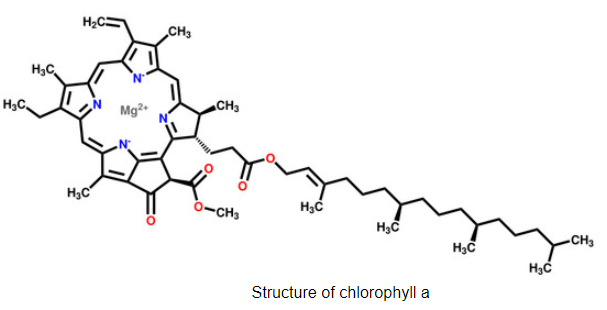
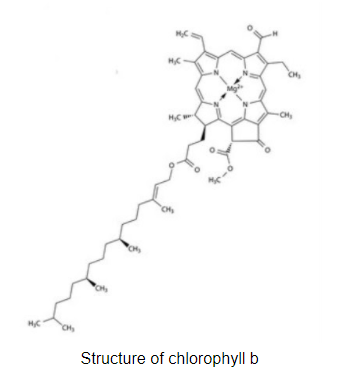
Thus, the correct answer is option (A) $-C{{H}_{3}}$ of chlorophyll a is replaced by $-CHO$ in chlorophyll b.
Note:There are four different types of chlorophyll,
-Chlorophyll a: It is used in oxygenic photosynthesis and absorbs energy from violet - blue and orange-red wavelengths.
-Chlorophyll b: It helps in conversion of huge amounts of light energy to chemical energy and absorbs energy from blue light.
-Chlorophyll c: It is found in certain marine algae and it absorbs light in the wavelength of 447 -452 nm.
-Chlorophyll d: It is found in cyanobacteria and it absorbs far red light.
Complete answer:
Chlorophyll is a green color pigment that is found in the leaves of the plant and it is the pigment which gives leaves its green color. Two forms of chlorophyll a and b present themselves with various differences between them. The principal pigment that captures the sunlight during the process of photosynthesis is chlorophyll a while chlorophyll b captures and passes it to chlorophyll a. However this is not the major difference between them. Let us analyse the options to find the main difference between chlorophyll a and chlorophyll b.
>Option A: Chlorophyll a differs from chlorophyll b in that chlorophyll a has a methyl $(-C{{H}_{3}})$ group while chlorophyll b has a aldehyde group $(-CHO)$ in place of a methyl group. Therefore, this is the correct option.
>Option B: Both chlorophyll a and b have a cyclic structure. Therefore, this is the incorrect option.
>Option C: Magnesium (Mg) is a central compound in plants that is required by the plants to absorb sunlight during the process of photosynthesis. Both chlorophyll a and b have magnesium for absorption of sunlight.Therefore, this is the incorrect option.
>Option D: Since one of the above mentioned options is correct, this is the incorrect option.
Thus, the correct answer is option (A) $-C{{H}_{3}}$ of chlorophyll a is replaced by $-CHO$ in chlorophyll b.
Note:There are four different types of chlorophyll,
-Chlorophyll a: It is used in oxygenic photosynthesis and absorbs energy from violet - blue and orange-red wavelengths.
-Chlorophyll b: It helps in conversion of huge amounts of light energy to chemical energy and absorbs energy from blue light.
-Chlorophyll c: It is found in certain marine algae and it absorbs light in the wavelength of 447 -452 nm.
-Chlorophyll d: It is found in cyanobacteria and it absorbs far red light.
Recently Updated Pages
If x a + bt + ct2 where x is in meters and t is in class 11 physics CBSE

A car covers the first half distance between two places class 11 physics CBSE
The resultant of two vectors overrightarrow P and overrightarrow class 11 physics CBSE
Find the value of cos 135 class 11 maths CBSE
A mass M is held in place by an applied force F and class 11 physics CBSE
A solution of glucose in water is labelled as 10 dfracwv class 11 chemistry CBSE
Trending doubts
One Metric ton is equal to kg A 10000 B 1000 C 100 class 11 physics CBSE
Find the value of the expression given below sin 30circ class 11 maths CBSE
Draw a diagram of nephron and explain its structur class 11 biology CBSE
10 examples of friction in our daily life
Proton was discovered by A Thomson B Rutherford C Chadwick class 11 chemistry CBSE
Bond order ofO2 O2+ O2 and O22 is in order A O2 langle class 11 chemistry CBSE