




Long-form of DNA.
Answer
 Verified
656.4k+ views
Hint: An organic chemical molecule found in all prokaryotic and eukaryotic cells. It is the hereditary material in humans and almost all other organisms.
Complete answer:
The full form of DNA is Deoxyribonucleic Acid. DNA is a set of molecules responsible for the transmitting and carrying the inherited materials or genetic instructions from parents to children.
DNA is composed of a pentose sugar, phosphoric acid, and nitrogenous bases (purine and pyrimidine).
Additional Information: -DNA contains the genetic material of a person as well as the human genome.
-Its chemistry shows that it is a compound of several smaller molecules linked together.
-The two DNA strands are known as Polynucleotides as they are composed of simpler monomeric units called nucleotides.
-Each nucleotide is composed of one of the four nitrogen-containing nucleobases which are: cytosine, guanine, adenine, or thymine.
-It is an organic compound that has a unique molecular structure. It is found in all eukaryotic and prokaryotic cells.
-The molecule of DNA is a double helix structure which is negatively charged.
-Humans have approximately 20,000 – 25,000 protein-coding genes.
-DNA is also responsible for introducing a mutation in the species by random rearrangement of gene sequences or recombination during reproduction.
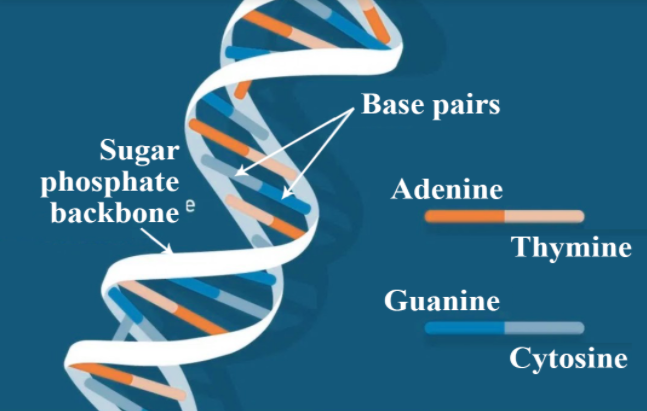
Note: The DNA was first named and recognized by Johannes Friedrich Miescher in 1869, during his work on white blood cells. There are different types of DNA, they are A-DNA, B-DNA, and Z-DNA.
Complete answer:
The full form of DNA is Deoxyribonucleic Acid. DNA is a set of molecules responsible for the transmitting and carrying the inherited materials or genetic instructions from parents to children.
DNA is composed of a pentose sugar, phosphoric acid, and nitrogenous bases (purine and pyrimidine).
Additional Information: -DNA contains the genetic material of a person as well as the human genome.
-Its chemistry shows that it is a compound of several smaller molecules linked together.
-The two DNA strands are known as Polynucleotides as they are composed of simpler monomeric units called nucleotides.
-Each nucleotide is composed of one of the four nitrogen-containing nucleobases which are: cytosine, guanine, adenine, or thymine.
-It is an organic compound that has a unique molecular structure. It is found in all eukaryotic and prokaryotic cells.
-The molecule of DNA is a double helix structure which is negatively charged.
-Humans have approximately 20,000 – 25,000 protein-coding genes.
-DNA is also responsible for introducing a mutation in the species by random rearrangement of gene sequences or recombination during reproduction.
Note: The DNA was first named and recognized by Johannes Friedrich Miescher in 1869, during his work on white blood cells. There are different types of DNA, they are A-DNA, B-DNA, and Z-DNA.
Recently Updated Pages
If x a + bt + ct2 where x is in meters and t is in class 11 physics CBSE

A car covers the first half distance between two places class 11 physics CBSE
The resultant of two vectors overrightarrow P and overrightarrow class 11 physics CBSE
Find the value of cos 135 class 11 maths CBSE
A mass M is held in place by an applied force F and class 11 physics CBSE
A solution of glucose in water is labelled as 10 dfracwv class 11 chemistry CBSE
Trending doubts
Find the value of the expression given below sin 30circ class 11 maths CBSE
One Metric ton is equal to kg A 10000 B 1000 C 100 class 11 physics CBSE
Draw a diagram of nephron and explain its structur class 11 biology CBSE
10 examples of friction in our daily life
Proton was discovered by A Thomson B Rutherford C Chadwick class 11 chemistry CBSE
Bond order ofO2 O2+ O2 and O22 is in order A O2 langle class 11 chemistry CBSE