




Lobefins evolved into?
A. Jawed cartilaginous fishes
B. Jawed bony fishes
C. Jawless fishes
D. Amphibian
Answer
 Verified
659.1k+ views
Hint: Vertebrates that need water or moist environment to survive, characterized as both aquatic and terrestrial organisms.
Complete answer:
Lobe finned fish constitute a class of the bony fish. A strict cladistic view shows that some lobe fins evolved into tetrapods, including amphibians, reptiles, and mammals.
Additional information
- Early lobe- finned fishes are bony fish with fleshy, lobes, and paired fins, which are joined to the body by a single bone.
- The morphology of these fishes that are similar looking to tetrapods gives indications of the transition from water to terrestrial life.
- The first amphibians were found to have evolved around 370 million years ago during the Devonian period.
- The articulations similar to the limbs of tetrapods are found in the pectoral and pelvic fins of these fishes.
- Those fins evolved into the legs of the first tetrapod land vertebrates, amphibians.
- The fin limbs of lobe- finned fishes show a strong similarity to the expected ancestral form of tetrapod limbs.
- Most of the lobe- finned fishes are extinct.
- The largest known lobe finned fish was Rhizodus hibberti from the carboniferous period of Scotland which may have exceeded 7 meters in length.
- It is believed that lobe fins evolved into tetrapod limbs during the Devonian period when amphibians evolved.
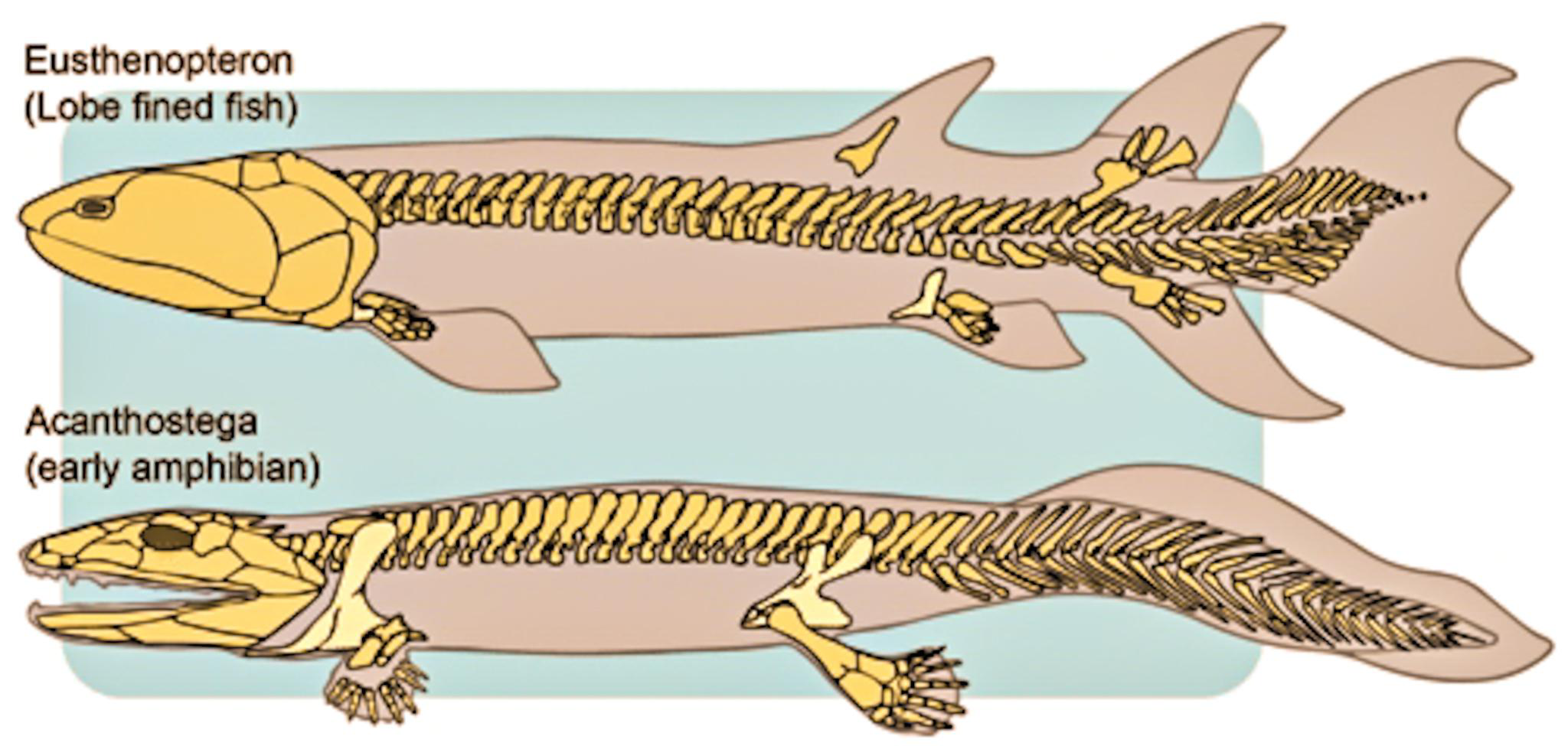
So, the correct answer is ‘Amphibian'.
Note: The lobe-finned fish is also called Sarcopterygii which is derived from a Greek word sarx meaning flesh and pteryx meaning fin. It is sometimes considered synonyms with Crossopterygii which means fringe- finned fish, it is also derived from a Greek word krossos meaning fringe. Amphibious is the Greek term from which the word amphibian is derived which is referred to as ‘both kinds of life’.
Complete answer:
Lobe finned fish constitute a class of the bony fish. A strict cladistic view shows that some lobe fins evolved into tetrapods, including amphibians, reptiles, and mammals.
Additional information
- Early lobe- finned fishes are bony fish with fleshy, lobes, and paired fins, which are joined to the body by a single bone.
- The morphology of these fishes that are similar looking to tetrapods gives indications of the transition from water to terrestrial life.
- The first amphibians were found to have evolved around 370 million years ago during the Devonian period.
- The articulations similar to the limbs of tetrapods are found in the pectoral and pelvic fins of these fishes.
- Those fins evolved into the legs of the first tetrapod land vertebrates, amphibians.
- The fin limbs of lobe- finned fishes show a strong similarity to the expected ancestral form of tetrapod limbs.
- Most of the lobe- finned fishes are extinct.
- The largest known lobe finned fish was Rhizodus hibberti from the carboniferous period of Scotland which may have exceeded 7 meters in length.
- It is believed that lobe fins evolved into tetrapod limbs during the Devonian period when amphibians evolved.
So, the correct answer is ‘Amphibian'.
Note: The lobe-finned fish is also called Sarcopterygii which is derived from a Greek word sarx meaning flesh and pteryx meaning fin. It is sometimes considered synonyms with Crossopterygii which means fringe- finned fish, it is also derived from a Greek word krossos meaning fringe. Amphibious is the Greek term from which the word amphibian is derived which is referred to as ‘both kinds of life’.
Recently Updated Pages
Master Class 11 Maths: Engaging Questions & Answers for Success

Master Class 11 Economics: Engaging Questions & Answers for Success
Master Class 11 Biology: Engaging Questions & Answers for Success
Class 11 Question and Answer - Your Ultimate Solutions Guide
Master Class 11 English: Engaging Questions & Answers for Success
Master Class 11 Social Science: Engaging Questions & Answers for Success
Trending doubts
Find the value of the expression given below sin 30circ class 11 maths CBSE
Draw a diagram of nephron and explain its structur class 11 biology CBSE
Proton was discovered by A Thomson B Rutherford C Chadwick class 11 chemistry CBSE
What is the sex ratio of Kerala class 11 social science CBSE
State the laws of reflection of light
Derive the equation of motion by the calculus method class 11 physics CBSE