




Lichen is an example of ……..
(a). Commensalism
(b). Mutualism
(c). Parasitism
(d). Mycorrhizal association
Answer
 Verified
627k+ views
Hint: It can survive within the most unusual and hostile habitats. They cover rocks, tree bark, gravestones, and are therefore found in the ground where plant roots cannot penetrate generally called tundra. It also can survive extended periods of drought, once they become completely desiccated, then rapidly become active once water is out there again.
Complete answer:
During mutualism, lichens aren't one creature, however, rather, a fungus normally an individual from the Ascomycota or Basidiomycota phylum lives in close contact with a photosynthetic organism.
Additional information
The body of a lichen, referenced as a thallus, is made of hyphae folded over the photosynthetic accomplice. The photosynthetic organism provides carbon and energy within the sort of carbohydrates. Some cyanobacteria fix nitrogen from the air, contributing nitrogenous mixes to the affiliation. Consequently, the fungus supplies minerals and security from dryness and over the top light by encasing the green growth in its mycelium. The fungus additionally connects the advantageous life form to the substrate.
Lichens are incredibly delicate to contamination, particularly to anomalous degrees of nitrogen and sulfur. The U.S. Forest Service and Park Service can monitor air quality by measuring the relative abundance and health of the lichen population in a neighborhood. Lichens fulfill many ecological roles. Caribou and reindeer eat lichens, and that they give secure little spineless creatures that stow away inside the mycelium. Within the production of textiles, weavers used lichens to dye wool for several centuries until the arrival of synthetic dyes.
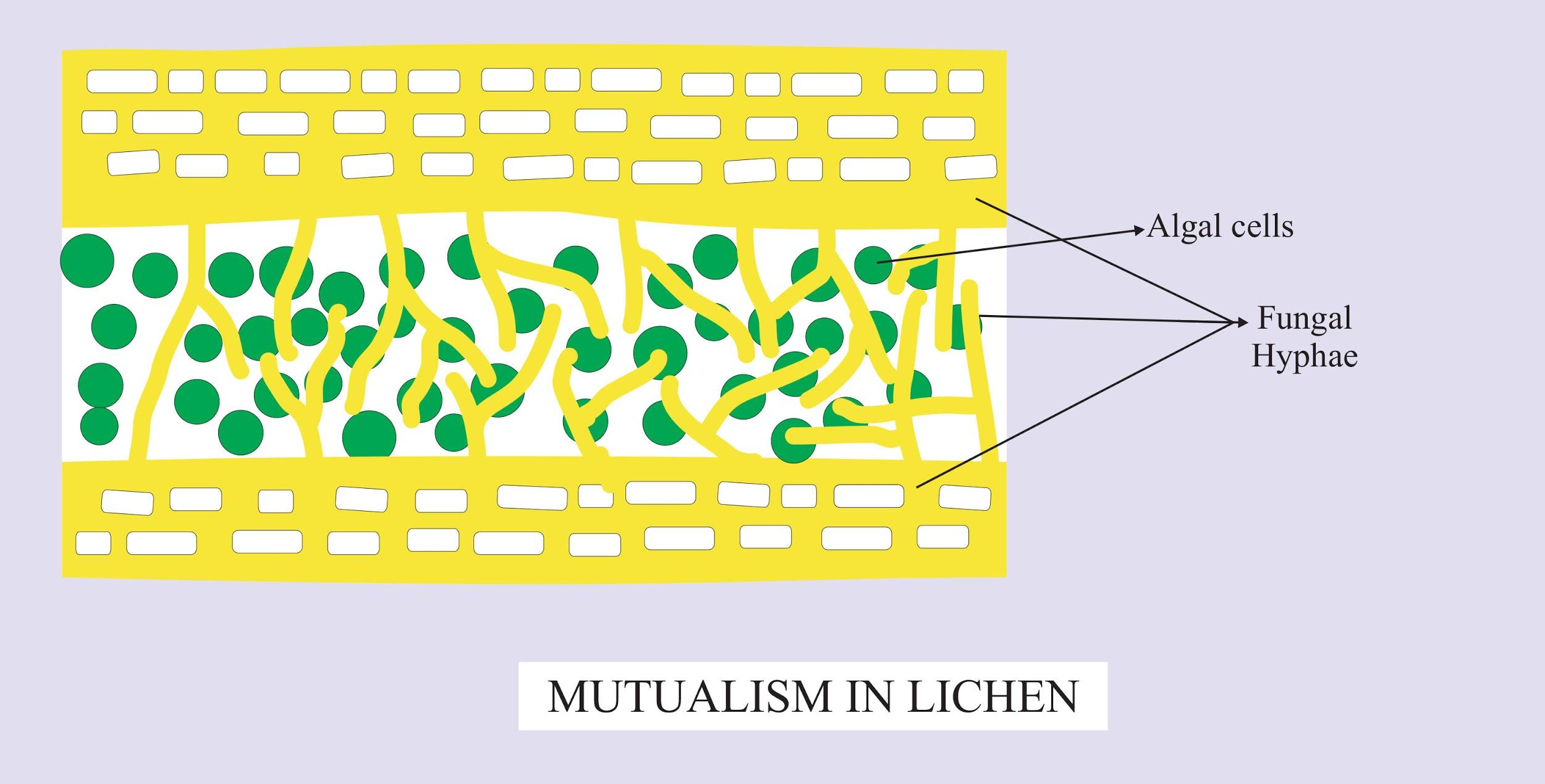
So the correct answer is ‘Mutualism’.
Note: The thallus of lichens grows very slowly, expanding its diameter a couple of millimeters per annum. Both the fungus and therefore the alga participate within the formation of dispersal units for the copy. Lichens produce soredia, bunches of algal cells encompassed by mycelia. Soredia are scattered by wind and water and structure new lichens.
Complete answer:
During mutualism, lichens aren't one creature, however, rather, a fungus normally an individual from the Ascomycota or Basidiomycota phylum lives in close contact with a photosynthetic organism.
Additional information
The body of a lichen, referenced as a thallus, is made of hyphae folded over the photosynthetic accomplice. The photosynthetic organism provides carbon and energy within the sort of carbohydrates. Some cyanobacteria fix nitrogen from the air, contributing nitrogenous mixes to the affiliation. Consequently, the fungus supplies minerals and security from dryness and over the top light by encasing the green growth in its mycelium. The fungus additionally connects the advantageous life form to the substrate.
Lichens are incredibly delicate to contamination, particularly to anomalous degrees of nitrogen and sulfur. The U.S. Forest Service and Park Service can monitor air quality by measuring the relative abundance and health of the lichen population in a neighborhood. Lichens fulfill many ecological roles. Caribou and reindeer eat lichens, and that they give secure little spineless creatures that stow away inside the mycelium. Within the production of textiles, weavers used lichens to dye wool for several centuries until the arrival of synthetic dyes.
So the correct answer is ‘Mutualism’.
Note: The thallus of lichens grows very slowly, expanding its diameter a couple of millimeters per annum. Both the fungus and therefore the alga participate within the formation of dispersal units for the copy. Lichens produce soredia, bunches of algal cells encompassed by mycelia. Soredia are scattered by wind and water and structure new lichens.
Recently Updated Pages
Master Class 12 Economics: Engaging Questions & Answers for Success

Master Class 12 Social Science: Engaging Questions & Answers for Success
Master Class 12 English: Engaging Questions & Answers for Success
Master Class 12 Maths: Engaging Questions & Answers for Success
Master Class 12 Physics: Engaging Questions & Answers for Success
Master Class 12 Biology: Engaging Questions & Answers for Success
Trending doubts
Which is the correct genotypic ratio of mendel dihybrid class 12 biology CBSE
Differentiate between homogeneous and heterogeneous class 12 chemistry CBSE
Draw a ray diagram of compound microscope when the class 12 physics CBSE
Derive an expression for the electric field intensity class 12 physics CBSE
Ethylidene chloride and ethylene dichloride are A Chain class 12 chemistry CBSE
Calculate the equivalent resistance between a and b class 12 physics CBSE