




Let $PQ$ be a double ordinate of the parabola, ${y^2} = - 4x$, where $P$ lies in the second quadrant. If $R$ divides $PQ$ in the ratio 2 : 1, then the locus of $R$ is
$
{\text{A}}{\text{. 3}}{y^2} = - 2x \\
{\text{B}}{\text{. }}9{y^2} = 4x \\
{\text{C}}{\text{. }}9{y^2} = - 4x \\
{\text{D}}{\text{. }}3{y^2} = 2x \\
$
Answer
 Verified
627.9k+ views
Hint: In this question, firstly we have to analyse the question and understand the concept of parabola. We have to identify the ratio in which the ordinate is divided and then find its locus by checking all the options one by one.
Complete step-by-step answer:
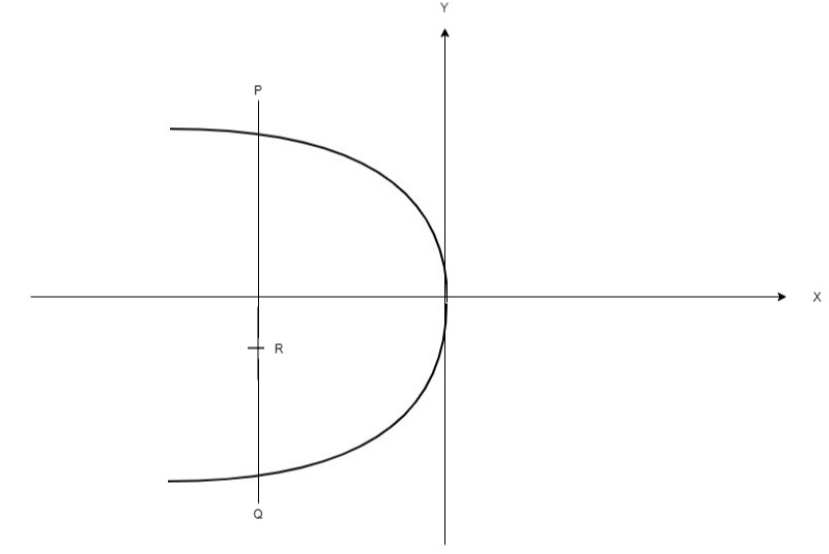
Now assume the coordinates of points ${\text{P,Q & R}}$ as
${\text{P}}\left( { - at_1^2,2a{t_1}} \right),Q\left( { - at_1^2,2a{t_1}} \right)$ and ${\text{R}}\left( {h,k} \right)$
As ${\text{R}}$ divides ${\text{PQ}}$in the ratio 2:1 according to question, we take the coordinates of P & Q in that ratio and equate it with the coordinates of ${\text{R}}$
Then, step 1 is
$h = \dfrac{{ - 1at_1^2 - 2at_1^2}}{{2 + 1}} = - at_1^2$
and step 2 is
$k = \dfrac{{1 \times 2a{t_1} - 2 \times 2a{t_1}}}{{2 + 1}} = \dfrac{{ - 2a{t_1}}}{3}$
Now from step 2 we gather the value of ${t_1}$ and put it in step 1. So, we get
$h = - a{\left( {\dfrac{{3k}}{{ - 2a}}} \right)^2} = - \dfrac{{9{k^2}}}{4}$
$ \Rightarrow 9{k^2} = - 4h$ or we can put $x\& y$ in place of $h\& k$
$9{y^2} = - 4x$
Hence, option C is the correct answer.
Note: Whenever we face such types of questions the key point to remember is that any chord that is perpendicular to the axis of parabola is called a double ordinate. So, we have to assume the points on parabola and equate them to the point on double ordinate and then check our options and find the right answer.
Complete step-by-step answer:
Now assume the coordinates of points ${\text{P,Q & R}}$ as
${\text{P}}\left( { - at_1^2,2a{t_1}} \right),Q\left( { - at_1^2,2a{t_1}} \right)$ and ${\text{R}}\left( {h,k} \right)$
As ${\text{R}}$ divides ${\text{PQ}}$in the ratio 2:1 according to question, we take the coordinates of P & Q in that ratio and equate it with the coordinates of ${\text{R}}$
Then, step 1 is
$h = \dfrac{{ - 1at_1^2 - 2at_1^2}}{{2 + 1}} = - at_1^2$
and step 2 is
$k = \dfrac{{1 \times 2a{t_1} - 2 \times 2a{t_1}}}{{2 + 1}} = \dfrac{{ - 2a{t_1}}}{3}$
Now from step 2 we gather the value of ${t_1}$ and put it in step 1. So, we get
$h = - a{\left( {\dfrac{{3k}}{{ - 2a}}} \right)^2} = - \dfrac{{9{k^2}}}{4}$
$ \Rightarrow 9{k^2} = - 4h$ or we can put $x\& y$ in place of $h\& k$
$9{y^2} = - 4x$
Hence, option C is the correct answer.
Note: Whenever we face such types of questions the key point to remember is that any chord that is perpendicular to the axis of parabola is called a double ordinate. So, we have to assume the points on parabola and equate them to the point on double ordinate and then check our options and find the right answer.
Recently Updated Pages
Basicity of sulphurous acid and sulphuric acid are

Master Class 11 Business Studies: Engaging Questions & Answers for Success
Master Class 11 Computer Science: Engaging Questions & Answers for Success
Master Class 11 Economics: Engaging Questions & Answers for Success
Master Class 11 Social Science: Engaging Questions & Answers for Success
Master Class 11 English: Engaging Questions & Answers for Success
Trending doubts
The largest wind power cluster is located in the state class 11 social science CBSE
Explain zero factorial class 11 maths CBSE
Which among the following are examples of coming together class 11 social science CBSE
Can anyone list 10 advantages and disadvantages of friction
State the laws of reflection of light
Draw a diagram of a plant cell and label at least eight class 11 biology CBSE