




Is sickle cell anemia dominant or recessive?
Answer
 Verified
513.9k+ views
Hint: Sickle cell anaemia is one of several diseases commonly known as sickle cell disease. Sickle cell anaemia is a hereditary red blood cell disease in which there are insufficient healthy red blood cells to transport oxygen throughout the body. Normally, red blood cells are flexible and spherical, and they flow readily through blood arteries.
Complete answer:
Normally, red blood cells are flexible and spherical, and they flow readily through blood arteries. Red blood cells in sickle cell anaemia are shaped like sickles or crescent moons. These hard, sticky cells can become lodged in tiny blood arteries, slowing or blocking blood flow and oxygen delivery to various areas of the body.
Most patients with sickle cell anaemia do not have a cure. Treatments, on the other hand, can alleviate discomfort and aid in the prevention of illness consequences.
Image showing Sickle Cell Anemia
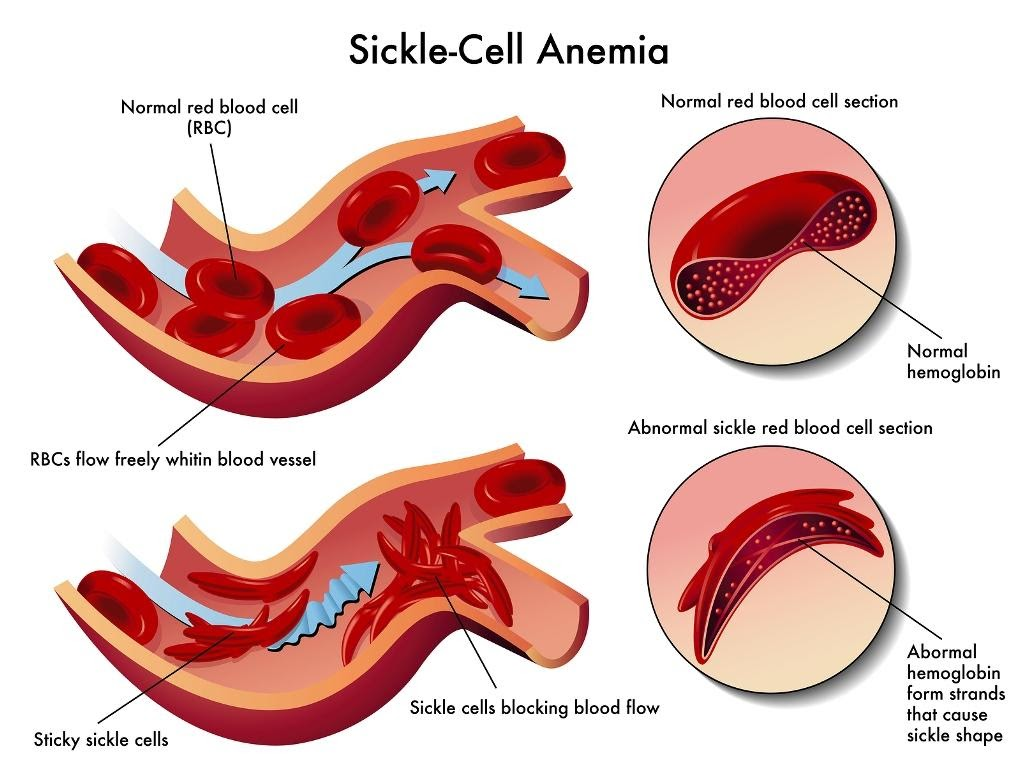
An abnormality in the development of red blood cells is the cause of sickle cell disease (SCD). There's a one-in-four risk that a kid born to parents who have the gene would be born with sickle cell anemia. Often, the child's parents don't have sickle cell disease and are merely transmitters of the sickle cell trait for their children.
Anemia caused by sickle cell occurs when both copies of a gene in a cell are mutated. Genetic mutations can be passed down from one generation to the next, although the parents of an autosomal recessive patient do not display symptoms of the illness.
Therefore, sickle cell anemia is recessive in nature.
Note:
Sickle cell illness affects all main organs. Due to the aberrant activity of sickle cells and their inability to pass through the tiny blood arteries appropriately, organs such as the liver, heart, kidneys, gallbladder, eyes, bones, and joints may be affected.
Complete answer:
Normally, red blood cells are flexible and spherical, and they flow readily through blood arteries. Red blood cells in sickle cell anaemia are shaped like sickles or crescent moons. These hard, sticky cells can become lodged in tiny blood arteries, slowing or blocking blood flow and oxygen delivery to various areas of the body.
Most patients with sickle cell anaemia do not have a cure. Treatments, on the other hand, can alleviate discomfort and aid in the prevention of illness consequences.
Image showing Sickle Cell Anemia
An abnormality in the development of red blood cells is the cause of sickle cell disease (SCD). There's a one-in-four risk that a kid born to parents who have the gene would be born with sickle cell anemia. Often, the child's parents don't have sickle cell disease and are merely transmitters of the sickle cell trait for their children.
Anemia caused by sickle cell occurs when both copies of a gene in a cell are mutated. Genetic mutations can be passed down from one generation to the next, although the parents of an autosomal recessive patient do not display symptoms of the illness.
Therefore, sickle cell anemia is recessive in nature.
Note:
Sickle cell illness affects all main organs. Due to the aberrant activity of sickle cells and their inability to pass through the tiny blood arteries appropriately, organs such as the liver, heart, kidneys, gallbladder, eyes, bones, and joints may be affected.
Recently Updated Pages
Master Class 12 Business Studies: Engaging Questions & Answers for Success

Master Class 12 Biology: Engaging Questions & Answers for Success
Master Class 12 Chemistry: Engaging Questions & Answers for Success
Class 12 Question and Answer - Your Ultimate Solutions Guide
Master Class 11 Social Science: Engaging Questions & Answers for Success
Master Class 11 English: Engaging Questions & Answers for Success
Trending doubts
Which are the Top 10 Largest Countries of the World?
Draw a labelled sketch of the human eye class 12 physics CBSE
Differentiate between homogeneous and heterogeneous class 12 chemistry CBSE
Why is the cell called the structural and functional class 12 biology CBSE
Draw ray diagrams each showing i myopic eye and ii class 12 physics CBSE
Which is the correct genotypic ratio of mendel dihybrid class 12 biology CBSE