




Is maize $C_3$ or $C_4$?
Answer
 Verified
570.3k+ views
Hint: The plants in which oxaloacetic acid (OAA) is the first stable product after the fixation of carbon dioxide are called $C_4$ plants. OAA is the four carbon compounds and hence, the plants are so-called $C_4$ plants. The $C_4$ plants have a special type of anatomy in their leaves. It is called Kranz anatomy. On the other hand, in $C_3$ plants, Kranz anatomy is not present. The Calvin cycle occurs in $C_3$ plants. Phosphoglyceric acid is the first stable product formed in $C_3$ plants.
Complete answer:
The plants that grow in hot and dry environmental conditions use the $C_4$ pathway. The $C_4$ pathway is seen in grasses such as sugarcane, maize etc.
The leaves of $C_4$ plants shows the following anatomical features-
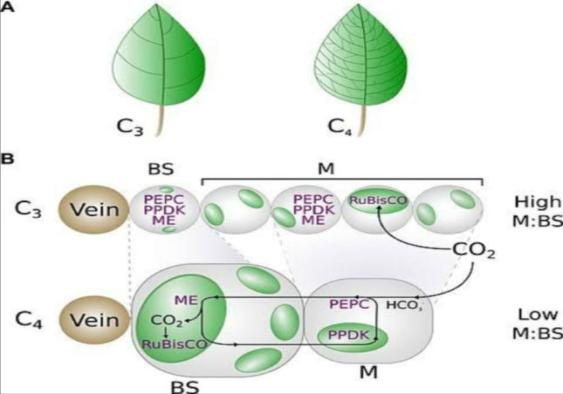
The vascular bundles of $C_4$ plants are surrounded by several layers of bundle sheath cells. The chloroplasts of the bundle sheath cells are very large. There are no intercellular spaces between the bundle sheath cells.
The mesophyll cells have chloroplasts that are smaller in size.
Two enzymes are involved in the $C_4$ pathway- RuBisCO and PEPCase enzyme. RuBisCO enzyme is present in bundle sheath cells while PEPCase enzyme is present in mesophyll cells.
The plants that grow in cool and wet environmental conditions use the Calvin cycle. The Calvin cycle is seen in rice, wheat etc. They are most commonly found in temperate areas. Dark reactions occur in mesophyll cells of leaves. About 95% of the plants undergo the $C_3$ pathway.
The $C_4$ pathway provides advantage to plants in the following ways-
$C_4$ plants are more tolerant to high temperature
They use water more efficiently than other plants
In $C_4$ plants, no photorespiration takes place which is a wasteful phenomenon.
High carbon dioxide fixation increases the productivity of these plants.
The maize has Kranz anatomy; hence it is a $C_4$ plant.
Note:
As the $C_4$ pathway was discovered by Davidson Hatch and Charles Roger Slack, it is also called the Hatch and Slack pathway. The $C_4$ pathway provides many advantages to the plant over $C_3$ plants. It increases the concentration of carbon dioxide in the cells in which sugars are formed. Hence, the productivity of $C_4$ plants is higher than $C_3$ plants.
Complete answer:
The plants that grow in hot and dry environmental conditions use the $C_4$ pathway. The $C_4$ pathway is seen in grasses such as sugarcane, maize etc.
The leaves of $C_4$ plants shows the following anatomical features-
The vascular bundles of $C_4$ plants are surrounded by several layers of bundle sheath cells. The chloroplasts of the bundle sheath cells are very large. There are no intercellular spaces between the bundle sheath cells.
The mesophyll cells have chloroplasts that are smaller in size.
Two enzymes are involved in the $C_4$ pathway- RuBisCO and PEPCase enzyme. RuBisCO enzyme is present in bundle sheath cells while PEPCase enzyme is present in mesophyll cells.
The plants that grow in cool and wet environmental conditions use the Calvin cycle. The Calvin cycle is seen in rice, wheat etc. They are most commonly found in temperate areas. Dark reactions occur in mesophyll cells of leaves. About 95% of the plants undergo the $C_3$ pathway.
The $C_4$ pathway provides advantage to plants in the following ways-
$C_4$ plants are more tolerant to high temperature
They use water more efficiently than other plants
In $C_4$ plants, no photorespiration takes place which is a wasteful phenomenon.
High carbon dioxide fixation increases the productivity of these plants.
The maize has Kranz anatomy; hence it is a $C_4$ plant.
Note:
As the $C_4$ pathway was discovered by Davidson Hatch and Charles Roger Slack, it is also called the Hatch and Slack pathway. The $C_4$ pathway provides many advantages to the plant over $C_3$ plants. It increases the concentration of carbon dioxide in the cells in which sugars are formed. Hence, the productivity of $C_4$ plants is higher than $C_3$ plants.
Recently Updated Pages
If x a + bt + ct2 where x is in meters and t is in class 11 physics CBSE

A car covers the first half distance between two places class 11 physics CBSE
The resultant of two vectors overrightarrow P and overrightarrow class 11 physics CBSE
Find the value of cos 135 class 11 maths CBSE
A mass M is held in place by an applied force F and class 11 physics CBSE
A solution of glucose in water is labelled as 10 dfracwv class 11 chemistry CBSE
Trending doubts
Find the value of the expression given below sin 30circ class 11 maths CBSE
One Metric ton is equal to kg A 10000 B 1000 C 100 class 11 physics CBSE
Draw a diagram of nephron and explain its structur class 11 biology CBSE
10 examples of friction in our daily life
Proton was discovered by A Thomson B Rutherford C Chadwick class 11 chemistry CBSE
Bond order ofO2 O2+ O2 and O22 is in order A O2 langle class 11 chemistry CBSE