




Is glomerular filtrate: clear in appearance and contains no glucose; a concentrated solution of waste products; identical to blood plasma; blood plasma that lacks most proteins; or is it whole blood?
Answer
 Verified
504k+ views
Hint: Glomerular filtration is the first step of urine making. This is the process in which the kidneys filter the excess water and waste products from the blood into the urine collecting tubules of our kidneys. During this process our blood enters into the afferent arteriole and flows into the glomerulus where filterable blood components, like water and nitrogenous waste will move towards the inside of the glomerulus. And non-filterable components of blood like blood cells (RBC, WBC etc.) and serum albumins will exit via the efferent arteriole.
Complete answer:
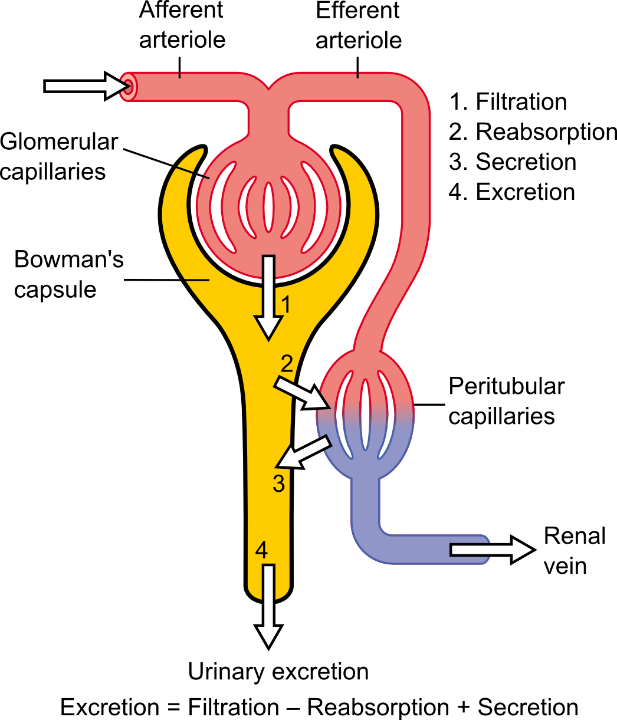
Here the right answer is the fourth option - the glomerular filtrate is identical to the blood plasma that lacks most proteins.
The glomerulus filters the proteins and the cells that are too large to pass through the membrane from the blood. So, our blood cells are unable to pass through the membrane.
Additional Information:
The glomerular filtrate contains water, salt, urea and also glucose.
So, the first option, “The glomerular filtrate is clear in appearance and contains no glucose” is the wrong option.
The urea, salts and glucose enter into the Bowman’s Capsule with the same concentration as they already have in the blood.
So, the second option, “The glomerular filtrate is a concentrated solution of waste products” is not the correct option.
As the glomerular membrane is extremely sensitive it allows only $0.02\% $of plasma albumin to pass through the membrane.
So, the third option, “Glomerular filtrate is identical to blood plasma” is not the correct option.
The whole blood contains the blood cells and proteins that can’t pass through the membrane of glomerulus.
So, the last or the fifth option, “Glomerular filtrate is identical to the whole blood” is not the correct option.
Hence, the only correct option is “Glomerular filtrate is identical to the blood plasma that lacks proteins”.
Note:
There is a test process to estimate how much blood passes through the glomeruli each minute. The process is called Glomerular filtration rate. This diagnosis is used to check if the kidneys are working properly or not. Glomeruli are the tiny filters of our kidneys that filter wastes from our blood.
Complete answer:
Here the right answer is the fourth option - the glomerular filtrate is identical to the blood plasma that lacks most proteins.
The glomerulus filters the proteins and the cells that are too large to pass through the membrane from the blood. So, our blood cells are unable to pass through the membrane.
Additional Information:
The glomerular filtrate contains water, salt, urea and also glucose.
So, the first option, “The glomerular filtrate is clear in appearance and contains no glucose” is the wrong option.
The urea, salts and glucose enter into the Bowman’s Capsule with the same concentration as they already have in the blood.
So, the second option, “The glomerular filtrate is a concentrated solution of waste products” is not the correct option.
As the glomerular membrane is extremely sensitive it allows only $0.02\% $of plasma albumin to pass through the membrane.
So, the third option, “Glomerular filtrate is identical to blood plasma” is not the correct option.
The whole blood contains the blood cells and proteins that can’t pass through the membrane of glomerulus.
So, the last or the fifth option, “Glomerular filtrate is identical to the whole blood” is not the correct option.
Hence, the only correct option is “Glomerular filtrate is identical to the blood plasma that lacks proteins”.
Note:
There is a test process to estimate how much blood passes through the glomeruli each minute. The process is called Glomerular filtration rate. This diagnosis is used to check if the kidneys are working properly or not. Glomeruli are the tiny filters of our kidneys that filter wastes from our blood.
Recently Updated Pages
Master Class 11 Social Science: Engaging Questions & Answers for Success

Master Class 11 Physics: Engaging Questions & Answers for Success
Master Class 11 Maths: Engaging Questions & Answers for Success
Master Class 11 Economics: Engaging Questions & Answers for Success
Master Class 11 Computer Science: Engaging Questions & Answers for Success
Master Class 11 Chemistry: Engaging Questions & Answers for Success
Trending doubts
Discuss the various forms of bacteria class 11 biology CBSE
Draw a diagram of nephron and explain its structur class 11 biology CBSE
What organs are located on the left side of your body class 11 biology CBSE
Draw a labelled diagram showing structure of LS of class 11 biology CBSE
How many rings are present in MEDTA+n class 11 chemistry CBSE
Draw the molecular orbital diagram of N2N2 + N2 Write class 11 chemistry CBSE