




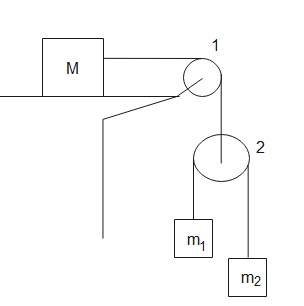
Ion the arrangement as shown below, ${{m}_{1}}=1kg$, ${{m}_{2}}=2kg$. Pulleys are massless and strings are light. For what value of $M$, the mass ${{m}_{1}}$ will move with constant velocity? (Neglect friction)
(1). $4kg$
(2). $8kg$
(3). $6kg$
(4). $10kg$
Answer
 Verified
624.6k+ views
Hint: The system of blocks and pulleys is isolated as no external forces are acting on it. All the forces acting between the elements of the system are internal forces. We can resolve forces along the different directions and use it to make equations. Using the equations, we can calculate the required parameter.
Formula Used:
${{m}_{1}}g=T$
${{m}_{2}}g-T={{m}_{2}}a$
$2T=M{{a}_{1}}$
Complete step-by-step solution:
Given a system of three blocks attached to two pulleys, mass ${{m}_{1}}$ is moving with constant velocity, this means net forces acting on it are zero.
The forces acting on the system are as shown,
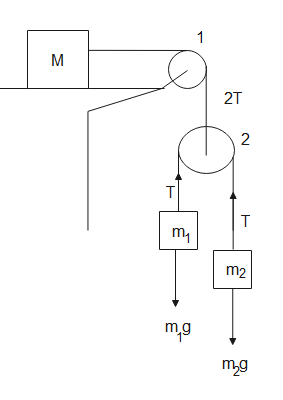
Forces acting on ${{m}_{1}}$ are-
${{m}_{1}}g=T$
From the above equation, we get,
$\begin{align}
& T=1\times g \\
& \therefore T=g \\
\end{align}$
The forces acting on ${{m}_{2}}$ are
${{m}_{2}}g-T={{m}_{2}}a$
When we substitute given values in the above equation, we get,
$\begin{align}
& 2\times g-g=2\times a \\
& \Rightarrow g=2a \\
& \therefore a=\dfrac{g}{2} \\
\end{align}$
${{m}_{2}}$ is moving with acceleration, $\dfrac{g}{2}$.
Let the mass $M$ move with acceleration, ${{a}_{1}}$ . so the whole system will move with acceleration ${{a}_{1}}$. The forces acting on the string will cause it to stretch, since there is no movement on the string, the accelerations cancel each other.
$\begin{align}
& a-{{a}_{1}}-{{a}_{1}}=0 \\
& \Rightarrow a=2{{a}_{1}} \\
& \Rightarrow {{a}_{1}}=\dfrac{a}{2} \\
& \therefore {{a}_{1}}=\dfrac{g}{2} \\
\end{align}$
The forces acting on mass $M$ are-
$\begin{align}
& 2T=M{{a}_{1}} \\
& \Rightarrow \dfrac{2T}{{{a}_{1}}}=M \\
& \Rightarrow \dfrac{2\times g}{\dfrac{g}{2}}=M \\
& \therefore 4kg=M \\
\end{align}$
Therefore, the mass of $M$ for which ${{m}_{1}}$ moves with constant velocity is $4kg$.
Hence, the correct option is (1).
Note:
The tension in a string is the pulling force acting on a string. It is the action-reaction pair of forces acting on the point at which a string is connected to an object. The pulleys and strings are considered massless. The action-reaction pairs follow Newton’s third law of motion, which states that forces acting between two bodies are equal and opposite. According to Newton’s second law of motion, a force is required to change the state of rest or motion of an object.
Formula Used:
${{m}_{1}}g=T$
${{m}_{2}}g-T={{m}_{2}}a$
$2T=M{{a}_{1}}$
Complete step-by-step solution:
Given a system of three blocks attached to two pulleys, mass ${{m}_{1}}$ is moving with constant velocity, this means net forces acting on it are zero.
The forces acting on the system are as shown,
Forces acting on ${{m}_{1}}$ are-
${{m}_{1}}g=T$
From the above equation, we get,
$\begin{align}
& T=1\times g \\
& \therefore T=g \\
\end{align}$
The forces acting on ${{m}_{2}}$ are
${{m}_{2}}g-T={{m}_{2}}a$
When we substitute given values in the above equation, we get,
$\begin{align}
& 2\times g-g=2\times a \\
& \Rightarrow g=2a \\
& \therefore a=\dfrac{g}{2} \\
\end{align}$
${{m}_{2}}$ is moving with acceleration, $\dfrac{g}{2}$.
Let the mass $M$ move with acceleration, ${{a}_{1}}$ . so the whole system will move with acceleration ${{a}_{1}}$. The forces acting on the string will cause it to stretch, since there is no movement on the string, the accelerations cancel each other.
$\begin{align}
& a-{{a}_{1}}-{{a}_{1}}=0 \\
& \Rightarrow a=2{{a}_{1}} \\
& \Rightarrow {{a}_{1}}=\dfrac{a}{2} \\
& \therefore {{a}_{1}}=\dfrac{g}{2} \\
\end{align}$
The forces acting on mass $M$ are-
$\begin{align}
& 2T=M{{a}_{1}} \\
& \Rightarrow \dfrac{2T}{{{a}_{1}}}=M \\
& \Rightarrow \dfrac{2\times g}{\dfrac{g}{2}}=M \\
& \therefore 4kg=M \\
\end{align}$
Therefore, the mass of $M$ for which ${{m}_{1}}$ moves with constant velocity is $4kg$.
Hence, the correct option is (1).
Note:
The tension in a string is the pulling force acting on a string. It is the action-reaction pair of forces acting on the point at which a string is connected to an object. The pulleys and strings are considered massless. The action-reaction pairs follow Newton’s third law of motion, which states that forces acting between two bodies are equal and opposite. According to Newton’s second law of motion, a force is required to change the state of rest or motion of an object.
Recently Updated Pages
Master Class 12 Economics: Engaging Questions & Answers for Success

Master Class 12 Social Science: Engaging Questions & Answers for Success
Master Class 12 English: Engaging Questions & Answers for Success
Master Class 12 Maths: Engaging Questions & Answers for Success
Master Class 12 Physics: Engaging Questions & Answers for Success
Master Class 12 Biology: Engaging Questions & Answers for Success
Trending doubts
Draw a labelled sketch of the human eye class 12 physics CBSE
Which are the Top 10 Largest Countries of the World?
Draw ray diagrams each showing i myopic eye and ii class 12 physics CBSE
Which is the correct genotypic ratio of mendel dihybrid class 12 biology CBSE
Differentiate between homogeneous and heterogeneous class 12 chemistry CBSE
Which animal never drinks water in its entire life class 12 biology CBSE