




What is inflorescence? Give a brief account of different types of inflorescence in flowering plants.
Answer
 Verified
429.3k+ views
Hint: A flower is a very important part of the plant, formed specifically to help in the biological process of reproduction. The main function of these beautiful parts of the plants is to ensure that reproduction is achieved, it is done by attracting the pollinating agents or being evolved to make it easier for abiotic agents to easily transfer the pollen grains. The different types of arrangement of flowers along the flowering axis of a plant are known as its inflorescence.
Complete step-by-step answer:
The stalk is the basal part upon which the whole flower is formed and sustained till it achieves its goals in reproduction. Each flower-bearing stalk is called a pedicel. Some flowers do not occur in groups, rather these flowers occur individually and are known as solitary flowers. Only plants where a group of flowers is found can be said to possess an inflorescence.
The different types of inflorescence depend on the flowering axis of the plant, i.e. whether the floral axis keeps on growing or terminates after the flower at the tip is formed.
Based on the above-mentioned fact, the inflorescence is primarily of two different types,
i) Racemose Inflorescence- in this type of inflorescence, the flowers are formed laterally along the floral axis of the plant. In this case, the floral axis keeps on growing and the stem height is not terminated by the flower formed at the tip of the floral axis.
ii) Cymose Inflorescence- In this type of inflorescence, the growth of the stem is terminated by the formation of a flower at the tip of the stem.
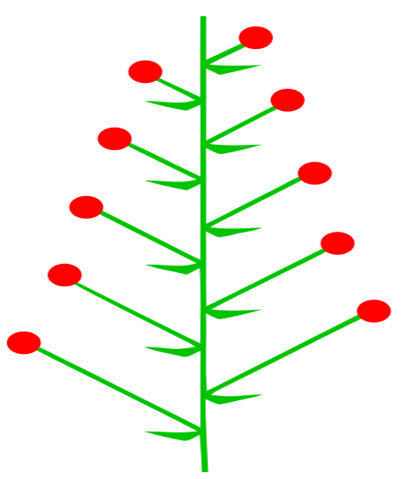
Image - Racemose Inflorescence
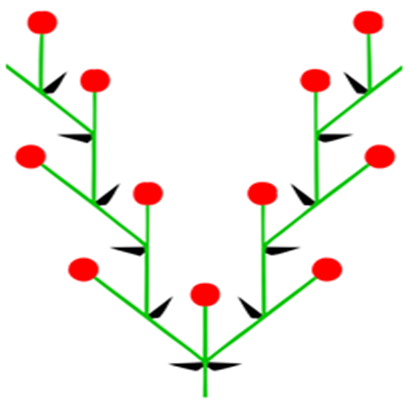
Image - Cymose Inflorescence
Note Compound Inflorescence- In this type of inflorescence the main axis or the peduncle branches repeatedly once or twice in a racemose or cymose manner. In the first case, it becomes a compound raceme and in the latter case, it becomes a compound cymose inflorescence.
There are many other types of inflorescence evolved specifically for different plants but they all are divided into these two primary divisions of racemose or cymose inflorescence.
Complete step-by-step answer:
The stalk is the basal part upon which the whole flower is formed and sustained till it achieves its goals in reproduction. Each flower-bearing stalk is called a pedicel. Some flowers do not occur in groups, rather these flowers occur individually and are known as solitary flowers. Only plants where a group of flowers is found can be said to possess an inflorescence.
The different types of inflorescence depend on the flowering axis of the plant, i.e. whether the floral axis keeps on growing or terminates after the flower at the tip is formed.
Based on the above-mentioned fact, the inflorescence is primarily of two different types,
i) Racemose Inflorescence- in this type of inflorescence, the flowers are formed laterally along the floral axis of the plant. In this case, the floral axis keeps on growing and the stem height is not terminated by the flower formed at the tip of the floral axis.
ii) Cymose Inflorescence- In this type of inflorescence, the growth of the stem is terminated by the formation of a flower at the tip of the stem.
Image - Racemose Inflorescence
Image - Cymose Inflorescence
Note Compound Inflorescence- In this type of inflorescence the main axis or the peduncle branches repeatedly once or twice in a racemose or cymose manner. In the first case, it becomes a compound raceme and in the latter case, it becomes a compound cymose inflorescence.
There are many other types of inflorescence evolved specifically for different plants but they all are divided into these two primary divisions of racemose or cymose inflorescence.
Recently Updated Pages
Master Class 12 Economics: Engaging Questions & Answers for Success

Master Class 12 English: Engaging Questions & Answers for Success
Master Class 12 Social Science: Engaging Questions & Answers for Success
Master Class 12 Maths: Engaging Questions & Answers for Success
Master Class 12 Physics: Engaging Questions & Answers for Success
Master Class 9 General Knowledge: Engaging Questions & Answers for Success
Trending doubts
The common characteristics between tomato and potato class 11 biology NEET_UG
Which are the Top 10 Largest Countries of the World?
One Metric ton is equal to kg A 10000 B 1000 C 100 class 11 physics CBSE
Explain the Treaty of Vienna of 1815 class 10 social science CBSE
Draw a labelled sketch of the human eye class 12 physics CBSE
What is BLO What is the full form of BLO class 8 social science CBSE