




In the spectrum of visible light, the red light has_ _ _ _ wavelength and _ _ _ _ frequency.
A) minimum, maximum
B) maximum, minimum
C) maximum, maximum
D) minimum, minimum
Answer
 Verified
661.2k+ views
Hint: In visible light spectrum, the amount of energy contained in each wave is related in proportion to its frequency. For the more energy of a wave, the frequency is also higher and vice versa.
Complete step by step solution:
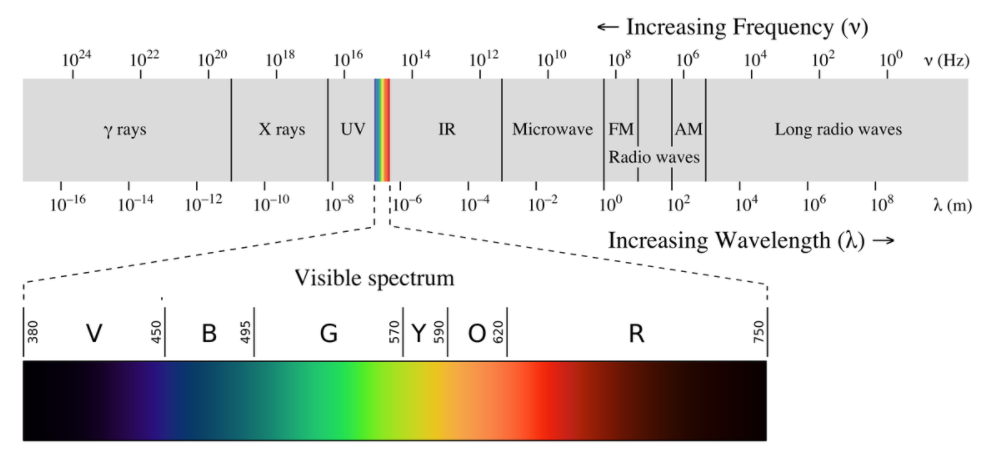
The visible spectrum is the portion of the electromagnetic spectrum that is visible to the human eye. Electromagnetic radiation in this range of wavelengths is called visible light or simply light. Visible wavelengths range from 740 nm for red light and through orange, yellow, green and blue to 380 nm for violet light. Ultraviolet is shorter wavelengths than violet.
Electromagnetic spectrum given in the below figure:
For the electromagnetic radiation, the energy of light waves defined as:
$E = hf$ _ _ _ _ _ (1)
Where,
$f$ is the frequency of the light.
$E$ is the energy of the light wave.
$h$ is the Planck’s Constant
And the velocity of light waves defined as:
\[v = \;\lambda f\]_ _ _ _ _ (2)
and according to above equation wavelength of light waves given as:
\[\lambda = \dfrac{v}{f}\]_ _ _ _ _ (3)
where,
$\lambda$ is wavelength of light waves
\[\;v\] is velocity of light waves
Here the first equation denotes the wave nature of the light and the second equation denotes the particle nature of the light.
We noticed from the above figure that the wavelength of red light is higher and so the frequency of red light decreases as wavelength increases from equation (3). The red light has lower energy compared to other colours of the visible spectrum.
So in the visible spectrum of light, the red light has maximum wavelength and minimum frequency.
Hence, Option (B) is correct.
Note:
The spectrum of visible light has about numerous different colours having different wavelengths.
The violet colour is said to have the shortest form of wavelength whereas red colour is said to have the longest wavelength.
Complete step by step solution:
The visible spectrum is the portion of the electromagnetic spectrum that is visible to the human eye. Electromagnetic radiation in this range of wavelengths is called visible light or simply light. Visible wavelengths range from 740 nm for red light and through orange, yellow, green and blue to 380 nm for violet light. Ultraviolet is shorter wavelengths than violet.
Electromagnetic spectrum given in the below figure:
For the electromagnetic radiation, the energy of light waves defined as:
$E = hf$ _ _ _ _ _ (1)
Where,
$f$ is the frequency of the light.
$E$ is the energy of the light wave.
$h$ is the Planck’s Constant
And the velocity of light waves defined as:
\[v = \;\lambda f\]_ _ _ _ _ (2)
and according to above equation wavelength of light waves given as:
\[\lambda = \dfrac{v}{f}\]_ _ _ _ _ (3)
where,
$\lambda$ is wavelength of light waves
\[\;v\] is velocity of light waves
Here the first equation denotes the wave nature of the light and the second equation denotes the particle nature of the light.
We noticed from the above figure that the wavelength of red light is higher and so the frequency of red light decreases as wavelength increases from equation (3). The red light has lower energy compared to other colours of the visible spectrum.
So in the visible spectrum of light, the red light has maximum wavelength and minimum frequency.
Hence, Option (B) is correct.
Note:
The spectrum of visible light has about numerous different colours having different wavelengths.
The violet colour is said to have the shortest form of wavelength whereas red colour is said to have the longest wavelength.
Recently Updated Pages
Write any three differences between metals and nonmetals class 10 social science CBSE

Amit standing on a horizontal plane finds a bird flying class 10 maths CBSE
Two circles of radii 5 cm and 3 cm intersect at two class 10 maths CBSE
Solve the following i John and Jivanti together have class 10 maths CBSE
What is the relation between orthocenter circumcentre class 10 maths CBSE
Two plane mirrors are inclined at 70circ A ray incident class 10 physics CBSE
Trending doubts
Explain the Treaty of Vienna of 1815 class 10 social science CBSE
Which country is known as "The land of Fire and Ice"?
1 GB equals how many MB?
10 examples of evaporation in daily life with explanations
What is the full form of POSCO class 10 social science CBSE
Which is the hottest planet in the Solar system A Earth class 10 social science CBSE