




In the Lewis structure of $ICl_2^ -$, how many lone pairs of electrons are around the iodine atom?
Answer
 Verified
594k+ views
Hint: In $ICl_2^ -$, the central atom is iodine which is surrounded by two chlorine atoms. The electronic configuration of iodine is $[Kr]4{d^{10}}5{s^2}5{p^5}$and the electronic configuration of chlorine is $[Ne]3{s^2}3{p^5}$.
Complete step by step answer:
Lewis structure is defined as the representation for the arrangement of valence electrons surrounding each atom present in the molecule.
The compound $ICl_2^ -$ is an anion, where the central iodine atom is attached with two chlorine atoms by a single bond and a negative charge is present on the overall molecule. The atomic number of iodine is 53 and the electronic configuration of iodine is $[Kr]4{d^{10}}5{s^2}5{p^5}$. The valence electrons in iodine is 7 where two electrons take part in bonding and six electrons are present as three lone pairs. The atomic number of chlorine is 17 and the electronic configuration of chlorine is $[Ne]3{s^2}3{p^5}$. The valence electrons in chlorine is 7. As two chlorine atoms are present one electron from each chlorine takes part in bonding and each chlorine atom contains 6 electrons as three lone pairs. The negative charge shows that one electron is gained by iodine atom.
The Lewis structure of $ICl_2^ -$ is shown below.
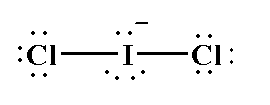
Therefore, In the Lewis structure of $ICl_2^ -$, 3 lone pairs of electrons are around the iodine atom.
Note:
The relative atomic mass has no units. The calculation of relative formula mass is done the same as the calculation of molecular weight where atomic mass of the atoms are added but the unit of molecular weight is g/mol.
Complete step by step answer:
Lewis structure is defined as the representation for the arrangement of valence electrons surrounding each atom present in the molecule.
The compound $ICl_2^ -$ is an anion, where the central iodine atom is attached with two chlorine atoms by a single bond and a negative charge is present on the overall molecule. The atomic number of iodine is 53 and the electronic configuration of iodine is $[Kr]4{d^{10}}5{s^2}5{p^5}$. The valence electrons in iodine is 7 where two electrons take part in bonding and six electrons are present as three lone pairs. The atomic number of chlorine is 17 and the electronic configuration of chlorine is $[Ne]3{s^2}3{p^5}$. The valence electrons in chlorine is 7. As two chlorine atoms are present one electron from each chlorine takes part in bonding and each chlorine atom contains 6 electrons as three lone pairs. The negative charge shows that one electron is gained by iodine atom.
The Lewis structure of $ICl_2^ -$ is shown below.
Therefore, In the Lewis structure of $ICl_2^ -$, 3 lone pairs of electrons are around the iodine atom.
Note:
The relative atomic mass has no units. The calculation of relative formula mass is done the same as the calculation of molecular weight where atomic mass of the atoms are added but the unit of molecular weight is g/mol.
Recently Updated Pages
Master Class 12 Business Studies: Engaging Questions & Answers for Success

Master Class 12 Biology: Engaging Questions & Answers for Success
Master Class 12 Chemistry: Engaging Questions & Answers for Success
Class 12 Question and Answer - Your Ultimate Solutions Guide
Master Class 11 English: Engaging Questions & Answers for Success
Master Class 11 Social Science: Engaging Questions & Answers for Success
Trending doubts
Which are the Top 10 Largest Countries of the World?
Draw a labelled sketch of the human eye class 12 physics CBSE
Differentiate between homogeneous and heterogeneous class 12 chemistry CBSE
Why is the cell called the structural and functional class 12 biology CBSE
Draw ray diagrams each showing i myopic eye and ii class 12 physics CBSE
Which is the correct genotypic ratio of mendel dihybrid class 12 biology CBSE