




In the given figure two poles of height a meters and b meters are p meters apart. Prove that the height of the point of intersection of the lines joining the top of each pole to the foot of the opposite pole is given by $\dfrac{{{\text{ab}}}}{{{\text{a + b}}}}$meters.
Answer
 Verified
646.2k+ views
Hint – To prove the height, we observe the figure and using the properties of triangles we compare them and establish a relationship between the distance between the poles and the height. We then simplify the relation to prove the height.
Complete step-by-step answer:
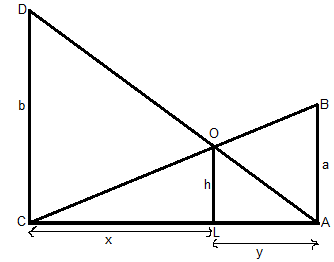
Let AB and CD be two poles of heights a meters and b meters respectively such that the poles are p meters apart i.e. AC = p meters. Let us suppose the lines AD and BC meet at O such that OL = h meters.
Let CL = x and LA = y, then x + y = p.
In ∆ABC and ∆LOC, we have
∠CAB = ∠CLO -- (equal to 90°)
∠C = ∠C -- (common angle for both triangles)
We know, the AA Similarity Postulate says that two triangles are similar if two angles in a triangle are congruent to two angles in another.
∴∆CAB ~ ∆CLO -- (By AA criterion of similarity)
$
\Rightarrow \dfrac{{{\text{CA}}}}{{{\text{CL}}}} = \dfrac{{{\text{AB}}}}{{{\text{LO}}}} \\
\Rightarrow \dfrac{{\text{p}}}{{\text{x}}} = \dfrac{{\text{a}}}{{\text{h}}} \\
\Rightarrow {\text{x = }}\dfrac{{{\text{ph}}}}{{\text{a}}}{\text{ - - - - (1)}} \\
$
Now in ∆ALO and ∆ACD, we have
∠ALO = ∠ACD -- (both are equal to 90° from the figure)
∠A = ∠A -- (common angle)
∴∆ALO ~ ∆ACD -- (By AA criterion of similarity)
⟹$
\Rightarrow \dfrac{{{\text{AL}}}}{{{\text{AC}}}} = \dfrac{{{\text{OL}}}}{{{\text{DC}}}} \\
\Rightarrow \dfrac{{\text{y}}}{{\text{p}}} = \dfrac{{\text{h}}}{{\text{b}}} \\
\Rightarrow {\text{y = }}\dfrac{{{\text{ph}}}}{{\text{b}}}{\text{ - - - - (2)}} \\
$
Now from (1) and (2) we have
x + y = $\dfrac{{{\text{ph}}}}{{\text{a}}} + \dfrac{{{\text{ph}}}}{{\text{b}}}$
We know x + y = p, hence the equation becomes
$
\Rightarrow {\text{p = ph}}\left( {\dfrac{1}{{\text{a}}} + \dfrac{1}{{\text{b}}}} \right) \\
\Rightarrow 1 = {\text{ h}}\left( {\dfrac{{{\text{a + b}}}}{{{\text{ab}}}}} \right) \\
\Rightarrow {\text{h = }}\dfrac{{{\text{ab}}}}{{{\text{a + b}}}}{\text{meters}} \\
$
Hence, the height of the intersection of the lines joining the top of each pole to the foot of the opposite pole is $\dfrac{{{\text{ab}}}}{{{\text{a + b}}}}$meters.
Hence Proved.
Note – In order to solve this type of problems the key is to construct a figure with given data and we assume a height h and point L in the figure for our convenience. A good knowledge in triangles and their properties is appreciated. The angles ∠BAC and ∠ACD are 90° because poles are generally placed vertical to the ground, also height refers to the perpendicular distance from a point.Students should remember theorems and postulates for solving these type of problems.
Complete step-by-step answer:
Let AB and CD be two poles of heights a meters and b meters respectively such that the poles are p meters apart i.e. AC = p meters. Let us suppose the lines AD and BC meet at O such that OL = h meters.
Let CL = x and LA = y, then x + y = p.
In ∆ABC and ∆LOC, we have
∠CAB = ∠CLO -- (equal to 90°)
∠C = ∠C -- (common angle for both triangles)
We know, the AA Similarity Postulate says that two triangles are similar if two angles in a triangle are congruent to two angles in another.
∴∆CAB ~ ∆CLO -- (By AA criterion of similarity)
$
\Rightarrow \dfrac{{{\text{CA}}}}{{{\text{CL}}}} = \dfrac{{{\text{AB}}}}{{{\text{LO}}}} \\
\Rightarrow \dfrac{{\text{p}}}{{\text{x}}} = \dfrac{{\text{a}}}{{\text{h}}} \\
\Rightarrow {\text{x = }}\dfrac{{{\text{ph}}}}{{\text{a}}}{\text{ - - - - (1)}} \\
$
Now in ∆ALO and ∆ACD, we have
∠ALO = ∠ACD -- (both are equal to 90° from the figure)
∠A = ∠A -- (common angle)
∴∆ALO ~ ∆ACD -- (By AA criterion of similarity)
⟹$
\Rightarrow \dfrac{{{\text{AL}}}}{{{\text{AC}}}} = \dfrac{{{\text{OL}}}}{{{\text{DC}}}} \\
\Rightarrow \dfrac{{\text{y}}}{{\text{p}}} = \dfrac{{\text{h}}}{{\text{b}}} \\
\Rightarrow {\text{y = }}\dfrac{{{\text{ph}}}}{{\text{b}}}{\text{ - - - - (2)}} \\
$
Now from (1) and (2) we have
x + y = $\dfrac{{{\text{ph}}}}{{\text{a}}} + \dfrac{{{\text{ph}}}}{{\text{b}}}$
We know x + y = p, hence the equation becomes
$
\Rightarrow {\text{p = ph}}\left( {\dfrac{1}{{\text{a}}} + \dfrac{1}{{\text{b}}}} \right) \\
\Rightarrow 1 = {\text{ h}}\left( {\dfrac{{{\text{a + b}}}}{{{\text{ab}}}}} \right) \\
\Rightarrow {\text{h = }}\dfrac{{{\text{ab}}}}{{{\text{a + b}}}}{\text{meters}} \\
$
Hence, the height of the intersection of the lines joining the top of each pole to the foot of the opposite pole is $\dfrac{{{\text{ab}}}}{{{\text{a + b}}}}$meters.
Hence Proved.
Note – In order to solve this type of problems the key is to construct a figure with given data and we assume a height h and point L in the figure for our convenience. A good knowledge in triangles and their properties is appreciated. The angles ∠BAC and ∠ACD are 90° because poles are generally placed vertical to the ground, also height refers to the perpendicular distance from a point.Students should remember theorems and postulates for solving these type of problems.
Recently Updated Pages
Master Class 12 Business Studies: Engaging Questions & Answers for Success

Master Class 12 Chemistry: Engaging Questions & Answers for Success
Master Class 12 Biology: Engaging Questions & Answers for Success
Class 12 Question and Answer - Your Ultimate Solutions Guide
Master Class 11 Social Science: Engaging Questions & Answers for Success
Master Class 11 Chemistry: Engaging Questions & Answers for Success
Trending doubts
Which are the Top 10 Largest Countries of the World?
Draw a labelled sketch of the human eye class 12 physics CBSE
Name the crygenes that control cotton bollworm and class 12 biology CBSE
Differentiate between homogeneous and heterogeneous class 12 chemistry CBSE
In a transcription unit the promoter is said to be class 12 biology CBSE
Sulphuric acid is known as the king of acids State class 12 chemistry CBSE