




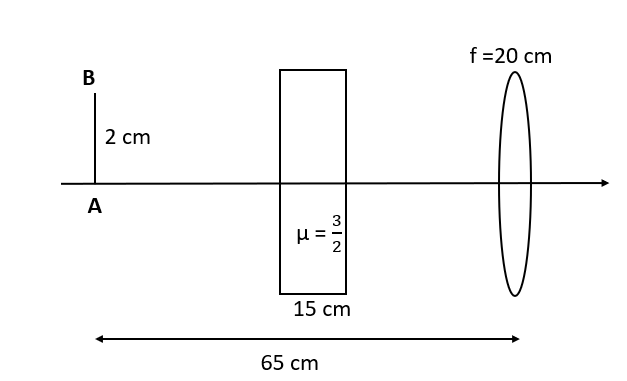
In the given figure, the image of object AB observed by observer is:
Answer
 Verified
531.6k+ views
Hint: The image distance can be measured with the information of object length and focal length with the aid of the lens formula. In optics, the connection between the image distance (i), the object distance (u), and the focal length (f) are provided by the formula identified as the Lens formula. The lens formula is suitable for convex and concave lenses. These lenses have almost negligible thickness.
Complete step-by-step solution:
Given: A plate of thickness $t = 15 cm$ is inserted in between the lens.
Refractive index of plate is $\mu = \dfrac{3}{2}$
Object’s distance, $u = 65 cm$
Focal length, $f = 20 cm$
There is shift in the object distance due to insertion of plate.
Shift, $s = t \left(1 - \dfrac{1}{\mu} \right)$
After putting the value of thickness and refractive index. We get,
$s = 15 \left(1 - \dfrac{2}{3} \right) = 5 cm$
We need to subtract shift distance from object’s distance.
Then, object distance will be $65 – 5 = 60 cm$
Apply Len’s formula,
$\dfrac{1}{f} = \dfrac{1}{v} - \dfrac{1}{u}$
Put $f = 20 cm; u =- 60 cm $
$\dfrac{1}{20} = \dfrac{1}{v} - \dfrac{1}{-60}$
$\dfrac{1}{20} - \dfrac{1}{60} = \dfrac{1}{v}$
$ \dfrac{1}{v} = \dfrac{3-1}{60}$
We get, $v = 30 cm$.
Hence, the image of object AB observed by the observer is $30 cm$.
Note: The lens formula applies to all sites with suitable sign conventions. This lens formula applies to both the convex and concave lens. If the equation explains a negative image length, then the image is a practical image on the corresponding side of the lens while the object. If this equation gives a negative focal length, then the lens is a divergent lens rather than the convergent lens. This equation is utilized to obtain image distance for both real or virtual images.
Complete step-by-step solution:
Given: A plate of thickness $t = 15 cm$ is inserted in between the lens.
Refractive index of plate is $\mu = \dfrac{3}{2}$
Object’s distance, $u = 65 cm$
Focal length, $f = 20 cm$
There is shift in the object distance due to insertion of plate.
Shift, $s = t \left(1 - \dfrac{1}{\mu} \right)$
After putting the value of thickness and refractive index. We get,
$s = 15 \left(1 - \dfrac{2}{3} \right) = 5 cm$
We need to subtract shift distance from object’s distance.
Then, object distance will be $65 – 5 = 60 cm$
Apply Len’s formula,
$\dfrac{1}{f} = \dfrac{1}{v} - \dfrac{1}{u}$
Put $f = 20 cm; u =- 60 cm $
$\dfrac{1}{20} = \dfrac{1}{v} - \dfrac{1}{-60}$
$\dfrac{1}{20} - \dfrac{1}{60} = \dfrac{1}{v}$
$ \dfrac{1}{v} = \dfrac{3-1}{60}$
We get, $v = 30 cm$.
Hence, the image of object AB observed by the observer is $30 cm$.
Note: The lens formula applies to all sites with suitable sign conventions. This lens formula applies to both the convex and concave lens. If the equation explains a negative image length, then the image is a practical image on the corresponding side of the lens while the object. If this equation gives a negative focal length, then the lens is a divergent lens rather than the convergent lens. This equation is utilized to obtain image distance for both real or virtual images.
Recently Updated Pages
Master Class 12 Social Science: Engaging Questions & Answers for Success

Master Class 12 Physics: Engaging Questions & Answers for Success
Master Class 12 Maths: Engaging Questions & Answers for Success
Master Class 12 Economics: Engaging Questions & Answers for Success
Master Class 12 Chemistry: Engaging Questions & Answers for Success
Master Class 12 Business Studies: Engaging Questions & Answers for Success
Trending doubts
Which are the Top 10 Largest Countries of the World?
Draw a labelled sketch of the human eye class 12 physics CBSE
Explain the structure of megasporangium class 12 biology CBSE
What are the major means of transport Explain each class 12 social science CBSE
How many chromosomes are found in human ovum a 46 b class 12 biology CBSE
The diagram of the section of a maize grain is given class 12 biology CBSE