



In the given figure, $\angle ABC = 69^\circ ,\angle ACB = 31^\circ . $ Find $ \angle BDC $
Answer
 Verified
594.6k+ views
Hint: Apply angle sum property of triangle. And then use the properties of the circle to find $ \angle BDC $ ,Always remember the sum of angles in any triangle is 180 degree.
Complete step-by-step answer:
It is given in the question that,
$\angle ABC = 69^\circ $ and $ \angle ACB = 31^\circ $
We know that, in any triangle, sum of all the angles is equal to $ {180^0} $
Therefore, in $ \Delta ABC $
$ \angle BAC + \angle ABC + \angle ACB = 180^\circ $ (angle sum property of triangle)
$
\angle BAC + 69^\circ + 31^\circ = 180^\circ \\
\angle BAC + 100^\circ = 180^\circ \\
\angle BAC = 80^\circ \\
$
In any circle, angles opposite to the same arc are equal.
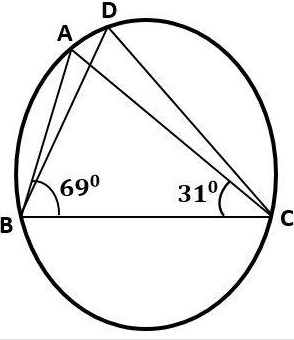
From the diagram, we can observe that,
$ \angle BDC $ and $ \angle BAC $ are angles opposite to the same arc, $ arc(BC) $
Therefore, $ \angle BDC = \angle BAC $ (Angles subtended by the same segment are equal)
$ \Rightarrow \angle BDC = 80^\circ $
Note: When angles are congruent, they have exactly the same in measure.
The angle subtended at the center by some arc is twice the angle subtended on the circumference of the circle by the same arc.
Complete step-by-step answer:
It is given in the question that,
$\angle ABC = 69^\circ $ and $ \angle ACB = 31^\circ $
We know that, in any triangle, sum of all the angles is equal to $ {180^0} $
Therefore, in $ \Delta ABC $
$ \angle BAC + \angle ABC + \angle ACB = 180^\circ $ (angle sum property of triangle)
$
\angle BAC + 69^\circ + 31^\circ = 180^\circ \\
\angle BAC + 100^\circ = 180^\circ \\
\angle BAC = 80^\circ \\
$
In any circle, angles opposite to the same arc are equal.
From the diagram, we can observe that,
$ \angle BDC $ and $ \angle BAC $ are angles opposite to the same arc, $ arc(BC) $
Therefore, $ \angle BDC = \angle BAC $ (Angles subtended by the same segment are equal)
$ \Rightarrow \angle BDC = 80^\circ $
Note: When angles are congruent, they have exactly the same in measure.
The angle subtended at the center by some arc is twice the angle subtended on the circumference of the circle by the same arc.
Recently Updated Pages
The branch of science which deals with nature and natural class 10 physics CBSE

Understanding the Sun's Density: Exploring the Mass Density of a Hot Plasma - FAQs and Data Analysis
Where is the Centre for Environmental Education Located?
How is Abiogenesis Theory Disproved Experimentally?
Which country won UEFA Euro 2020 tournament (played in 2021)?
In a plane electromagnetic wave the electric field class 12 physics CBSE
Trending doubts
Fill the blanks with the suitable prepositions 1 The class 9 english CBSE
Difference Between Plant Cell and Animal Cell
Find the sum of series 1 + 2 + 3 + 4 + 5 + + 100 class 9 maths CBSE
What is tincture of iodine? Identify the solute and solvent in it
What is pollution? How many types of pollution? Define it
What is the Full Form of ICSE / ISC ?