




In the following reaction, the product(s) formed is (are):
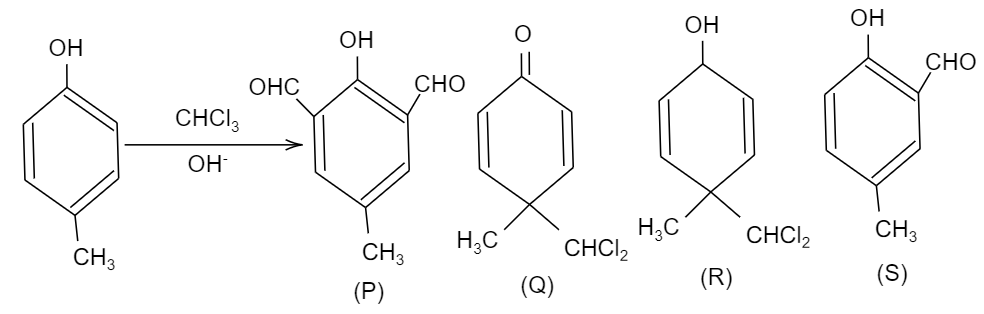
A. P(major)
B. Q(minor)
C. R(minor)
D. S(major)
Answer
 Verified
605.4k+ views
Hint: The given questions about the major and minor products formed after reaction. So, to get the appropriate answer for the question, we have to consider the Riemer Tiemann reaction mechanism. So, look upon what happens when the compound given undergoes this reaction and see what are the products formed.
Complete step by step answer:
As per the given question, the compound given is named as $4$-methyl phenol and it is being reacted with $CHC{{l}_{3}}$ and $O{{H}^{-}}$. So, before proceeding to find what are the products formed, let us look upon what is Riemer Tiemann reaction.
Riemer Tiemann reaction is a type of substitution reaction, which is named after chemists Karl Reimer and Ferdinand Tiemann. The reaction is usually used for the ortho-formylation of phenols.
So, when phenols i.e. ${{C}_{6}}{{H}_{5}}OH$ is treated with chloroform i.e. $CHC{{l}_{3}}$ in the presence of $NaOH$(sodium hydroxide), an aldehyde group ($-CHO$) is introduced at the ortho position of the benzene ring leading to the formation of o-hydroxybenzaldehyde as the major product. And this reaction is popularly known as the Reimer Tiemann reaction.
So, here in the given question, when $4$-methyl phenol reacts with chloroform i.e. $CHC{{l}_{3}}$ and sodium hydroxide having hydroxyl ion, i.e. $O{{H}^{-}}$, an aldehyde group will be attached to the ortho position of the compound due to ortho-formylation of the compound. This product is the major product and it is named as $2-hydroxy-5-methyl-benzaldehyde$. While. We should also see that there is significant charge density at the fourth position of the compound, so there will be an attack of the nucleophile at the fourth position, forming the minor product.
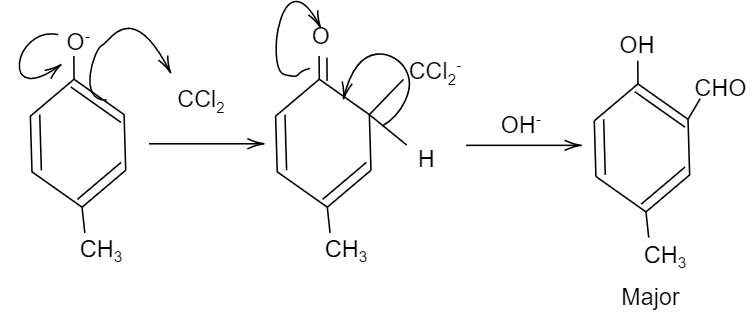
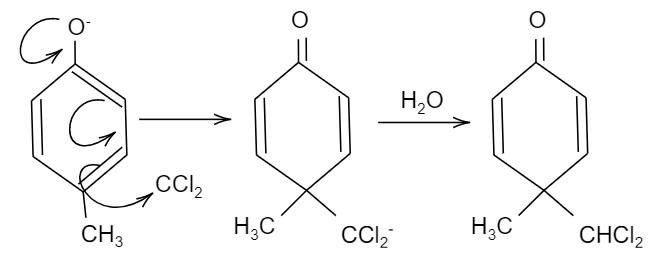
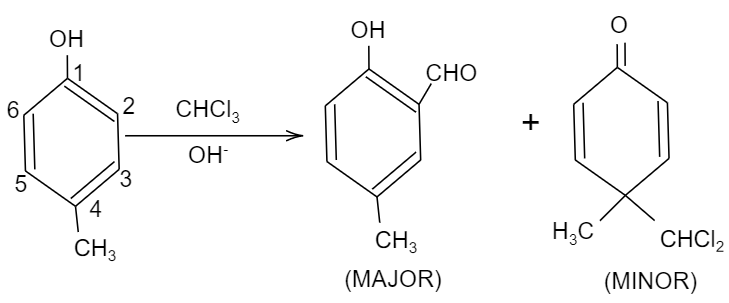
The products formed are Q as minor and S as minor.
So, the correct answer is “Option B and D”.
Note: Remember, the Reimer Tiemann reaction is used for the ortho formylation of the phenols. It is effective for other hydroxy-aromatic compounds, such as naphthols, etc. Electron rich heterocycles such as pyrroles also react using this mechanism.
Complete step by step answer:
As per the given question, the compound given is named as $4$-methyl phenol and it is being reacted with $CHC{{l}_{3}}$ and $O{{H}^{-}}$. So, before proceeding to find what are the products formed, let us look upon what is Riemer Tiemann reaction.
Riemer Tiemann reaction is a type of substitution reaction, which is named after chemists Karl Reimer and Ferdinand Tiemann. The reaction is usually used for the ortho-formylation of phenols.
So, when phenols i.e. ${{C}_{6}}{{H}_{5}}OH$ is treated with chloroform i.e. $CHC{{l}_{3}}$ in the presence of $NaOH$(sodium hydroxide), an aldehyde group ($-CHO$) is introduced at the ortho position of the benzene ring leading to the formation of o-hydroxybenzaldehyde as the major product. And this reaction is popularly known as the Reimer Tiemann reaction.
So, here in the given question, when $4$-methyl phenol reacts with chloroform i.e. $CHC{{l}_{3}}$ and sodium hydroxide having hydroxyl ion, i.e. $O{{H}^{-}}$, an aldehyde group will be attached to the ortho position of the compound due to ortho-formylation of the compound. This product is the major product and it is named as $2-hydroxy-5-methyl-benzaldehyde$. While. We should also see that there is significant charge density at the fourth position of the compound, so there will be an attack of the nucleophile at the fourth position, forming the minor product.
The products formed are Q as minor and S as minor.
So, the correct answer is “Option B and D”.
Note: Remember, the Reimer Tiemann reaction is used for the ortho formylation of the phenols. It is effective for other hydroxy-aromatic compounds, such as naphthols, etc. Electron rich heterocycles such as pyrroles also react using this mechanism.
Recently Updated Pages
Master Class 12 Business Studies: Engaging Questions & Answers for Success

Master Class 12 Biology: Engaging Questions & Answers for Success
Master Class 12 Chemistry: Engaging Questions & Answers for Success
Class 12 Question and Answer - Your Ultimate Solutions Guide
Master Class 11 Social Science: Engaging Questions & Answers for Success
Master Class 11 English: Engaging Questions & Answers for Success
Trending doubts
Which are the Top 10 Largest Countries of the World?
Draw a labelled sketch of the human eye class 12 physics CBSE
Differentiate between homogeneous and heterogeneous class 12 chemistry CBSE
Sulphuric acid is known as the king of acids State class 12 chemistry CBSE
Why is the cell called the structural and functional class 12 biology CBSE
Which is the correct genotypic ratio of mendel dihybrid class 12 biology CBSE