




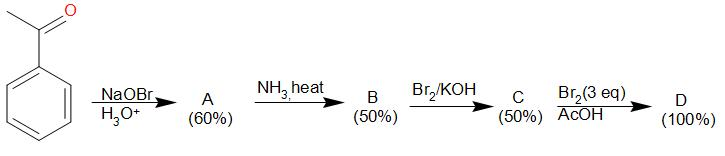
In the following reaction sequence, the amount of D(in g) formed from 10 moles of acetophenone is:
Answer
 Verified
580.8k+ views
Hint: In a carbonyl group, a more negative oxygen atom is bonded to a less electronegative carbon atom. This difference in electronegativity draws electron density away from the carbon atom making it an electrophile. As a result, carbonyl compounds are susceptible to nucleophilic attacks.
Complete step by step answer:
Acetophenone is a methyl ketone.
Methyl ketones when reacted to sodium hypohalite are oxidised to form sodium salts of corresponding carboxylic acid, along with haloform.
Acetophenone is oxidized by sodium hypobromite to sodium benzoate which in acidic medium forms benzoic acid. A is benzoic acid.
The yield of reaction is given to be $60\% $. So, 10 moles of acetophenone will give,
$\dfrac{{60}}{{100}} \times 10 = 6$moles of benzoic acid.
Benzoic acid when treated with ammonia forms ammonium benzoate which on heating, loses a water molecule to form benzamide. B is benzamide.
We have 6 moles of benzoic acid and yield of the reaction is given to be $50\% $. As a result, we obtain 3 moles of benzamide.
Benzamide in reaction with bromine in presence of potassium hydroxide gives Hoffmann Bromamide reaction which is a stepping down reaction and a carbon atom is lost. The product obtained is aniline. C is aniline.
We have 3 moles of benzamide and the yield of reaction is $50\% $. Thus, $1.5$ moles of aniline are obtained.
Aniline when exposed to 3 equivalents of bromine in presence of ethanoic acid, undergoes tri-substitution and forms 2,4,6-tribromoaniline.
The yield of the reaction is $100\% $. Thus, $1.5$ molecules of aniline will form $1.5$ moles of 2,4,6-tribromoaniline.
The molar mass of 2,4,6-tribromoaniline is $330g/mol$.
So, the mass of $1.5$ moles of the compound will be,
$
m = 1.5 \times 330 \\
\Rightarrow m = 495g \\
$
Therefore, the amount of D formed is 495g.
Note:
Aniline is a strongly activated compound. Its ortho and para positions are susceptible to nucleophilic attack because of the $ + R$ effect of the lone pair of nitrogen atoms on the benzene ring.
Complete step by step answer:
Acetophenone is a methyl ketone.
Methyl ketones when reacted to sodium hypohalite are oxidised to form sodium salts of corresponding carboxylic acid, along with haloform.
Acetophenone is oxidized by sodium hypobromite to sodium benzoate which in acidic medium forms benzoic acid. A is benzoic acid.
The yield of reaction is given to be $60\% $. So, 10 moles of acetophenone will give,
$\dfrac{{60}}{{100}} \times 10 = 6$moles of benzoic acid.
Benzoic acid when treated with ammonia forms ammonium benzoate which on heating, loses a water molecule to form benzamide. B is benzamide.
We have 6 moles of benzoic acid and yield of the reaction is given to be $50\% $. As a result, we obtain 3 moles of benzamide.
Benzamide in reaction with bromine in presence of potassium hydroxide gives Hoffmann Bromamide reaction which is a stepping down reaction and a carbon atom is lost. The product obtained is aniline. C is aniline.
We have 3 moles of benzamide and the yield of reaction is $50\% $. Thus, $1.5$ moles of aniline are obtained.
Aniline when exposed to 3 equivalents of bromine in presence of ethanoic acid, undergoes tri-substitution and forms 2,4,6-tribromoaniline.
The yield of the reaction is $100\% $. Thus, $1.5$ molecules of aniline will form $1.5$ moles of 2,4,6-tribromoaniline.
The molar mass of 2,4,6-tribromoaniline is $330g/mol$.
So, the mass of $1.5$ moles of the compound will be,
$
m = 1.5 \times 330 \\
\Rightarrow m = 495g \\
$
Therefore, the amount of D formed is 495g.
Note:
Aniline is a strongly activated compound. Its ortho and para positions are susceptible to nucleophilic attack because of the $ + R$ effect of the lone pair of nitrogen atoms on the benzene ring.
Recently Updated Pages
Master Class 12 Economics: Engaging Questions & Answers for Success

Master Class 12 Physics: Engaging Questions & Answers for Success
Master Class 12 English: Engaging Questions & Answers for Success
Master Class 12 Social Science: Engaging Questions & Answers for Success
Master Class 12 Maths: Engaging Questions & Answers for Success
Master Class 12 Business Studies: Engaging Questions & Answers for Success
Trending doubts
Which are the Top 10 Largest Countries of the World?
What are the major means of transport Explain each class 12 social science CBSE
Draw a labelled sketch of the human eye class 12 physics CBSE
What is a transformer Explain the principle construction class 12 physics CBSE
Why cannot DNA pass through cell membranes class 12 biology CBSE
Differentiate between insitu conservation and exsitu class 12 biology CBSE