




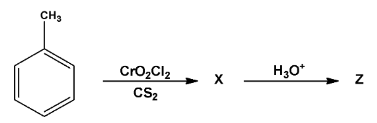
In the following reaction, compound Z Is:
\[A.\;\,\,Benzoic{\text{ }}acid\]
\[B.\;\,\,Benzaldehyde\]
\[C.\,\,Acetophenone\]
\[D.\,\,benzene\]
Answer
 Verified
562.8k+ views
Hint:It is a type of an Etard’s reaction which involves the conversion of alkyl benzene or compounds having alkyl group attached to a heterocyclic ring into aromatic aldehydes in presence of chromyl chloride. In this case, we have toluene which reacts with chromyl chloride in the presence of carbon disulfide as a medium forms Etard complex then acidic hydrolysis takes place to form benzaldehyde. This reaction is an Etard reaction.
Complete step-by-step answer:The Etard reaction is one type of reaction in which the direct oxidation of an aromatic or heterocyclic bound alkyl group takes place. In this reaction mechanism, via ene-reaction, the further reaction takes place with the chromyl chloride that forms a precipitate i.e., an Etard complex. The Etard complex which was formed will further decompose by sigma-tropic rearrangement under reducing conditions which prevent the further oxidation to a carboxylic acid. The main reducing condition is provided by a saturated solution of aqueous sodium sulfite \[\left( {N{a_2}S{O_3}} \right)\] which prevents further decomposition.
In the aforesaid reaction, the toluene \[({C_6}{H_5}C{H_3})\] reacts with chromyl chloride in the presence of carbon disulfide as a medium form the Etard complex. This complex gets reduced to in the presence of acidic medium (where acidic hydrolysis takes place) to form benzaldehyde.
In this reaction,to chromyl chloride \[\;\left( {Cr{O_2}C{l_2}} \right)\] attacks on the methyl group connected to the benzene ring to form an intermediate which further undergoes \[2-3\,sigmatropic\] rearrangement reaction to form a chromium complex, and this complex undergoes hydrolyses so easily to benzaldehyde as a product.
The reaction goes like;
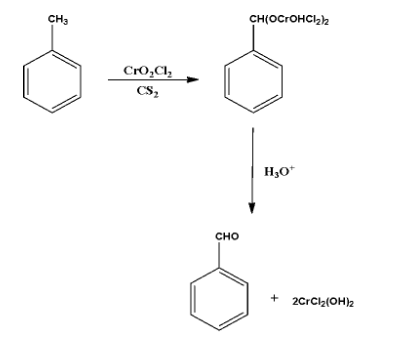
The toluene \[({C_6}{H_5}C{H_3})\] reacts with chromyl chloride \[\;\left( {Cr{O_2}C{l_2}} \right)\] in the presence of carbon disulfide \[\;\left( {C{S_2}} \right)\] as a medium forms Etard complex which is further reacted with the hydronium ion \[\;\left( {{H_3}{O^ + }} \right)\] and form benzaldehyde \[({C_6}{H_5}CHO)\]. This reaction is an Etard reaction.
Toluene \[({C_6}{H_5}C{H_3})\] is oxidized with alkaline potassium permanganate $(KMn{O_4})$ followed by acidification to form benzoic acid which on further heating with soda-lime that results in the formation of benzene. The oxidation of toluene to benzoic acid \[({C_6}{H_5}COOH)\] and then converted to benzoyl chloride \[({C_6}{H_5}COCl)\] by treating with thionyl chloride \[\left( {SOC{l_2}} \right)\] and then treated with methyl lithium \[\left( {C{H_3}Li} \right)\] to form Acetophenone \[({C_6}{H_5}COC{H_3})\] .
So, the correct answer for this question is benzaldehyde formation is taking place.
Therefore, the option \[B.\;\,\,Benzaldehyde\]\[({C_6}{H_5}CHO)\] is the correct answer.
Note:The chromyl chloride \[\;\left( {Cr{O_2}C{l_2}} \right)\] is used to form an organic complex Etard Complex which can undergo hydrolysis to form the desired compound. Benzaldehyde \[({C_6}{H_5}CHO)\] can be reduced to toluene \[({C_6}{H_5}C{H_3})\] by Clemmenson reduction reaction.
Complete step-by-step answer:The Etard reaction is one type of reaction in which the direct oxidation of an aromatic or heterocyclic bound alkyl group takes place. In this reaction mechanism, via ene-reaction, the further reaction takes place with the chromyl chloride that forms a precipitate i.e., an Etard complex. The Etard complex which was formed will further decompose by sigma-tropic rearrangement under reducing conditions which prevent the further oxidation to a carboxylic acid. The main reducing condition is provided by a saturated solution of aqueous sodium sulfite \[\left( {N{a_2}S{O_3}} \right)\] which prevents further decomposition.
In the aforesaid reaction, the toluene \[({C_6}{H_5}C{H_3})\] reacts with chromyl chloride in the presence of carbon disulfide as a medium form the Etard complex. This complex gets reduced to in the presence of acidic medium (where acidic hydrolysis takes place) to form benzaldehyde.
In this reaction,to chromyl chloride \[\;\left( {Cr{O_2}C{l_2}} \right)\] attacks on the methyl group connected to the benzene ring to form an intermediate which further undergoes \[2-3\,sigmatropic\] rearrangement reaction to form a chromium complex, and this complex undergoes hydrolyses so easily to benzaldehyde as a product.
The reaction goes like;
The toluene \[({C_6}{H_5}C{H_3})\] reacts with chromyl chloride \[\;\left( {Cr{O_2}C{l_2}} \right)\] in the presence of carbon disulfide \[\;\left( {C{S_2}} \right)\] as a medium forms Etard complex which is further reacted with the hydronium ion \[\;\left( {{H_3}{O^ + }} \right)\] and form benzaldehyde \[({C_6}{H_5}CHO)\]. This reaction is an Etard reaction.
Toluene \[({C_6}{H_5}C{H_3})\] is oxidized with alkaline potassium permanganate $(KMn{O_4})$ followed by acidification to form benzoic acid which on further heating with soda-lime that results in the formation of benzene. The oxidation of toluene to benzoic acid \[({C_6}{H_5}COOH)\] and then converted to benzoyl chloride \[({C_6}{H_5}COCl)\] by treating with thionyl chloride \[\left( {SOC{l_2}} \right)\] and then treated with methyl lithium \[\left( {C{H_3}Li} \right)\] to form Acetophenone \[({C_6}{H_5}COC{H_3})\] .
So, the correct answer for this question is benzaldehyde formation is taking place.
Therefore, the option \[B.\;\,\,Benzaldehyde\]\[({C_6}{H_5}CHO)\] is the correct answer.
Note:The chromyl chloride \[\;\left( {Cr{O_2}C{l_2}} \right)\] is used to form an organic complex Etard Complex which can undergo hydrolysis to form the desired compound. Benzaldehyde \[({C_6}{H_5}CHO)\] can be reduced to toluene \[({C_6}{H_5}C{H_3})\] by Clemmenson reduction reaction.
Recently Updated Pages
Master Class 12 Social Science: Engaging Questions & Answers for Success

Master Class 12 Physics: Engaging Questions & Answers for Success
Master Class 12 Maths: Engaging Questions & Answers for Success
Master Class 12 Economics: Engaging Questions & Answers for Success
Master Class 12 Chemistry: Engaging Questions & Answers for Success
Master Class 12 Business Studies: Engaging Questions & Answers for Success
Trending doubts
Which are the Top 10 Largest Countries of the World?
Draw a labelled sketch of the human eye class 12 physics CBSE
Explain the structure of megasporangium class 12 biology CBSE
What are the major means of transport Explain each class 12 social science CBSE
How many chromosomes are found in human ovum a 46 b class 12 biology CBSE
The diagram of the section of a maize grain is given class 12 biology CBSE