




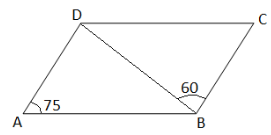
In the figure given below, ABCD is a parallelogram in which angle BAD = 75° and angle DBC = 60°. Calculate the measures of the following angles:-
(A). Angle ADB
(B). Angle ABD
(C). Angle CDB
Answer
 Verified
626.1k+ views
HINT:- Before solving this question, we must know about transversal and TRANSVERSAL: A transversal is a line that intersects two or more lines (that are often parallel).
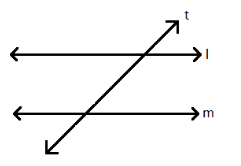
Here, ‘l’ and ‘m’ are parallel lines and ‘t’ is the transversal.
Complete step-by-step solution -
The different angles formed when a transversal cuts two parallel lines are mentioned below in the hint.
We should also know about the angle sum property of triangles.
ANGLE SUM PROPERTY: The sum of the angles of a triangle is 180°.
GIVEN: ABCD is a parallelogram
Angle BAD = 75°
Angle DBC = 60°
TO FIND: Angle ADB
Angle ABD
Angle CDB
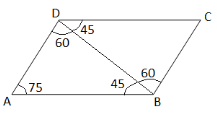
(a).Measure of angle ADB.
Angle ADB = Angle DBC (alternate interior angles)
ALTERNATE INTERIOR ANGLES: A pair of alternate interior angles is always equal.
Therefore, angle ADB = 60°
(b)Measure of angle ABD.
Now, as we know that the measure of angle ADB is 60°, we can find the measure of the angles ABD using the angle sum property of triangles.
In ∆ABD,
Angle A + Angle B + Angle D = 180° (angle sum property of triangle)
ANGLE SUM PROPERTY: The sum of the angles of a triangle is 180°
75° + Angle B + 60° = 180°
135°+ Angle B = 180°
Angle B = 180° - 135°
Angle B = 45°
Therefore, angle ABD = 45°
(c) Measure of angle CDB
Angle CDB = Angle ABD (alternate interior angles)
ALTERNATE INTERIOR ANGLES: A pair of alternate interior angles is always equal.
Therefore, angle CDB = 45°
NOTE:- Let us now know about some more angles formed when a transversal cuts two parallel lines.
VERTICALLY OPPOSITE ANGLES: A pair of vertically opposite angles is always equal.
SUPPLEMENTARY ANGLES: A pair of angles that lie on a straight line, whose sum is 180°
CORRESPONDING ANGLES: A pair of corresponding angles is always equal.
ALTERNATE EXTERIOR ANGLES: A pair of alternate exterior angles is always equal.
CONSECUTIVE INTERIOR ANGLES: The sum of a pair of consecutive interior angles is always 180°.
Here, ‘l’ and ‘m’ are parallel lines and ‘t’ is the transversal.
Complete step-by-step solution -
The different angles formed when a transversal cuts two parallel lines are mentioned below in the hint.
We should also know about the angle sum property of triangles.
ANGLE SUM PROPERTY: The sum of the angles of a triangle is 180°.
GIVEN: ABCD is a parallelogram
Angle BAD = 75°
Angle DBC = 60°
TO FIND: Angle ADB
Angle ABD
Angle CDB
(a).Measure of angle ADB.
Angle ADB = Angle DBC (alternate interior angles)
ALTERNATE INTERIOR ANGLES: A pair of alternate interior angles is always equal.
Therefore, angle ADB = 60°
(b)Measure of angle ABD.
Now, as we know that the measure of angle ADB is 60°, we can find the measure of the angles ABD using the angle sum property of triangles.
In ∆ABD,
Angle A + Angle B + Angle D = 180° (angle sum property of triangle)
ANGLE SUM PROPERTY: The sum of the angles of a triangle is 180°
75° + Angle B + 60° = 180°
135°+ Angle B = 180°
Angle B = 180° - 135°
Angle B = 45°
Therefore, angle ABD = 45°
(c) Measure of angle CDB
Angle CDB = Angle ABD (alternate interior angles)
ALTERNATE INTERIOR ANGLES: A pair of alternate interior angles is always equal.
Therefore, angle CDB = 45°
NOTE:- Let us now know about some more angles formed when a transversal cuts two parallel lines.
VERTICALLY OPPOSITE ANGLES: A pair of vertically opposite angles is always equal.
SUPPLEMENTARY ANGLES: A pair of angles that lie on a straight line, whose sum is 180°
CORRESPONDING ANGLES: A pair of corresponding angles is always equal.
ALTERNATE EXTERIOR ANGLES: A pair of alternate exterior angles is always equal.
CONSECUTIVE INTERIOR ANGLES: The sum of a pair of consecutive interior angles is always 180°.

Recently Updated Pages
Three beakers labelled as A B and C each containing 25 mL of water were taken A small amount of NaOH anhydrous CuSO4 and NaCl were added to the beakers A B and C respectively It was observed that there was an increase in the temperature of the solutions contained in beakers A and B whereas in case of beaker C the temperature of the solution falls Which one of the following statements isarecorrect i In beakers A and B exothermic process has occurred ii In beakers A and B endothermic process has occurred iii In beaker C exothermic process has occurred iv In beaker C endothermic process has occurred

Master Class 8 Social Science: Engaging Questions & Answers for Success
Master Class 8 Science: Engaging Questions & Answers for Success
Master Class 8 Maths: Engaging Questions & Answers for Success
Class 8 Question and Answer - Your Ultimate Solutions Guide
Master Class 9 Social Science: Engaging Questions & Answers for Success
Three beakers labelled as A B and C each containing 25 mL of water were taken A small amount of NaOH anhydrous CuSO4 and NaCl were added to the beakers A B and C respectively It was observed that there was an increase in the temperature of the solutions contained in beakers A and B whereas in case of beaker C the temperature of the solution falls Which one of the following statements isarecorrect i In beakers A and B exothermic process has occurred ii In beakers A and B endothermic process has occurred iii In beaker C exothermic process has occurred iv In beaker C endothermic process has occurred
Master Class 8 Social Science: Engaging Questions & Answers for Success
Master Class 8 Science: Engaging Questions & Answers for Success
Trending doubts
What is BLO What is the full form of BLO class 8 social science CBSE
Citizens of India can vote at the age of A 18 years class 8 social science CBSE
Advantages and disadvantages of science
Full form of STD, ISD and PCO
Give me the opposite gender of Duck class 8 english CBSE
What are gulf countries and why they are called Gulf class 8 social science CBSE