




In the eukaryotes, the DNA molecules are organized within the nucleus. How are the DNA molecules organized in a bacterial cell in the absence of a nucleus?
Answer
 Verified
573.9k+ views
Hint: Histones, a family of fundamental proteins present in all eukaryotic nuclei, are the most abundant proteins associated with eukaryotic DNA. H1, H2A, H2B, H3, and H4 are the five main forms of histone proteins rich in positively charged basic amino acids that interact with DNA's negatively charged phosphate groups that help in the packaging of the DNA within the nucleus.
Complete answer:
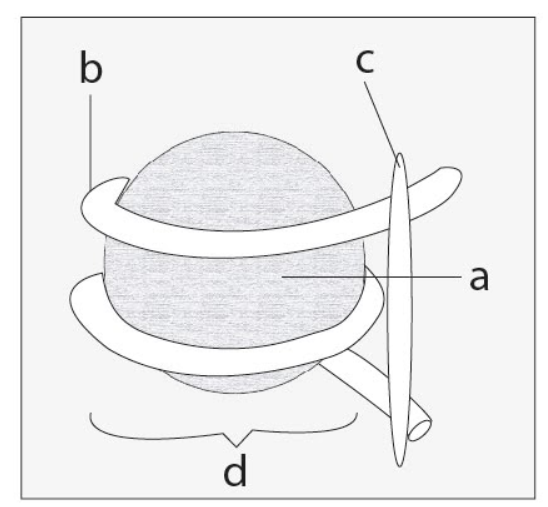
- This diagram is representing the structure of nucleosome
a = Histone octamer, b = DNA,
c = histone positions, d = Core of histone molecules
- A different kind of packing technique is used by eukaryotes, whose chromosomes each consist of a linear DNA molecule, to suit their DNA within the nucleus.
- DNA is wrapped around proteins known as histones at the most basic level to form structures called nucleosomes.
- Histones are proteins that are evolutionarily conserved and rich in essential amino acids, forming an octamer. The DNA is wrapped tightly around the histone center (which is negatively charged because of the phosphate groups).
- With the assistance of a linker DNA, this nucleosome is correlated with the next one. "This is also known as the arrangement of" beads on a string.
- This is further compacted into a fiber of 30 nm, which is the structure's diameter. The chromosomes are at their most compact at the metaphase level, are around 700 nm wide, and are present in combination with scaffold proteins.
- Heterochromatin is known as the tightly packed region, and the less compact region is known as euchromatin.
- Heterochromatin commonly contains non- expressed genes and is located in the centromere and telomere regions.
- Euchromatin usually contains transcribed genes, with DNA packaged but not further compacted around nucleosomes
- Genes are encoded on large circular chromosomes in most bacterial cells.
- In order to fit chromosomal DNA into the bacterial cell, supercoiling contributes to the compaction required.
- The chromosomal DNA is linked with multiple small protein molecules, allowing it to fold into a more compact structure. A dimer of a 15.6 kDa polypeptide is the most abundant of these proteins, H- NS. - H- NS binds DNA closely and significantly compacts it,
Note: A few of the basic amino acid side chains in a fraction of the histone proteins of most cells are modified by post- translational addition of acetyl, phosphate, or methyl groups, neutralizing or transforming the positive charge of the side chain to a negative charge.
Complete answer:
- This diagram is representing the structure of nucleosome
a = Histone octamer, b = DNA,
c = histone positions, d = Core of histone molecules
- A different kind of packing technique is used by eukaryotes, whose chromosomes each consist of a linear DNA molecule, to suit their DNA within the nucleus.
- DNA is wrapped around proteins known as histones at the most basic level to form structures called nucleosomes.
- Histones are proteins that are evolutionarily conserved and rich in essential amino acids, forming an octamer. The DNA is wrapped tightly around the histone center (which is negatively charged because of the phosphate groups).
- With the assistance of a linker DNA, this nucleosome is correlated with the next one. "This is also known as the arrangement of" beads on a string.
- This is further compacted into a fiber of 30 nm, which is the structure's diameter. The chromosomes are at their most compact at the metaphase level, are around 700 nm wide, and are present in combination with scaffold proteins.
- Heterochromatin is known as the tightly packed region, and the less compact region is known as euchromatin.
- Heterochromatin commonly contains non- expressed genes and is located in the centromere and telomere regions.
- Euchromatin usually contains transcribed genes, with DNA packaged but not further compacted around nucleosomes
- Genes are encoded on large circular chromosomes in most bacterial cells.
- In order to fit chromosomal DNA into the bacterial cell, supercoiling contributes to the compaction required.
- The chromosomal DNA is linked with multiple small protein molecules, allowing it to fold into a more compact structure. A dimer of a 15.6 kDa polypeptide is the most abundant of these proteins, H- NS. - H- NS binds DNA closely and significantly compacts it,
Note: A few of the basic amino acid side chains in a fraction of the histone proteins of most cells are modified by post- translational addition of acetyl, phosphate, or methyl groups, neutralizing or transforming the positive charge of the side chain to a negative charge.
Recently Updated Pages
Master Class 12 Economics: Engaging Questions & Answers for Success

Master Class 12 Physics: Engaging Questions & Answers for Success
Master Class 12 English: Engaging Questions & Answers for Success
Master Class 12 Social Science: Engaging Questions & Answers for Success
Master Class 12 Maths: Engaging Questions & Answers for Success
Master Class 12 Business Studies: Engaging Questions & Answers for Success
Trending doubts
Which are the Top 10 Largest Countries of the World?
What are the major means of transport Explain each class 12 social science CBSE
Draw a labelled sketch of the human eye class 12 physics CBSE
What is a transformer Explain the principle construction class 12 physics CBSE
Why cannot DNA pass through cell membranes class 12 biology CBSE
Differentiate between insitu conservation and exsitu class 12 biology CBSE