




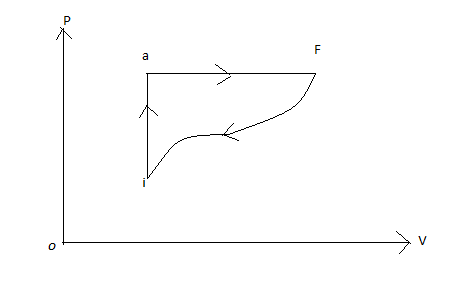
In the diagram shown ${Q_{iaf}} = 80cal$ and ${W_{iaf}} = 50cal$ . If $W = ( - 30)cal$ for the curved path fi, find the Q for path fi?
a. $60cal$
b. $30cal$
c. $ - 30cal$
d. $ - 60cal$
Answer
 Verified
586.8k+ views
Hint In the entire solution only one formula will be used repeatedly that is
$Q = \Delta U + W$ where Q is the heat, U is the internal energy and W is the work done.
We will also have to take care of sign conventions . We will also make use of the fact that U(internal energy) is a state function, that means it does not depend upon the path followed but only the initial and final states.
Complete step-by-step solution:
First of all, we will consider path iaf. We are given ${Q_{iaf}} = 80cal$ and ${W_{iaf}} = 50cal$
The change in internal energy can then be calculated by using the first law of thermodynamics, which states that
${Q_{iaf}} = \Delta U + {W_{iaf}}$
Since , $\Delta U$ only depends on initial and final states , here $\Delta U = {U_f} - {U_i}$
Now, substituting the values in the equation we will get
$ 80 = \Delta U + {W_{iaf}} \\
80 = \Delta U + 50 \\
\Delta U = 80 - 50 \\
\Delta U = 30cal \\
{U_f} - {U_i} = 30cal \\ $
Now, we will move from f to i through the curved path .
We are given that work done in moving f to i is
${W_{fi}} = ( - 30cal)$
The change in internal energy while moving from f to i will be
$\Delta U = {U_f} - {U_i} = ( - ({U_i} - {U_f})) = ( - 30cal)$
We shall again make the use of the relation we had used before for path fi,
${Q_{fi}} = \Delta U + {W_{fi}}$
Substituting the values, we have$
{Q_{fi}} = - 30 - 30 \\
{Q_{fi}} = - 60cal \\ $
So, option (d.) is correct
Note:-
In this type of problem we need to take care of the directions in which we are moving. While moving through the same path but in the opposite direction, we need to use the opposite sign. So, good care must be taken in the use of signs.
$Q = \Delta U + W$ where Q is the heat, U is the internal energy and W is the work done.
We will also have to take care of sign conventions . We will also make use of the fact that U(internal energy) is a state function, that means it does not depend upon the path followed but only the initial and final states.
Complete step-by-step solution:
First of all, we will consider path iaf. We are given ${Q_{iaf}} = 80cal$ and ${W_{iaf}} = 50cal$
The change in internal energy can then be calculated by using the first law of thermodynamics, which states that
${Q_{iaf}} = \Delta U + {W_{iaf}}$
Since , $\Delta U$ only depends on initial and final states , here $\Delta U = {U_f} - {U_i}$
Now, substituting the values in the equation we will get
$ 80 = \Delta U + {W_{iaf}} \\
80 = \Delta U + 50 \\
\Delta U = 80 - 50 \\
\Delta U = 30cal \\
{U_f} - {U_i} = 30cal \\ $
Now, we will move from f to i through the curved path .
We are given that work done in moving f to i is
${W_{fi}} = ( - 30cal)$
The change in internal energy while moving from f to i will be
$\Delta U = {U_f} - {U_i} = ( - ({U_i} - {U_f})) = ( - 30cal)$
We shall again make the use of the relation we had used before for path fi,
${Q_{fi}} = \Delta U + {W_{fi}}$
Substituting the values, we have$
{Q_{fi}} = - 30 - 30 \\
{Q_{fi}} = - 60cal \\ $
So, option (d.) is correct
Note:-
In this type of problem we need to take care of the directions in which we are moving. While moving through the same path but in the opposite direction, we need to use the opposite sign. So, good care must be taken in the use of signs.
Recently Updated Pages
Master Class 12 Economics: Engaging Questions & Answers for Success

Master Class 12 Physics: Engaging Questions & Answers for Success
Master Class 12 English: Engaging Questions & Answers for Success
Master Class 12 Social Science: Engaging Questions & Answers for Success
Master Class 12 Maths: Engaging Questions & Answers for Success
Master Class 12 Business Studies: Engaging Questions & Answers for Success
Trending doubts
Which are the Top 10 Largest Countries of the World?
What are the major means of transport Explain each class 12 social science CBSE
Draw a labelled sketch of the human eye class 12 physics CBSE
What is a transformer Explain the principle construction class 12 physics CBSE
Why cannot DNA pass through cell membranes class 12 biology CBSE
Differentiate between insitu conservation and exsitu class 12 biology CBSE