




In the diagram of the excretory system of human beings given below, different parts have been indicated by alphabets. Choose the answer in which these alphabets have been correctly matched with the parts, which they represent.
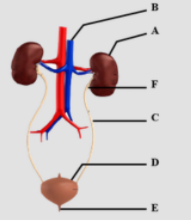
I. A. Kidney B. abdominal aorta C. Ureters D. Urinary Bladder E. urethra F- Renal pelvis
II. A. Kidney B. Abdominal aorta C. Urethra D. Urinary bladder E. Renal pelvis F. Urethra
III. A. Kidney B.Renal pelvis C. Urethra. D. Urinary bladder, E. Ureters F. Abdominal aorta
IV. A. Kidney B. Abdominal aorta C. Urethra. D. Urinary bladder, E. Renal pelvis F. Ureters
Answer
 Verified
621.3k+ views
Hint: All organisms are made up of cells. Cells work all the time for sustaining the life of an organism-(biochemical reaction). These reactions produce toxic waste in the body and create an imbalance of ions. Excretion is the process of removal of harmful metabolic waste from the body of an organism.
Step by step answer:Kidneys are the major excretory and osmoregulatory organs of vertebrates. The human excretory system consists of a pair of kidneys, a pair of ureters, a urinary bladder, and a urethra.
Kidney: excrete urea, uric acid, and water. There are two kidneys in the man, abdominal cavity on either side of the backbone. Urine collected in the kidneys. A kidney is composed of numerous microscopic coiled nephrons or uriniferous tubules. The nephrons are held together by connective tissue.
Ureter: from the hilum of each kidney emerges a slender, whitish tube, the ureter. Within the kidney is the ureters are expanded to form the renal pelvis.
Urinary bladder: It is a median pear-shaped sac situated in the lower or pelvic region of the abdominal cavity within the front (ventral) body wall. It has a thick, muscular, distensible wall lined by transitional epithelium that allows expansion.
Urethra: the urethra starts from the lower part or neck of the urinary bladder and leads to the exterior. In a female, it is quite short, only about 3 to 5 cm.
A kidney receives the blood by the renal artery that arises from the dorsal aorta.
Hence, the correct answer is option C. A. Kidney B. abdominal aorta C. Ureters D. Urinary Bladder E. urethra F- Renal pelvis
Note: An infection in the kidney, injury to the kidney, or restricted blood flow can damage the kidneys and they stop working. Urea and other wastes collect in the blood and can cause even death if untreated.
Step by step answer:Kidneys are the major excretory and osmoregulatory organs of vertebrates. The human excretory system consists of a pair of kidneys, a pair of ureters, a urinary bladder, and a urethra.
Kidney: excrete urea, uric acid, and water. There are two kidneys in the man, abdominal cavity on either side of the backbone. Urine collected in the kidneys. A kidney is composed of numerous microscopic coiled nephrons or uriniferous tubules. The nephrons are held together by connective tissue.
Ureter: from the hilum of each kidney emerges a slender, whitish tube, the ureter. Within the kidney is the ureters are expanded to form the renal pelvis.
Urinary bladder: It is a median pear-shaped sac situated in the lower or pelvic region of the abdominal cavity within the front (ventral) body wall. It has a thick, muscular, distensible wall lined by transitional epithelium that allows expansion.
Urethra: the urethra starts from the lower part or neck of the urinary bladder and leads to the exterior. In a female, it is quite short, only about 3 to 5 cm.
A kidney receives the blood by the renal artery that arises from the dorsal aorta.
Hence, the correct answer is option C. A. Kidney B. abdominal aorta C. Ureters D. Urinary Bladder E. urethra F- Renal pelvis
Note: An infection in the kidney, injury to the kidney, or restricted blood flow can damage the kidneys and they stop working. Urea and other wastes collect in the blood and can cause even death if untreated.
Recently Updated Pages
Master Class 11 English: Engaging Questions & Answers for Success

Master Class 11 Social Science: Engaging Questions & Answers for Success
Master Class 11 Maths: Engaging Questions & Answers for Success
Master Class 11 Biology: Engaging Questions & Answers for Success
Master Class 11 Physics: Engaging Questions & Answers for Success
Master Class 11 Chemistry: Engaging Questions & Answers for Success
Trending doubts
One Metric ton is equal to kg A 10000 B 1000 C 100 class 11 physics CBSE
Difference Between Prokaryotic Cells and Eukaryotic Cells
1 ton equals to A 100 kg B 1000 kg C 10 kg D 10000 class 11 physics CBSE
Find the value of the expression given below sin 30circ class 11 maths CBSE
Two of the body parts which do not appear in MRI are class 11 biology CBSE
Draw a diagram of a plant cell and label at least eight class 11 biology CBSE