




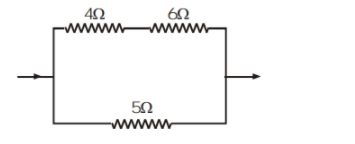
In the circuit shown in the figure the heat produced in the 5ohm resistor due to the current flowing through it is 10 calories per second. The heat generated in the 4 ohm resistor is
A. 1calorie/per
B. 2 calorie/per
C. 3 calorie/per
D. 4 calorie/per
Answer
 Verified
654.6k+ views
Hint: In such a type of question we must know the concept of resistor in series and parallel and the heating effect of electric current and how I and V vary in series and parallel combination.
Formula used - $I_4^2{R_4} = {(\dfrac{{\sqrt 2 }}{2})^2} \times 4 = 2cal/\sec $
1) $H = {I^2}Rt$
2) $V = IR$
3) Current through a resistor in series combination, ${I_S} = \dfrac{V}{{{R_1} + {R_2}}}$
Complete step-by-step answer:
Any resistor in a circuit that has a voltage drop over it dissipates electrical power. This electrical power is converted to heat energy, and thus all resistors have a power rating. The conversion rate is the dissipation power.
Now, it is given that,
Heat generated at 5 ohms resistor=10 calories per second
Heat yielded, $H = {I^2}Rt$
Here, $\dfrac{{{H_5}}}{t} = {I_5}^2{R_5} = 10 \Rightarrow {I_5} = \sqrt {\dfrac{{10}}{5}} = \sqrt 2 $, This is the current through the resistor to 5 ohm.
Voltage through 5 ohms resistor ${V_5} = {I_5}{R_5} = \sqrt 2 \times 5 = 5\sqrt 2 V$
As the resistors (4,6) and 5 are parallel, the overall potential (4,6) is equal to that of ${V_5}$
As the 4 and 6 resistors are so present through each resistor in series ${I_4} = {I_6} = \dfrac{{{V_5}}}{{4 + 6}} = \dfrac{{5\sqrt 2 }}{{4 + 6}} = \dfrac{{\sqrt 2 }}{2}$
Heat produce in resistor 4 per sec,$I_4^2{R_4} = {(\dfrac{{\sqrt 2 }}{2})^2} \times 4 = 2cal/\sec $
Hence the correct answer is option B.
Note: In such a type of question, we must apply the formula on the given resistor to obtain V and I in the resistor given and then apply the concept and formula of series and parallel combination for finding the required quantity.
Formula used - $I_4^2{R_4} = {(\dfrac{{\sqrt 2 }}{2})^2} \times 4 = 2cal/\sec $
1) $H = {I^2}Rt$
2) $V = IR$
3) Current through a resistor in series combination, ${I_S} = \dfrac{V}{{{R_1} + {R_2}}}$
Complete step-by-step answer:
Any resistor in a circuit that has a voltage drop over it dissipates electrical power. This electrical power is converted to heat energy, and thus all resistors have a power rating. The conversion rate is the dissipation power.
Now, it is given that,
Heat generated at 5 ohms resistor=10 calories per second
Heat yielded, $H = {I^2}Rt$
Here, $\dfrac{{{H_5}}}{t} = {I_5}^2{R_5} = 10 \Rightarrow {I_5} = \sqrt {\dfrac{{10}}{5}} = \sqrt 2 $, This is the current through the resistor to 5 ohm.
Voltage through 5 ohms resistor ${V_5} = {I_5}{R_5} = \sqrt 2 \times 5 = 5\sqrt 2 V$
As the resistors (4,6) and 5 are parallel, the overall potential (4,6) is equal to that of ${V_5}$
As the 4 and 6 resistors are so present through each resistor in series ${I_4} = {I_6} = \dfrac{{{V_5}}}{{4 + 6}} = \dfrac{{5\sqrt 2 }}{{4 + 6}} = \dfrac{{\sqrt 2 }}{2}$
Heat produce in resistor 4 per sec,$I_4^2{R_4} = {(\dfrac{{\sqrt 2 }}{2})^2} \times 4 = 2cal/\sec $
Hence the correct answer is option B.
Note: In such a type of question, we must apply the formula on the given resistor to obtain V and I in the resistor given and then apply the concept and formula of series and parallel combination for finding the required quantity.
Recently Updated Pages
Explain the structure of megasporangium class 12 biology CBSE

Why is chloroform kept in dark coloured bottles class 12 chemistry CBSE
Derive the balancing condition of a Wheatstone bri class 12 physics CBSE
Draw VI characteristics of a pn junction diode Explain class 12 physics CBSE
Is it possible to carry pride in ones language too class 12 english CBSE
In a population at Hardy Weinberg equilibrium the allele class 12 biology CBSE
Trending doubts
Draw a labelled sketch of the human eye class 12 physics CBSE
Which are the Top 10 Largest Countries of the World?
Draw ray diagrams each showing i myopic eye and ii class 12 physics CBSE
Which is the correct genotypic ratio of mendel dihybrid class 12 biology CBSE
Differentiate between homogeneous and heterogeneous class 12 chemistry CBSE
Which animal never drinks water in its entire life class 12 biology CBSE