




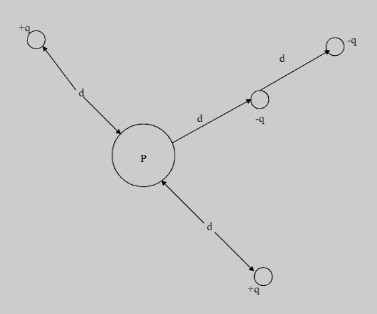
In the above figure, what is the net electric potential at point P due to the four particles if $ V = 0 $ at infinity, $ q = 5.00fC $ and $ d = 4.00cm $ ?
Answer
 Verified
595.8k+ views
Hint: Electric field is a vector quantity, while electric potential is a scalar quantity. Thus, to find the electric potential on a point due to several other point charges, we could make a sum of their individual electric potential with respect to the point charge. So, to find the electric potential on point P due to the other point charges, we can find the electric potential of each point charge on P and add them, $ V = {V_1} + {V_2} + {V_3} + {V_4} $ .
Formulas used We will be using the formula to find the electric potential of a point charge on a body given by, $ V = \dfrac{{kq}}{d} $ , where $ V $ is the electric potential on a point by a point charge, $ q $ is the magnitude of the point charge, $ d $ is the distance between the charge and the point, and $ k $ is the electrostatic constant given by, $ k = \dfrac{1}{{4\pi {\varepsilon _0}}} $ .
Complete Step by Step Solution
We can see that there are 4 charges surrounding the point P, in 3 directions. There are 2 point charges $ + q $ at a distance $ d $ in two opposite sides of point P, and a charge $ - q $ at a distance $ 2d $ from P, and another charge $ - q $ at a distance $ d $ from the point P in the same direction along the previously mentioned charge.
The electric potential of charges at either side of point P on P are given by,
$ {V_1} = {V_2} = \dfrac{{k( + q)}}{d} $
Similarly, the electric potential on point P, due to the third charge,
$ {V_3} = \dfrac{{k( - q)}}{{2d}} $
And the electric potential on point P due to the fourth charge will be,
$ {V_4} = \dfrac{{k( - q)}}{d} $
We know that electric potential is a scalar quantity, thus the total electric potential on point P is simply the sum of all the electric potentials on point P, $ V = {V_1} + {V_2} + {V_3} + {V_4} $ .
$ {V_{total}} = \dfrac{{k( + q)}}{d} + \dfrac{{k( + q)}}{d} + \dfrac{{k( - q)}}{{2d}} + \dfrac{{k( - q)}}{d} $
$ {V_{total}} = kq\left[ {\dfrac{{( + 1)}}{d} + \dfrac{{( + 1)}}{d} + \dfrac{{( - 1)}}{{2d}} + \dfrac{{( - 1)}}{d}} \right] $
Substituting the value of $ k = \dfrac{1}{{4\pi {\varepsilon _0}}} $ and solving,
$ {V_{total}} = \dfrac{1}{{4\pi {\varepsilon _0}}}q\left[ {\dfrac{{(2 + 2 - 1 - 2)}}{{2d}}} \right] $
$ {V_{total}} = \dfrac{1}{{4\pi {\varepsilon _0}}}q\left[ {\dfrac{{(1)}}{{2d}}} \right] $
We also know that the $ q = 5.00fC = 5 \times {10^{ - 15}}C $ , $ d = 4.00cm = 4 \times {10^{ - 2}}m $ and the value of the electrostatic constant, $ k = \dfrac{1}{{4\pi {\varepsilon _0}}} = 8.996 \times {10^9}N{m^2}{C^{ - 2}} $ .
$ {V_{total}} = 8.996 \times {10^9}N{m^2}{C^{ - 2}} \times 5 \times {10^{ - 15}}C\left[ {\dfrac{{(1)}}{{2 \times 4 \times {{10}^{ - 2}}m}}} \right] $
Solving for $ {V_{total}} $ we get,
$ {V_{total}} = 5.5625 \times {10^{ - 4}}Nm/C $ .
Note
The electric potential is a scalar quantity because it is a ratio of the potential energy of the system per unit charge, but the electric field is a vector because it is the ratio of the electric force applied to the distance.
Formulas used We will be using the formula to find the electric potential of a point charge on a body given by, $ V = \dfrac{{kq}}{d} $ , where $ V $ is the electric potential on a point by a point charge, $ q $ is the magnitude of the point charge, $ d $ is the distance between the charge and the point, and $ k $ is the electrostatic constant given by, $ k = \dfrac{1}{{4\pi {\varepsilon _0}}} $ .
Complete Step by Step Solution
We can see that there are 4 charges surrounding the point P, in 3 directions. There are 2 point charges $ + q $ at a distance $ d $ in two opposite sides of point P, and a charge $ - q $ at a distance $ 2d $ from P, and another charge $ - q $ at a distance $ d $ from the point P in the same direction along the previously mentioned charge.
The electric potential of charges at either side of point P on P are given by,
$ {V_1} = {V_2} = \dfrac{{k( + q)}}{d} $
Similarly, the electric potential on point P, due to the third charge,
$ {V_3} = \dfrac{{k( - q)}}{{2d}} $
And the electric potential on point P due to the fourth charge will be,
$ {V_4} = \dfrac{{k( - q)}}{d} $
We know that electric potential is a scalar quantity, thus the total electric potential on point P is simply the sum of all the electric potentials on point P, $ V = {V_1} + {V_2} + {V_3} + {V_4} $ .
$ {V_{total}} = \dfrac{{k( + q)}}{d} + \dfrac{{k( + q)}}{d} + \dfrac{{k( - q)}}{{2d}} + \dfrac{{k( - q)}}{d} $
$ {V_{total}} = kq\left[ {\dfrac{{( + 1)}}{d} + \dfrac{{( + 1)}}{d} + \dfrac{{( - 1)}}{{2d}} + \dfrac{{( - 1)}}{d}} \right] $
Substituting the value of $ k = \dfrac{1}{{4\pi {\varepsilon _0}}} $ and solving,
$ {V_{total}} = \dfrac{1}{{4\pi {\varepsilon _0}}}q\left[ {\dfrac{{(2 + 2 - 1 - 2)}}{{2d}}} \right] $
$ {V_{total}} = \dfrac{1}{{4\pi {\varepsilon _0}}}q\left[ {\dfrac{{(1)}}{{2d}}} \right] $
We also know that the $ q = 5.00fC = 5 \times {10^{ - 15}}C $ , $ d = 4.00cm = 4 \times {10^{ - 2}}m $ and the value of the electrostatic constant, $ k = \dfrac{1}{{4\pi {\varepsilon _0}}} = 8.996 \times {10^9}N{m^2}{C^{ - 2}} $ .
$ {V_{total}} = 8.996 \times {10^9}N{m^2}{C^{ - 2}} \times 5 \times {10^{ - 15}}C\left[ {\dfrac{{(1)}}{{2 \times 4 \times {{10}^{ - 2}}m}}} \right] $
Solving for $ {V_{total}} $ we get,
$ {V_{total}} = 5.5625 \times {10^{ - 4}}Nm/C $ .
Note
The electric potential is a scalar quantity because it is a ratio of the potential energy of the system per unit charge, but the electric field is a vector because it is the ratio of the electric force applied to the distance.
Recently Updated Pages
Master Class 12 Business Studies: Engaging Questions & Answers for Success

Master Class 12 Biology: Engaging Questions & Answers for Success
Master Class 12 Chemistry: Engaging Questions & Answers for Success
Class 12 Question and Answer - Your Ultimate Solutions Guide
Master Class 11 Social Science: Engaging Questions & Answers for Success
Master Class 11 English: Engaging Questions & Answers for Success
Trending doubts
Which are the Top 10 Largest Countries of the World?
Draw a labelled sketch of the human eye class 12 physics CBSE
Differentiate between homogeneous and heterogeneous class 12 chemistry CBSE
Why is the cell called the structural and functional class 12 biology CBSE
Draw ray diagrams each showing i myopic eye and ii class 12 physics CBSE
Which is the correct genotypic ratio of mendel dihybrid class 12 biology CBSE