




In human males, the testes lie in the scrotum, because it helps in
A. Process of mating
B. Formation of sperm
C. Easy transfer of gametes
D. All of the above
Answer
 Verified
588.9k+ views
Hint: The testes are primary sex organs of the male reproductive system. The testes are the site of production of male gametes called sperms. Testes lie in the sac-like structure called the scrotum, which helps to regulate the temperature of testes.
Complete answer: Sperms are male gametes which are the tiniest cells of the human male body. Sperms start developing at the onset of puberty. The sperms are made in ovoid-shaped structures that lie in the cavity of a sac-like scrotum called testes. Testes are about 3 centimetres in diameter and 5 centimetres in length. These are two in number and each is situated in one sac of the scrotum. The scrotum is made up of a tough, white capsule from inside that encloses the testes. The connective tissue in the posterior body of the capsule extends into the testes and forms septa. The septae divide the testes into 250 lobules, each of which contains four highly coiled seminiferous tubules. Each of these tubules forms a complex network that forms several ducts. These ducts join the epididymis.
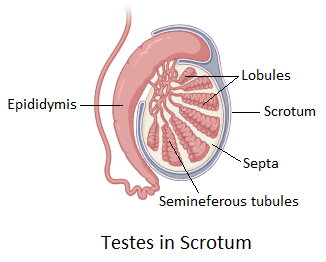
The scrotum hangs from the lower region of the abdomen just posterior to the penis. The scrotum is divided into two sacs by the medial septum. The serous membrane within each sac secretes a fluid that reduces friction, which allows easy movement of testes. The main function of the scrotum is to maintain the temperature of testes. These factors are important to regulate sex cell production. The smooth muscle of the scrotum contracts when cold temperature stimulates the testes to move closer to the pelvic cavity. When warm conditions prevail, the scrotum relaxes and hangs loosely. This mechanism regulates the testes temperature as lower than the body temperature. This temperature regulation is important for sperm production.
Hence, the correct answer is option B.
Note: Various other male hormones stimulate sperm production, androgens such as testosterone. Spermatogenesis is the process of producing male gametes. Various other factors that aid in sperm production are also affected by temperature changes. Thus, it is important to regulate temperature differences.
Complete answer: Sperms are male gametes which are the tiniest cells of the human male body. Sperms start developing at the onset of puberty. The sperms are made in ovoid-shaped structures that lie in the cavity of a sac-like scrotum called testes. Testes are about 3 centimetres in diameter and 5 centimetres in length. These are two in number and each is situated in one sac of the scrotum. The scrotum is made up of a tough, white capsule from inside that encloses the testes. The connective tissue in the posterior body of the capsule extends into the testes and forms septa. The septae divide the testes into 250 lobules, each of which contains four highly coiled seminiferous tubules. Each of these tubules forms a complex network that forms several ducts. These ducts join the epididymis.
The scrotum hangs from the lower region of the abdomen just posterior to the penis. The scrotum is divided into two sacs by the medial septum. The serous membrane within each sac secretes a fluid that reduces friction, which allows easy movement of testes. The main function of the scrotum is to maintain the temperature of testes. These factors are important to regulate sex cell production. The smooth muscle of the scrotum contracts when cold temperature stimulates the testes to move closer to the pelvic cavity. When warm conditions prevail, the scrotum relaxes and hangs loosely. This mechanism regulates the testes temperature as lower than the body temperature. This temperature regulation is important for sperm production.
Hence, the correct answer is option B.
Note: Various other male hormones stimulate sperm production, androgens such as testosterone. Spermatogenesis is the process of producing male gametes. Various other factors that aid in sperm production are also affected by temperature changes. Thus, it is important to regulate temperature differences.
Recently Updated Pages
Master Class 12 Business Studies: Engaging Questions & Answers for Success

Master Class 12 Biology: Engaging Questions & Answers for Success
Master Class 12 Chemistry: Engaging Questions & Answers for Success
Class 12 Question and Answer - Your Ultimate Solutions Guide
Master Class 11 Social Science: Engaging Questions & Answers for Success
Master Class 11 English: Engaging Questions & Answers for Success
Trending doubts
Which are the Top 10 Largest Countries of the World?
Draw a labelled sketch of the human eye class 12 physics CBSE
Differentiate between homogeneous and heterogeneous class 12 chemistry CBSE
Sulphuric acid is known as the king of acids State class 12 chemistry CBSE
Why is the cell called the structural and functional class 12 biology CBSE
Which is the correct genotypic ratio of mendel dihybrid class 12 biology CBSE