




In Demospongiae skeleton is composed of
A. Spongin fibers
B. Siliceous spicules
C. Both A and B
D. Keratin fibers
Answer
 Verified
654.6k+ views
Hint: Demosponges are the largest class of organisms belonging to the phylum Porifera. These are soft-bodied creatures that possess a hard calcified skeleton. They are very porous in structure and their skeletons are made of siliceous spicules and spongin fibers.
Step by step answer:The Demosponges belongs to the phylum Porifera. These are named sponges due to their porous surface. These are predominantly marine dwelling organisms and can be found in a variety of vivid colors and shapes.
The most peculiar aspect of these organisms is that they have extremely long life spans ranging from 500 to 1000 years. This is mainly attributed to their skeletal structure. Demosponges have a leuconoid structure which refers to a porous jelly-like surface with a hard skeleton.
The skeletons of Demospongiae are made up of spicules. Spicules are structural elements made up of either silica or protein fibers such as spongin. In Demosponges, both types of spicules, siliceous spicules, and spongin fibers are present.
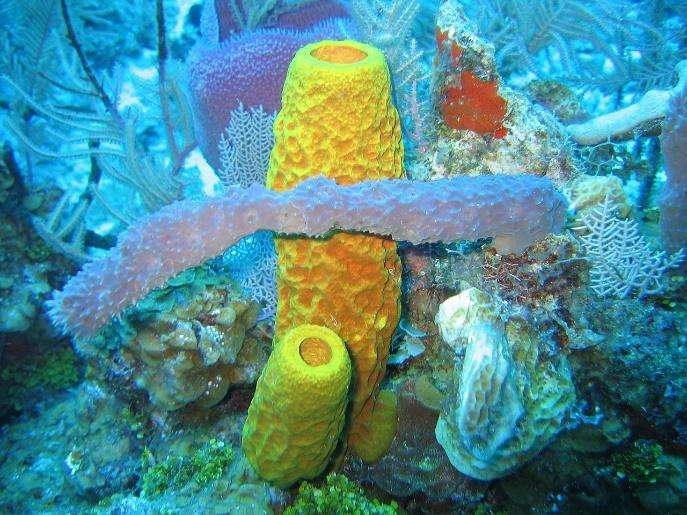
These spicules can be found in many different shapes and their arrangements are determinants of the class or genus of Demosponges.
Therefore, the correct option is C
Note: The Demosponges are soft-bodied organisms with hard internal skeletons. They are porous and have very long life spans. The skeleton is made up of spicules which are structural elements, made up of silica or protein fibers called siliceous spicules or spongin fibers. Spongin is a form of modified collagen that forms a fibrous mesh to provide structural support. Keratin fibers are proteins found in hair and nails of certain vertebrate organisms and not in Porifera.
Step by step answer:The Demosponges belongs to the phylum Porifera. These are named sponges due to their porous surface. These are predominantly marine dwelling organisms and can be found in a variety of vivid colors and shapes.
The most peculiar aspect of these organisms is that they have extremely long life spans ranging from 500 to 1000 years. This is mainly attributed to their skeletal structure. Demosponges have a leuconoid structure which refers to a porous jelly-like surface with a hard skeleton.
The skeletons of Demospongiae are made up of spicules. Spicules are structural elements made up of either silica or protein fibers such as spongin. In Demosponges, both types of spicules, siliceous spicules, and spongin fibers are present.
These spicules can be found in many different shapes and their arrangements are determinants of the class or genus of Demosponges.
Therefore, the correct option is C
Note: The Demosponges are soft-bodied organisms with hard internal skeletons. They are porous and have very long life spans. The skeleton is made up of spicules which are structural elements, made up of silica or protein fibers called siliceous spicules or spongin fibers. Spongin is a form of modified collagen that forms a fibrous mesh to provide structural support. Keratin fibers are proteins found in hair and nails of certain vertebrate organisms and not in Porifera.
Recently Updated Pages
Write structures of the following compounds i 2 Chloro3methylpentane class 11 chemistry CBSE

What is BLO What is the full form of BLO class 8 social science CBSE
Explain the Treaty of Vienna of 1815 class 10 social science CBSE
A Paragraph on Pollution in about 100-150 Words
XIX+XXX A 49 B 51 C 55 D 44 class 5 maths CBSE
If x a + bt + ct2 where x is in meters and t is in class 11 physics CBSE
Trending doubts
One Metric ton is equal to kg A 10000 B 1000 C 100 class 11 physics CBSE
Find the value of the expression given below sin 30circ class 11 maths CBSE
Draw a diagram of nephron and explain its structur class 11 biology CBSE
10 examples of friction in our daily life
Draw a diagram of a plant cell and label at least eight class 11 biology CBSE
Proton was discovered by A Thomson B Rutherford C Chadwick class 11 chemistry CBSE