




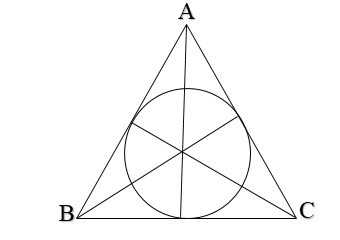
In an equilateral triangle of side 24 cm, a circle is inscribed touching its sides, find the areas of the remaining portion of the triangle.
Answer
 Verified
639.9k+ views
Hint: Here to find the remaining area of the triangle, we consider the relation between area of triangle, semi- perimeter and radius of inner circle as the circle is inscribed in the triangle i.e.., $R = \dfrac{A}{s}$
Complete step-by-step answer:
We know the relation between area of triangle, semi-perimeter, radius of inner circle is $R = \dfrac{A}{s}$ , where A is area of triangle, s is semi perimeter, R radius of incircle.
Given, the side of an equilateral triangle is 24 cm.
Also, semi perimeter s can be given as $s = \dfrac{{24 + 24 + 24}}{2} = 36cm$.
The formula for the area A for the equilateral triangle is $\dfrac{{\sqrt 3 }}{2}{(side)^2}$ .
So, the area will be $\dfrac{{\sqrt 3 }}{2}{(24)^2} = 144\sqrt 3 c{m^2}$ .
Now, we have got the value of A and s, so we can easily calculate the value of R as follows: $R = \dfrac{{144\sqrt 3 }}{{36}} = 4\sqrt 3 cm$ .
Formula for area for the circle is $\pi {(radius)^2}$ since we have got the radius, we can move further.
Area of the circle will be $\pi {R^2} = \pi \times {4^2} \times 3 = 48\pi $ .
Area of the remaining portion will be equal to the area of the circle subtracted from the total area of the triangle. Viz. $(144\sqrt 3 - 48)\pi c{m^2}$
Note: We can also put the value of $\pi $ as $\dfrac{{22}}{7}$ or $3.14$ for further simplification. While solving these types of problems we need to find the relations between the triangles and circles such that it makes the simplification easier.
Complete step-by-step answer:
We know the relation between area of triangle, semi-perimeter, radius of inner circle is $R = \dfrac{A}{s}$ , where A is area of triangle, s is semi perimeter, R radius of incircle.
Given, the side of an equilateral triangle is 24 cm.
Also, semi perimeter s can be given as $s = \dfrac{{24 + 24 + 24}}{2} = 36cm$.
The formula for the area A for the equilateral triangle is $\dfrac{{\sqrt 3 }}{2}{(side)^2}$ .
So, the area will be $\dfrac{{\sqrt 3 }}{2}{(24)^2} = 144\sqrt 3 c{m^2}$ .
Now, we have got the value of A and s, so we can easily calculate the value of R as follows: $R = \dfrac{{144\sqrt 3 }}{{36}} = 4\sqrt 3 cm$ .
Formula for area for the circle is $\pi {(radius)^2}$ since we have got the radius, we can move further.
Area of the circle will be $\pi {R^2} = \pi \times {4^2} \times 3 = 48\pi $ .
Area of the remaining portion will be equal to the area of the circle subtracted from the total area of the triangle. Viz. $(144\sqrt 3 - 48)\pi c{m^2}$
Note: We can also put the value of $\pi $ as $\dfrac{{22}}{7}$ or $3.14$ for further simplification. While solving these types of problems we need to find the relations between the triangles and circles such that it makes the simplification easier.
Recently Updated Pages
Master Class 12 Business Studies: Engaging Questions & Answers for Success

Master Class 12 Biology: Engaging Questions & Answers for Success
Master Class 12 Chemistry: Engaging Questions & Answers for Success
Class 12 Question and Answer - Your Ultimate Solutions Guide
Master Class 11 Social Science: Engaging Questions & Answers for Success
Master Class 11 English: Engaging Questions & Answers for Success
Trending doubts
What is the Full Form of ICSE / ISC ?
Find the sum of series 1 + 2 + 3 + 4 + 5 + + 100 class 9 maths CBSE
What is the situation called when no party gets the class 9 social science CBSE
Fill the blanks with the suitable prepositions 1 The class 9 english CBSE
Difference Between Plant Cell and Animal Cell
How many hours before the closure of election must class 9 social science CBSE