




In a meter-bridge, the balancing length from the left end when standard resistance of 1 $\Omega$ is in the right gap is found to be 20 cm. The value of unknown resistance is
(A) 0.25 $\Omega$
(B) 0.4 $\Omega$
(C) 0.5 $\Omega$
(D) 4 $\Omega$
Answer
 Verified
600.9k+ views
Hint: A meter bridge has an arrangement similar to Wheatstone bridge and is made up of a wire of uniform thickness upon which when the jockey of the galvanometer is placed, gets divided into 2 different resistances. The unknown resistance is found as the ratio of the two lengths times known resistance.
Formula used:
On the condition of balancing of bridge, the relationship among various resistance goes as follows:
$\dfrac{X}{R} = \dfrac{L}{100 - L}$
Complete answer:
Just like a Wheatstone bridge that has four arms, the metre bridge has that total four resistances. One resistance is given through a resistance box R which is the known resistance. One wire of unknown resistance is attached at X, one wire of length one meter is connected on a wooden board that gets divided into two different resistances of values rL and r(100-L). L is the length from one of the ends of the wire and r is the resistance per unit length of the wire.
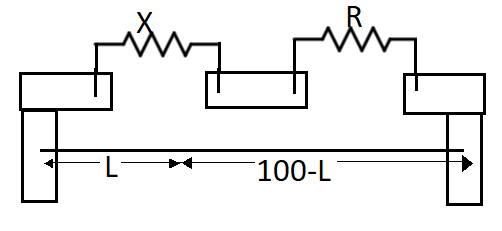
We are given the balancing length L = 20 cm from the left and also the value of resistance R = 1 $ \Omega$ on the standard resistance side. Now, we substitute these values in the formula to find the value of X, so that we get:
$X = \dfrac{20}{80} \times 1 \Omega = 0.25 \Omega$.
Therefore, when we connect an unknown resistance on the X and a standard resistance of value 1$\Omega$ that shows a balance point at 20 cm from the left, we find the value of unknown resistance at X to be $0.25 \Omega$ .
The correct answer is option (A).
Note:
Meter bridge is specifically used for determining the value of unknown resistance X. In a bridge, the ratios of two adjoining resistances on the opposite side are equal like here we have X:rL =R:r(100-L). One has to be careful about the notations.
Formula used:
On the condition of balancing of bridge, the relationship among various resistance goes as follows:
$\dfrac{X}{R} = \dfrac{L}{100 - L}$
Complete answer:
Just like a Wheatstone bridge that has four arms, the metre bridge has that total four resistances. One resistance is given through a resistance box R which is the known resistance. One wire of unknown resistance is attached at X, one wire of length one meter is connected on a wooden board that gets divided into two different resistances of values rL and r(100-L). L is the length from one of the ends of the wire and r is the resistance per unit length of the wire.
We are given the balancing length L = 20 cm from the left and also the value of resistance R = 1 $ \Omega$ on the standard resistance side. Now, we substitute these values in the formula to find the value of X, so that we get:
$X = \dfrac{20}{80} \times 1 \Omega = 0.25 \Omega$.
Therefore, when we connect an unknown resistance on the X and a standard resistance of value 1$\Omega$ that shows a balance point at 20 cm from the left, we find the value of unknown resistance at X to be $0.25 \Omega$ .
The correct answer is option (A).
Note:
Meter bridge is specifically used for determining the value of unknown resistance X. In a bridge, the ratios of two adjoining resistances on the opposite side are equal like here we have X:rL =R:r(100-L). One has to be careful about the notations.
Recently Updated Pages
Which of the following graphs shows the variation of class 12 physics CBSE

Draw a labelled diagram of the human male reproductive class 12 biology CBSE
Describe the experiment to compare the emf of two cells class 12 physics CBSE
What is standard hydrogen electrode
What is conventional current and electric current class 12 physics CBSE
2Bromopentane is treated with an alcoholic KOH solution class 12 chemistry CBSE
Trending doubts
Draw a labelled sketch of the human eye class 12 physics CBSE
Which are the Top 10 Largest Countries of the World?
A member of Simon commission later became Prime Minister class 12 social science CBSE
Differentiate between homogeneous and heterogeneous class 12 chemistry CBSE
Draw ray diagrams each showing i myopic eye and ii class 12 physics CBSE
Which is the correct genotypic ratio of mendel dihybrid class 12 biology CBSE