



In a face centred cubic lattice, all atoms at face are shared equally by how many unit cells?
A.8
B.4
C.2
D.6
Answer
 Verified
594.3k+ views
Hint: In the face centred cubic arrangement, eight atoms are present at the corners of the unit cell and one atom centred in each of the faces. The atom in the face is shared with the adjacent cell.
Complete step-by-step solution:
A unit cell is the smallest repeating portion of a crystal lattice. It has eight corners, twelve edges and six faces. There are three different types of unit cells:
Simple cubic
Face-centred cubic
Body-centred cubic
Particularly in FCC, the eight atoms at the corners contribute \[{\text{8 }} \times {\text{ }}\dfrac{1}{8}{\text{ = 1}}\]. There is one atom at each of the six faces which is shared by two unit cells each. Therefore, the contribution of six face-centred atoms \[6 \times {\text{ }}\dfrac{1}{2}{\text{ = 3}}\]. Total number of atoms be \[1{\text{ + 3 = 4}}\].
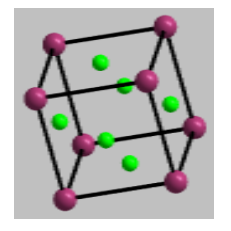
No matter what the crystal lattice be, each unit cell is always connected to six other unit cells and thereby each face of the unit cell is connected to any one face of another unit cell.
Hence, all atoms at face are shared equally by two adjacent unit cells. So, the correct option is (C).
Note: We can think of it in another way such that each face of the cell is common to two adjacent cells. Therefore, the contribution of each face-centred atom is only half of its mass and volume to one cell. Similarly, if we arrange six cells, each will share the remaining half of the face-centred atoms.
Complete step-by-step solution:
A unit cell is the smallest repeating portion of a crystal lattice. It has eight corners, twelve edges and six faces. There are three different types of unit cells:
Simple cubic
Face-centred cubic
Body-centred cubic
Particularly in FCC, the eight atoms at the corners contribute \[{\text{8 }} \times {\text{ }}\dfrac{1}{8}{\text{ = 1}}\]. There is one atom at each of the six faces which is shared by two unit cells each. Therefore, the contribution of six face-centred atoms \[6 \times {\text{ }}\dfrac{1}{2}{\text{ = 3}}\]. Total number of atoms be \[1{\text{ + 3 = 4}}\].
No matter what the crystal lattice be, each unit cell is always connected to six other unit cells and thereby each face of the unit cell is connected to any one face of another unit cell.
Hence, all atoms at face are shared equally by two adjacent unit cells. So, the correct option is (C).
Note: We can think of it in another way such that each face of the cell is common to two adjacent cells. Therefore, the contribution of each face-centred atom is only half of its mass and volume to one cell. Similarly, if we arrange six cells, each will share the remaining half of the face-centred atoms.
Recently Updated Pages
Master Class 12 Social Science: Engaging Questions & Answers for Success

Master Class 12 Physics: Engaging Questions & Answers for Success
Master Class 12 Maths: Engaging Questions & Answers for Success
Master Class 12 Economics: Engaging Questions & Answers for Success
Master Class 12 Chemistry: Engaging Questions & Answers for Success
Master Class 12 Business Studies: Engaging Questions & Answers for Success
Trending doubts
Which are the Top 10 Largest Countries of the World?
Draw a labelled sketch of the human eye class 12 physics CBSE
Explain the structure of megasporangium class 12 biology CBSE
What are the major means of transport Explain each class 12 social science CBSE
How many chromosomes are found in human ovum a 46 b class 12 biology CBSE
The diagram of the section of a maize grain is given class 12 biology CBSE