



IFind the total surface area of a cone, if its slant height is 2m and diameter of its base is 24m.
Answer
 Verified
642k+ views
Hint: Total Surface area of a cone is equal to the curved surface area of a cone plus the area of the base (circle).
Formulas used: Curved surface area of a cone is $\pi rL$ where ‘r’ denotes the radius of the base of the cone, and ‘L’ denotes the slant height of the cone.
Area of the base (circle) is $\pi {r^2}$ where ‘r’ denotes the radius of the base of the cone and $'\pi '$ is equal to 22/7 or 3.14.
Complete step-by-step solution:
We are given that the slant height ‘L’ of the cone is 21m and diameter if its base is 24m.
We need the radius of the base to find the total surface area.
Radius= half of the diameter= $\dfrac{{diameter}}{2} = \dfrac{{24}}{2} = 12m$
$\therefore r = 12m$
Total surface area = $\pi rL + \pi {r^2}$
Taking out $\pi r$ common, we get
$
\Rightarrow \pi r\left( {L + r} \right) \\
\Rightarrow \dfrac{{22}}{7} \times 12\left( {21 + 12} \right) \\
\Rightarrow \dfrac{{22 \times 12}}{7}\left( {33} \right) \\
\Rightarrow \dfrac{{22 \times 12}}{7} \times 33 \\
\Rightarrow \dfrac{{22 \times 12 \times 33}}{7} \\
= 1244.57{m^2} \\
$
Therefore, the total surface of a cone with slant height 21m and diameter 24m is 244.57 square meters.
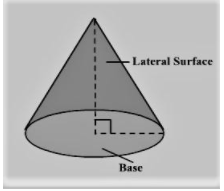
Note:Curved surface area or lateral surface area is just the area of the curved surface. Total surface area is the sum of curved surface area and area of the flat surfaces like the base of a cone. The base of a cone is in circular shape. Curved surface area of a cone is $\pi rL$ because if a perpendicular cut is made from a point on the circumference of the base to the vertex of the cone and the cone is opened up, a sector of a circle with radius ‘L’ is produced. Since the circumference of the base of the cone is \[2\pi r\] , therefore the arc length of the sector of the circle is \[2\pi r\].
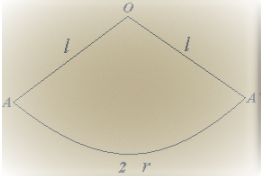
Curved surface area=Area of sector OAA’
Curved surface area= (Arc length of sector / Circumference of circle) × Area of circle
\[
= \dfrac{{2\pi r}}{{2\pi l}} \times \pi {l^2} \\
= \dfrac{{{2} \times {\pi } \times r}}{{{2} \times {\pi } \times {l}}} \times \pi \times{l} \times l \\
= r \times \pi \times l \\
= \pi rl \\
\]
Formulas used: Curved surface area of a cone is $\pi rL$ where ‘r’ denotes the radius of the base of the cone, and ‘L’ denotes the slant height of the cone.
Area of the base (circle) is $\pi {r^2}$ where ‘r’ denotes the radius of the base of the cone and $'\pi '$ is equal to 22/7 or 3.14.
Complete step-by-step solution:
We are given that the slant height ‘L’ of the cone is 21m and diameter if its base is 24m.
We need the radius of the base to find the total surface area.
Radius= half of the diameter= $\dfrac{{diameter}}{2} = \dfrac{{24}}{2} = 12m$
$\therefore r = 12m$
Total surface area = $\pi rL + \pi {r^2}$
Taking out $\pi r$ common, we get
$
\Rightarrow \pi r\left( {L + r} \right) \\
\Rightarrow \dfrac{{22}}{7} \times 12\left( {21 + 12} \right) \\
\Rightarrow \dfrac{{22 \times 12}}{7}\left( {33} \right) \\
\Rightarrow \dfrac{{22 \times 12}}{7} \times 33 \\
\Rightarrow \dfrac{{22 \times 12 \times 33}}{7} \\
= 1244.57{m^2} \\
$
Therefore, the total surface of a cone with slant height 21m and diameter 24m is 244.57 square meters.
Note:Curved surface area or lateral surface area is just the area of the curved surface. Total surface area is the sum of curved surface area and area of the flat surfaces like the base of a cone. The base of a cone is in circular shape. Curved surface area of a cone is $\pi rL$ because if a perpendicular cut is made from a point on the circumference of the base to the vertex of the cone and the cone is opened up, a sector of a circle with radius ‘L’ is produced. Since the circumference of the base of the cone is \[2\pi r\] , therefore the arc length of the sector of the circle is \[2\pi r\].
Curved surface area=Area of sector OAA’
Curved surface area= (Arc length of sector / Circumference of circle) × Area of circle
\[
= \dfrac{{2\pi r}}{{2\pi l}} \times \pi {l^2} \\
= \dfrac{{{2} \times {\pi } \times r}}{{{2} \times {\pi } \times {l}}} \times \pi \times{l} \times l \\
= r \times \pi \times l \\
= \pi rl \\
\]
Recently Updated Pages
Basicity of sulphurous acid and sulphuric acid are

Master Class 12 Economics: Engaging Questions & Answers for Success
Master Class 12 Biology: Engaging Questions & Answers for Success
Master Class 11 English: Engaging Questions & Answers for Success
Master Class 11 Physics: Engaging Questions & Answers for Success
Master Class 11 Computer Science: Engaging Questions & Answers for Success
Trending doubts
Difference Between Plant Cell and Animal Cell
Fill the blanks with the suitable prepositions 1 The class 9 english CBSE
What is pollution? How many types of pollution? Define it
What is the full form of pH?
What is the Full Form of ICSE, CBSE and SSC
On an outline map of India show its neighbouring c class 9 social science CBSE