




If Y-axis is the directrix of the ellipse with eccentricity $e = \dfrac{1}{2}$ and the corresponding focus is at (3,0), find the equation to its auxiliary circle.
$
{\text{A}}{\text{. }}{x^2} + {y^2} - 8x + 12 = 0 \\
{\text{B}}{\text{. }}{x^2} + {y^2} - 8x - 12 = 0 \\
{\text{C}}{\text{. }}{x^2} + {y^2} - 8x + 9 = 0 \\
{\text{D}}{\text{. }}{x^2} + {y^2} = 4 \\
$
Answer
 Verified
639.9k+ views
Hint- Here, we will proceed by using the formulas for the equation of directrix i.e.,$x = h - \dfrac{a}{e}$ , the focus coordinates i.e., F(h-ae,k) and ${b^2} = {a^2}\left( {1 - {e^2}} \right)$ corresponding to any ellipse $\dfrac{{{{\left( {x - h} \right)}^2}}}{{{a^2}}} + \dfrac{{{{\left( {y - k} \right)}^2}}}{{{b^2}}} = 1$ where a>b.
Complete step by step answer:
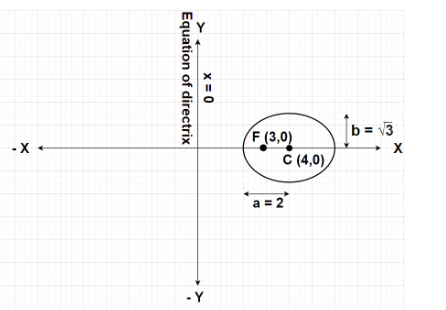
Given, Directrix to the given ellipse is represented by equation of Y-axis i.e., x = 0
Eccentricity, $e = \dfrac{1}{2}$
Focus of the ellipse is at F(3,0)
Since, the directrix of the given ellipse lies along the Y-axis. Therefore, the ellipse will be oriented along the X-axis.
Let the equation of the ellipse along Y-axis is given by $\dfrac{{{{\left( {x - h} \right)}^2}}}{{{a^2}}} + \dfrac{{{{\left( {y - k} \right)}^2}}}{{{b^2}}} = 1{\text{ }} \to {\text{(1)}}$ where a>b and the centre of the ellipse lies at point C(h,k).
As we know that the equation of the directrix to any ellipse $\dfrac{{{{\left( {x - h} \right)}^2}}}{{{a^2}}} + \dfrac{{{{\left( {y - k} \right)}^2}}}{{{b^2}}} = 1$ (having eccentricity as e) where a>b is given by
$x = h - \dfrac{a}{e}$
For the given ellipse, equation of the directrix is x = 0
$
\Rightarrow 0 = h - \dfrac{a}{e} \\
\Rightarrow h = \dfrac{a}{e} \\
$
By putting $e = \dfrac{1}{2}$ in the above equation, we get
$
\Rightarrow h = \dfrac{a}{{\left( {\dfrac{1}{2}} \right)}} \\
\Rightarrow h = 2a{\text{ }} \to {\text{(2)}} \\
$
Also, the focus coordinates for any ellipse $\dfrac{{{{\left( {x - h} \right)}^2}}}{{{a^2}}} + \dfrac{{{{\left( {y - k} \right)}^2}}}{{{b^2}}} = 1$ (having eccentricity as e) where a>b is given by F(h-ae,k)
Also, focus of the given ellipse is F(3,0)
So, h-ae = 3
$
\Rightarrow 2a - a\left( {\dfrac{1}{2}} \right) = 3 \\
\Rightarrow 2a - \dfrac{a}{2} = 3 \\
\Rightarrow \dfrac{{4a - a}}{2} = 3 \\
\Rightarrow \dfrac{{3a}}{2} = 3 \\
\Rightarrow a = 2 \\
$
Hence, ${a^2} = {2^2} = 4$
Also, k = 0
Using the formula ${b^2} = {a^2}\left( {1 - {e^2}} \right)$, the value of ${b^2}$ is given as
$
\Rightarrow {b^2} = 4\left( {1 - {{\left( {\dfrac{1}{2}} \right)}^2}} \right) = 4\left( {1 - \dfrac{1}{4}} \right) = 4\left( {\dfrac{{4 - 1}}{4}} \right) = 4\left( {\dfrac{3}{4}} \right) \\
\Rightarrow {b^2} = 3 \\
$
Putting a = 2 in equation (2), we get
$ \Rightarrow h = 2 \times 2 = 4$
Putting ${a^2} = 4$, ${b^2} = 3$, h = 4 and k = 0 in equation (1), we get
$
\Rightarrow \dfrac{{{{\left( {x - 4} \right)}^2}}}{4} + \dfrac{{{{\left( {y - 0} \right)}^2}}}{3} = 1 \\
\Rightarrow \dfrac{{{{\left( {x - 4} \right)}^2}}}{4} + \dfrac{{{y^2}}}{3} = 1 \\
$
This above equation represents the equation of the given ellipse.
Equation of the auxiliary circle to the ellipse $\dfrac{{{{\left( {x - h} \right)}^2}}}{{{a^2}}} + \dfrac{{{{\left( {y - k} \right)}^2}}}{{{b^2}}} = 1$ where a>b is given by
${\left( {x - h} \right)^2} + {\left( {y - k} \right)^2} = {a^2}{\text{ }} \to {\text{(3)}}$
By putting ${a^2} = 4$, h = 4 and k = 0 in the equation (3), we get
$
\Rightarrow {\left( {x - 4} \right)^2} + {\left( {y - 0} \right)^2} = 4 \\
\Rightarrow {\left( {x - 4} \right)^2} + {y^2} = 4 \\
\Rightarrow {x^2} + {4^2} - 8x + {y^2} = 4 \\
\Rightarrow {x^2} + {y^2} - 8x + 12 = 0 \\
$
The above equation represents the required equation of the auxiliary circle to the given ellipse.
Hence, option A is correct.
Note- In this particular problem, firstly it very important to find out that the given ellipse corresponds to which one of the two general cases of ellipse i.e., $\dfrac{{{{\left( {x - h} \right)}^2}}}{{{a^2}}} + \dfrac{{{{\left( {y - k} \right)}^2}}}{{{b^2}}} = 1$ where a>b or $\dfrac{{{{\left( {x - h} \right)}^2}}}{{{a^2}}} + \dfrac{{{{\left( {y - k} \right)}^2}}}{{{b^2}}} = 1$ where b>a, in order to use the formulas for various parameters. Also, the major axis of the given ellipse is X-axis and the minor axis is Y-axis.
Complete step by step answer:
Given, Directrix to the given ellipse is represented by equation of Y-axis i.e., x = 0
Eccentricity, $e = \dfrac{1}{2}$
Focus of the ellipse is at F(3,0)
Since, the directrix of the given ellipse lies along the Y-axis. Therefore, the ellipse will be oriented along the X-axis.
Let the equation of the ellipse along Y-axis is given by $\dfrac{{{{\left( {x - h} \right)}^2}}}{{{a^2}}} + \dfrac{{{{\left( {y - k} \right)}^2}}}{{{b^2}}} = 1{\text{ }} \to {\text{(1)}}$ where a>b and the centre of the ellipse lies at point C(h,k).
As we know that the equation of the directrix to any ellipse $\dfrac{{{{\left( {x - h} \right)}^2}}}{{{a^2}}} + \dfrac{{{{\left( {y - k} \right)}^2}}}{{{b^2}}} = 1$ (having eccentricity as e) where a>b is given by
$x = h - \dfrac{a}{e}$
For the given ellipse, equation of the directrix is x = 0
$
\Rightarrow 0 = h - \dfrac{a}{e} \\
\Rightarrow h = \dfrac{a}{e} \\
$
By putting $e = \dfrac{1}{2}$ in the above equation, we get
$
\Rightarrow h = \dfrac{a}{{\left( {\dfrac{1}{2}} \right)}} \\
\Rightarrow h = 2a{\text{ }} \to {\text{(2)}} \\
$
Also, the focus coordinates for any ellipse $\dfrac{{{{\left( {x - h} \right)}^2}}}{{{a^2}}} + \dfrac{{{{\left( {y - k} \right)}^2}}}{{{b^2}}} = 1$ (having eccentricity as e) where a>b is given by F(h-ae,k)
Also, focus of the given ellipse is F(3,0)
So, h-ae = 3
$
\Rightarrow 2a - a\left( {\dfrac{1}{2}} \right) = 3 \\
\Rightarrow 2a - \dfrac{a}{2} = 3 \\
\Rightarrow \dfrac{{4a - a}}{2} = 3 \\
\Rightarrow \dfrac{{3a}}{2} = 3 \\
\Rightarrow a = 2 \\
$
Hence, ${a^2} = {2^2} = 4$
Also, k = 0
Using the formula ${b^2} = {a^2}\left( {1 - {e^2}} \right)$, the value of ${b^2}$ is given as
$
\Rightarrow {b^2} = 4\left( {1 - {{\left( {\dfrac{1}{2}} \right)}^2}} \right) = 4\left( {1 - \dfrac{1}{4}} \right) = 4\left( {\dfrac{{4 - 1}}{4}} \right) = 4\left( {\dfrac{3}{4}} \right) \\
\Rightarrow {b^2} = 3 \\
$
Putting a = 2 in equation (2), we get
$ \Rightarrow h = 2 \times 2 = 4$
Putting ${a^2} = 4$, ${b^2} = 3$, h = 4 and k = 0 in equation (1), we get
$
\Rightarrow \dfrac{{{{\left( {x - 4} \right)}^2}}}{4} + \dfrac{{{{\left( {y - 0} \right)}^2}}}{3} = 1 \\
\Rightarrow \dfrac{{{{\left( {x - 4} \right)}^2}}}{4} + \dfrac{{{y^2}}}{3} = 1 \\
$
This above equation represents the equation of the given ellipse.
Equation of the auxiliary circle to the ellipse $\dfrac{{{{\left( {x - h} \right)}^2}}}{{{a^2}}} + \dfrac{{{{\left( {y - k} \right)}^2}}}{{{b^2}}} = 1$ where a>b is given by
${\left( {x - h} \right)^2} + {\left( {y - k} \right)^2} = {a^2}{\text{ }} \to {\text{(3)}}$
By putting ${a^2} = 4$, h = 4 and k = 0 in the equation (3), we get
$
\Rightarrow {\left( {x - 4} \right)^2} + {\left( {y - 0} \right)^2} = 4 \\
\Rightarrow {\left( {x - 4} \right)^2} + {y^2} = 4 \\
\Rightarrow {x^2} + {4^2} - 8x + {y^2} = 4 \\
\Rightarrow {x^2} + {y^2} - 8x + 12 = 0 \\
$
The above equation represents the required equation of the auxiliary circle to the given ellipse.
Hence, option A is correct.
Note- In this particular problem, firstly it very important to find out that the given ellipse corresponds to which one of the two general cases of ellipse i.e., $\dfrac{{{{\left( {x - h} \right)}^2}}}{{{a^2}}} + \dfrac{{{{\left( {y - k} \right)}^2}}}{{{b^2}}} = 1$ where a>b or $\dfrac{{{{\left( {x - h} \right)}^2}}}{{{a^2}}} + \dfrac{{{{\left( {y - k} \right)}^2}}}{{{b^2}}} = 1$ where b>a, in order to use the formulas for various parameters. Also, the major axis of the given ellipse is X-axis and the minor axis is Y-axis.
Recently Updated Pages
Master Class 12 Business Studies: Engaging Questions & Answers for Success

Master Class 12 Biology: Engaging Questions & Answers for Success
Master Class 12 Chemistry: Engaging Questions & Answers for Success
Class 12 Question and Answer - Your Ultimate Solutions Guide
Master Class 11 Social Science: Engaging Questions & Answers for Success
Master Class 11 English: Engaging Questions & Answers for Success
Trending doubts
Which is more stable and why class 12 chemistry CBSE
Which are the Top 10 Largest Countries of the World?
Draw a labelled sketch of the human eye class 12 physics CBSE
Differentiate between homogeneous and heterogeneous class 12 chemistry CBSE
What are the major means of transport Explain each class 12 social science CBSE
Sulphuric acid is known as the king of acids State class 12 chemistry CBSE