




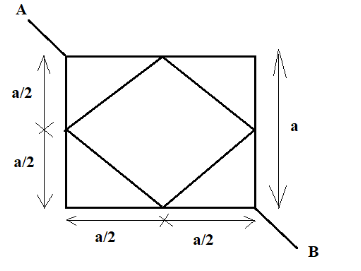
If the wire has resistivity \[\rho \], find the resistance between \[{\text{A}}\] and \[{\text{B}}\].
Answer
 Verified
568.5k+ views
Hint: First of all, we will find the slanting length of the figure inside. We will use a resistance formula which relates resistivity, length and cross-sectional area of the wire. If the current divides at a junction, then they are connected in parallel. Current does not flow under the same potential.
Complete step by step answer:
In the given question, we are supplied with the following information:
There is a mesh of wire, whose resistivity is \[\rho \].
The area of the cross section of the wire is \[A\].
We are required to find the equivalent resistance between \[{\text{A}}\] and \[{\text{B}}\].
To begin with, we will draw the diagram for better understanding.
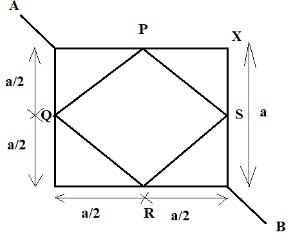
In the diagram, we can find the length of the part \[{\text{PQ}}\] by using Pythagoras theorem. In the triangle \[{\text{APQ}}\], we have,
$P{Q^2} = A{Q^2} + A{P^2} \\
\Rightarrow P{Q^2} = {\left( {\dfrac{a}{2}} \right)^2} + {\left( {\dfrac{a}{2}} \right)^2} \\
\Rightarrow PQ = \dfrac{a}{{\sqrt 2 }} $
Now, we have to find the total length of the wire such that we can calculate the net resistance of it.In the figure, it can be seen that the potential at the point \[P\] and \[Q\] are equal. Hence, there is no flow of current through that arm \[PQ\].Similarly, we can also say that there will be no current flowing in the arm \[RS\]. Now, we will need to find out the resistance of each arm.
${R_{AP}} = \dfrac{{\rho \times \dfrac{a}{2}}}{A} \\
\Rightarrow {R_{AP}} = \dfrac{{\rho a}}{{2A}}$
As we can see that the arm \[PXS\] is parallel to the arm \[PS\], so we can easily calculate the net resistance, by using the formula of parallel resistors.
$\dfrac{1}{{{R_1}}} = \dfrac{1}{{{R_{PXS}}}} + \dfrac{1}{{{R_{PS}}}} \\
\Rightarrow \dfrac{1}{{{R_1}}} = \dfrac{1}{{\dfrac{{\rho \times a}}{A}}} + \dfrac{1}{{\dfrac{{\rho \times a}}{{\sqrt 2 A}}}} \\
\Rightarrow \dfrac{1}{{{R_1}}} = \dfrac{A}{{\rho a}} + \dfrac{{\sqrt 2 A}}{{\rho a}} \\
\Rightarrow {R_1} = \dfrac{{\rho a}}{{A\left( {\sqrt 2 } \right) + 1}}$
Now, we can find the net resistance of the arms \[AP\], \[PXS\], \[PS\] and \[SB\] as they are in series connection now.
${R_2} = {R_{AP}} + {R_1} + {R_{SB}} \\
\Rightarrow {R_2} = \dfrac{{\rho a}}{{2A}} + \dfrac{{\rho a}}{{A\left( {\sqrt 2 } \right) + 1}} + \dfrac{{\rho a}}{{2A}} \\
\Rightarrow {R_2} = \dfrac{{\rho a}}{A}\left( {1 + \dfrac{1}{{1 + \sqrt 2 }}} \right) \\
\Rightarrow {R_2} = \dfrac{{\rho a\left( {\sqrt 2 + 2} \right)}}{{A\left( {\sqrt 2 + 1} \right)}}$
Similarly, the net resistance of the arm \[AQ\], \[QR\], \[QYR\] and \[RB\] is also:
${R_3} = \dfrac{{\rho a\left( {\sqrt 2 + 2} \right)}}{{A\left( {\sqrt 2 + 1} \right)}}$.
Now, we will find the net resistance of both the arms which are in parallel.
$\dfrac{1}{{{R_{{\text{eq}}}}}} = \dfrac{1}{{{R_2}}} + \dfrac{1}{{{R_3}}} \\
\Rightarrow \dfrac{1}{{{R_{{\text{eq}}}}}} = \dfrac{1}{{\dfrac{{\rho a\left( {\sqrt 2 + 2} \right)}}{{A\left( {\sqrt 2 + 1} \right)}}}} + \dfrac{1}{{\dfrac{{\rho a\left( {\sqrt 2 + 2} \right)}}{{A\left( {\sqrt 2 + 1} \right)}}}} \\
\Rightarrow {R_{{\text{eq}}}} = \dfrac{{\rho a\left( {\sqrt 2 + 2} \right)}}{{2A\left( {\sqrt 2 + 1} \right)}} \\
\Rightarrow {R_{{\text{eq}}}} = \dfrac{{\rho a}}{{\sqrt 2 A}}$
Hence, the equivalent resistance is \[\dfrac{{\rho a}}{{\sqrt 2 A}}\].
Note: While solving this problem, we should remember that current does not flow under the same potential difference. In case of series connection, current flow through the elements remains the same. While in the parallel connection, the voltage of all the elements remains the same.
Complete step by step answer:
In the given question, we are supplied with the following information:
There is a mesh of wire, whose resistivity is \[\rho \].
The area of the cross section of the wire is \[A\].
We are required to find the equivalent resistance between \[{\text{A}}\] and \[{\text{B}}\].
To begin with, we will draw the diagram for better understanding.
In the diagram, we can find the length of the part \[{\text{PQ}}\] by using Pythagoras theorem. In the triangle \[{\text{APQ}}\], we have,
$P{Q^2} = A{Q^2} + A{P^2} \\
\Rightarrow P{Q^2} = {\left( {\dfrac{a}{2}} \right)^2} + {\left( {\dfrac{a}{2}} \right)^2} \\
\Rightarrow PQ = \dfrac{a}{{\sqrt 2 }} $
Now, we have to find the total length of the wire such that we can calculate the net resistance of it.In the figure, it can be seen that the potential at the point \[P\] and \[Q\] are equal. Hence, there is no flow of current through that arm \[PQ\].Similarly, we can also say that there will be no current flowing in the arm \[RS\]. Now, we will need to find out the resistance of each arm.
${R_{AP}} = \dfrac{{\rho \times \dfrac{a}{2}}}{A} \\
\Rightarrow {R_{AP}} = \dfrac{{\rho a}}{{2A}}$
As we can see that the arm \[PXS\] is parallel to the arm \[PS\], so we can easily calculate the net resistance, by using the formula of parallel resistors.
$\dfrac{1}{{{R_1}}} = \dfrac{1}{{{R_{PXS}}}} + \dfrac{1}{{{R_{PS}}}} \\
\Rightarrow \dfrac{1}{{{R_1}}} = \dfrac{1}{{\dfrac{{\rho \times a}}{A}}} + \dfrac{1}{{\dfrac{{\rho \times a}}{{\sqrt 2 A}}}} \\
\Rightarrow \dfrac{1}{{{R_1}}} = \dfrac{A}{{\rho a}} + \dfrac{{\sqrt 2 A}}{{\rho a}} \\
\Rightarrow {R_1} = \dfrac{{\rho a}}{{A\left( {\sqrt 2 } \right) + 1}}$
Now, we can find the net resistance of the arms \[AP\], \[PXS\], \[PS\] and \[SB\] as they are in series connection now.
${R_2} = {R_{AP}} + {R_1} + {R_{SB}} \\
\Rightarrow {R_2} = \dfrac{{\rho a}}{{2A}} + \dfrac{{\rho a}}{{A\left( {\sqrt 2 } \right) + 1}} + \dfrac{{\rho a}}{{2A}} \\
\Rightarrow {R_2} = \dfrac{{\rho a}}{A}\left( {1 + \dfrac{1}{{1 + \sqrt 2 }}} \right) \\
\Rightarrow {R_2} = \dfrac{{\rho a\left( {\sqrt 2 + 2} \right)}}{{A\left( {\sqrt 2 + 1} \right)}}$
Similarly, the net resistance of the arm \[AQ\], \[QR\], \[QYR\] and \[RB\] is also:
${R_3} = \dfrac{{\rho a\left( {\sqrt 2 + 2} \right)}}{{A\left( {\sqrt 2 + 1} \right)}}$.
Now, we will find the net resistance of both the arms which are in parallel.
$\dfrac{1}{{{R_{{\text{eq}}}}}} = \dfrac{1}{{{R_2}}} + \dfrac{1}{{{R_3}}} \\
\Rightarrow \dfrac{1}{{{R_{{\text{eq}}}}}} = \dfrac{1}{{\dfrac{{\rho a\left( {\sqrt 2 + 2} \right)}}{{A\left( {\sqrt 2 + 1} \right)}}}} + \dfrac{1}{{\dfrac{{\rho a\left( {\sqrt 2 + 2} \right)}}{{A\left( {\sqrt 2 + 1} \right)}}}} \\
\Rightarrow {R_{{\text{eq}}}} = \dfrac{{\rho a\left( {\sqrt 2 + 2} \right)}}{{2A\left( {\sqrt 2 + 1} \right)}} \\
\Rightarrow {R_{{\text{eq}}}} = \dfrac{{\rho a}}{{\sqrt 2 A}}$
Hence, the equivalent resistance is \[\dfrac{{\rho a}}{{\sqrt 2 A}}\].
Note: While solving this problem, we should remember that current does not flow under the same potential difference. In case of series connection, current flow through the elements remains the same. While in the parallel connection, the voltage of all the elements remains the same.
Recently Updated Pages
Master Class 12 Economics: Engaging Questions & Answers for Success

Master Class 12 Physics: Engaging Questions & Answers for Success
Master Class 12 English: Engaging Questions & Answers for Success
Master Class 12 Social Science: Engaging Questions & Answers for Success
Master Class 12 Maths: Engaging Questions & Answers for Success
Master Class 12 Business Studies: Engaging Questions & Answers for Success
Trending doubts
Which are the Top 10 Largest Countries of the World?
What are the major means of transport Explain each class 12 social science CBSE
Draw a labelled sketch of the human eye class 12 physics CBSE
What is a transformer Explain the principle construction class 12 physics CBSE
Why cannot DNA pass through cell membranes class 12 biology CBSE
Differentiate between insitu conservation and exsitu class 12 biology CBSE