




If $l,b,h$are the length, breadth and height of a room, then area of 4 walls will be,
A. $2\left( l+b \right)h$
B. $\left( l+b \right)h$
C. $lbh$
D. $2\left( lb+bh+hl \right)h$
Answer
 Verified
651.6k+ views
Hint:
If we look around and observe the walls of a room, we find that generally the walls are in the shape of a rectangle. The floor and the ceiling of the room are also of rectangular shape. We have a formula for finding the area of a rectangle.
Area of rectangle $=length\ \times \ breadth$
Apply this formula for the four walls separately and then add them to get the area of four walls.
Complete step-by-step solution -

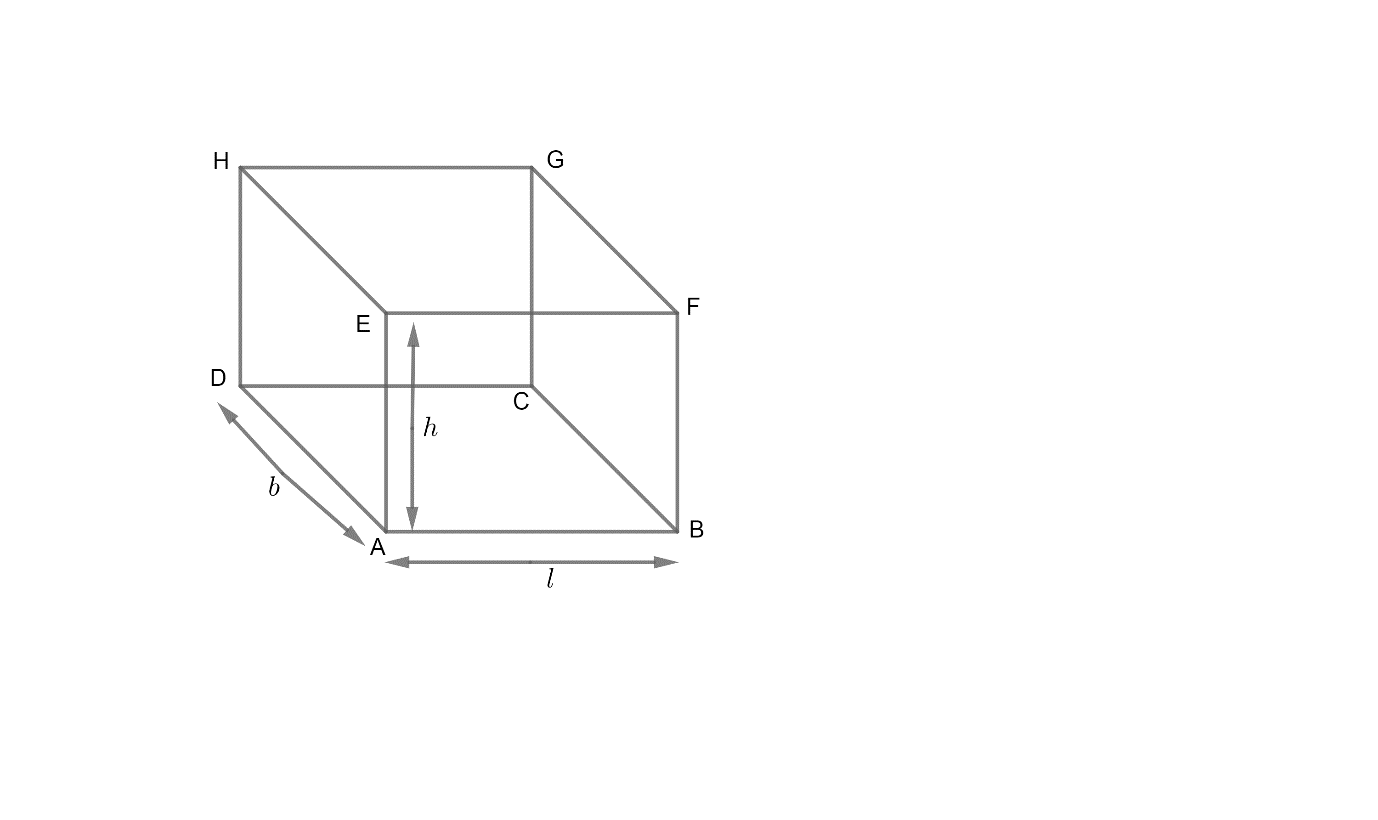
Suppose ABFE, BCGF, CDHG and DAEH are the four walls whose area we need to find.
Given,
$l,b\ and\ h$ are the length, breadth and height of a room.
So,
Length of AB $=l$
Length of AD $=b$
Length of AE $=h$
For the rectangle ABFE,
Length of AB $=l$
Length of AE $=h$
So, Area of rectangle ABFE $=AB\times AE$
$=\left( l\times h \right)$………….(1)
For the rectangle BCGF,
Length of BC = length of AD $=b$
Length of BF = length of AE $=h$
So, Area of rectangular wall BCGF
$\begin{align}
& =BC\times BF \\
& =\left( b\times h \right)...........\left( 2 \right) \\
\end{align}$
For the rectangular wall CDHG,
Length of CD = length of AB $=l$
Length of CG = length of AE $=h$
So, Area of rectangular wall CDHG
$\begin{align}
& =CD\times CG \\
& =lh...........\left( 3 \right) \\
\end{align}$
For the rectangular wall DAEH,
Length of AD $=b$
Length of AE $=h$
So, Area of rectangular wall DAEH
$\begin{align}
& =AD\times AE \\
& =b\times h.........\left( 4 \right) \\
\end{align}$
Now, the total area of four walls = Area of wall ABFE + Area of wall BCGF + Area of wall CDHG +Area of wall DAEH
So, adding equations (1), (2), (3) and (4), we get,
Total Area of four walls $=\left( l\times h+b\times h+l\times h+b\times h \right)$
$\begin{align}
& =\left( lh+bh+lh+bh \right) \\
& =2lh+2bh \\
\end{align}$
Area of four walls $=2lh+2bh$
Taking $2h$ common from both terms, we get,
Area of four walls $=2\left( l+b \right)h$
Hence, option (A) is correct.
Note: You can also do it quickly.
Look around in the room you are sitting to understand better. Observe that all four walls whose area we have to find have the $h$ (height of the room) as one side and other side will be length $\left( l \right)$ for two and breadth $\left( b \right)$ for the other two walls.
Also, observe the opposite walls being of the same size and shape and hence, have the same area too.
So,
Area of four walls $=2\left( lh \right)+2\left( bh \right)$
$=2\left( l+b \right)h$
(Taking $2h$ common from both terms).
If we look around and observe the walls of a room, we find that generally the walls are in the shape of a rectangle. The floor and the ceiling of the room are also of rectangular shape. We have a formula for finding the area of a rectangle.
Area of rectangle $=length\ \times \ breadth$
Apply this formula for the four walls separately and then add them to get the area of four walls.
Complete step-by-step solution -
Suppose ABFE, BCGF, CDHG and DAEH are the four walls whose area we need to find.
Given,
$l,b\ and\ h$ are the length, breadth and height of a room.
So,
Length of AB $=l$
Length of AD $=b$
Length of AE $=h$
For the rectangle ABFE,
Length of AB $=l$
Length of AE $=h$
So, Area of rectangle ABFE $=AB\times AE$
$=\left( l\times h \right)$………….(1)
For the rectangle BCGF,
Length of BC = length of AD $=b$
Length of BF = length of AE $=h$
So, Area of rectangular wall BCGF
$\begin{align}
& =BC\times BF \\
& =\left( b\times h \right)...........\left( 2 \right) \\
\end{align}$
For the rectangular wall CDHG,
Length of CD = length of AB $=l$
Length of CG = length of AE $=h$
So, Area of rectangular wall CDHG
$\begin{align}
& =CD\times CG \\
& =lh...........\left( 3 \right) \\
\end{align}$
For the rectangular wall DAEH,
Length of AD $=b$
Length of AE $=h$
So, Area of rectangular wall DAEH
$\begin{align}
& =AD\times AE \\
& =b\times h.........\left( 4 \right) \\
\end{align}$
Now, the total area of four walls = Area of wall ABFE + Area of wall BCGF + Area of wall CDHG +Area of wall DAEH
So, adding equations (1), (2), (3) and (4), we get,
Total Area of four walls $=\left( l\times h+b\times h+l\times h+b\times h \right)$
$\begin{align}
& =\left( lh+bh+lh+bh \right) \\
& =2lh+2bh \\
\end{align}$
Area of four walls $=2lh+2bh$
Taking $2h$ common from both terms, we get,
Area of four walls $=2\left( l+b \right)h$
Hence, option (A) is correct.
Note: You can also do it quickly.
Look around in the room you are sitting to understand better. Observe that all four walls whose area we have to find have the $h$ (height of the room) as one side and other side will be length $\left( l \right)$ for two and breadth $\left( b \right)$ for the other two walls.
Also, observe the opposite walls being of the same size and shape and hence, have the same area too.
So,
Area of four walls $=2\left( lh \right)+2\left( bh \right)$
$=2\left( l+b \right)h$
(Taking $2h$ common from both terms).
Recently Updated Pages
Master Class 11 English: Engaging Questions & Answers for Success

Master Class 11 Social Science: Engaging Questions & Answers for Success
Master Class 11 Maths: Engaging Questions & Answers for Success
Master Class 11 Chemistry: Engaging Questions & Answers for Success
Master Class 11 Biology: Engaging Questions & Answers for Success
Master Class 11 Physics: Engaging Questions & Answers for Success
Trending doubts
Why is it 530 pm in india when it is 1200 afternoon class 10 social science CBSE
What is the full form of CNG A Complete Natural Gas class 10 social science CBSE
In cricket, what is a "Yorker" designed to do?
Choose the feminine form of the given noun Fox AFoxess class 10 english CBSE
What were the majoritarian measures taken in Sri Lanka class 10 social science CBSE
Fill the blanks with proper collective nouns 1 A of class 10 english CBSE