




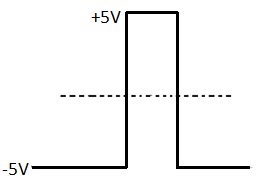
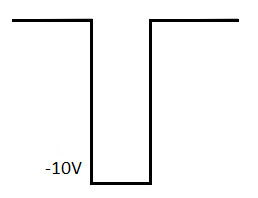
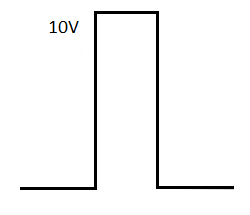
If in a p-n junction, a square input signal of $10V$ is applied, as shown, then the output across ${R_L}$ will be
(A)
(B)
(C)
(D)
Answer
 Verified
548.7k+ views
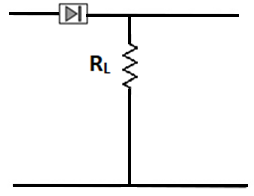
Hint: The arrowhead in the figure denotes that the diode is forward biased. Thus, voltage is positive and ${R_L}$ is also positive.
Complete Step by Step Solution:A p-n junction diode is two-terminal or two-electrode semiconductor device, which allows the electric current in only one direction while blocks the electric current in opposite or reverse direction. If the diode is forward biased, it allows the electric current flow. On the other hand, if the diode is reverse biased, it blocks the electric current flow. P-N junction semiconductor diode is also called as p-n junction semiconductor device.
It is a one way device. It offers a low resistance when forward biased and high resistance when reverse biased.
The arrowhead of a diode indicates the conventional direction of electric current when the diode is forward biased (from positive terminal to the negative terminal). The holes which move from the positive terminal (anode) to the negative terminal (cathode) is the conventional direction of current.
From the figure shown, it is evident from the arrowhead that the diode is forward biased.
For ${V_i} > 0$, the diode is forward biased and circuit would be as shown in fig. and ${V_0} = {V_i}$
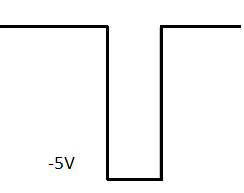
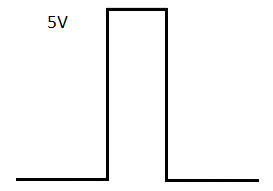
When the voltage is −5 V, the diode is reverse biased and the voltage across the resistor will be zero as current will be zero, and when voltage is 5 V, the diode is forward biased, the voltage across will be the same as input voltage.
Diode is forward bias for positive voltage i.e., $V > 0$, so output across ${R_L}$ is given by-
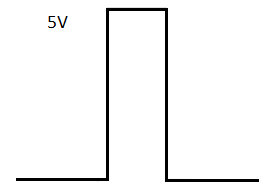
Hence, correct answer is option B.
Note: The free electrons moving from negative terminal (cathode) to the positive terminal (anode) actually carry the electric current. However, due to the convention we have to assume that the current direction is from positive terminal to the negative terminal.
Complete Step by Step Solution:A p-n junction diode is two-terminal or two-electrode semiconductor device, which allows the electric current in only one direction while blocks the electric current in opposite or reverse direction. If the diode is forward biased, it allows the electric current flow. On the other hand, if the diode is reverse biased, it blocks the electric current flow. P-N junction semiconductor diode is also called as p-n junction semiconductor device.
It is a one way device. It offers a low resistance when forward biased and high resistance when reverse biased.
The arrowhead of a diode indicates the conventional direction of electric current when the diode is forward biased (from positive terminal to the negative terminal). The holes which move from the positive terminal (anode) to the negative terminal (cathode) is the conventional direction of current.
From the figure shown, it is evident from the arrowhead that the diode is forward biased.
For ${V_i} > 0$, the diode is forward biased and circuit would be as shown in fig. and ${V_0} = {V_i}$
When the voltage is −5 V, the diode is reverse biased and the voltage across the resistor will be zero as current will be zero, and when voltage is 5 V, the diode is forward biased, the voltage across will be the same as input voltage.
Diode is forward bias for positive voltage i.e., $V > 0$, so output across ${R_L}$ is given by-
Hence, correct answer is option B.
Note: The free electrons moving from negative terminal (cathode) to the positive terminal (anode) actually carry the electric current. However, due to the convention we have to assume that the current direction is from positive terminal to the negative terminal.
Recently Updated Pages
Master Class 12 Economics: Engaging Questions & Answers for Success

Master Class 12 Physics: Engaging Questions & Answers for Success
Master Class 12 English: Engaging Questions & Answers for Success
Master Class 12 Social Science: Engaging Questions & Answers for Success
Master Class 12 Maths: Engaging Questions & Answers for Success
Master Class 12 Business Studies: Engaging Questions & Answers for Success
Trending doubts
Which are the Top 10 Largest Countries of the World?
What are the major means of transport Explain each class 12 social science CBSE
Draw a labelled sketch of the human eye class 12 physics CBSE
What is a transformer Explain the principle construction class 12 physics CBSE
Why cannot DNA pass through cell membranes class 12 biology CBSE
Differentiate between insitu conservation and exsitu class 12 biology CBSE