




If a transversal intersects two lines such that the bisectors of a pair of corresponding angles are parallel, then prove that the two lines are parallel.
Answer
 Verified
531.6k+ views
Hint: First of all draw the diagram of information given in the question to visualize the same. Now use the corresponding angle theorem to prove the corresponding angles of two bisectors equal. Now use the converse of the corresponding angle theorem to prove two lines parallel.
Complete step-by-step answer:
Here we have to prove that if a transversal intersects two lines such that the bisectors of a pair of corresponding angles are parallel, then prove that the two lines are parallel. Let us represent this situation diagrammatically.
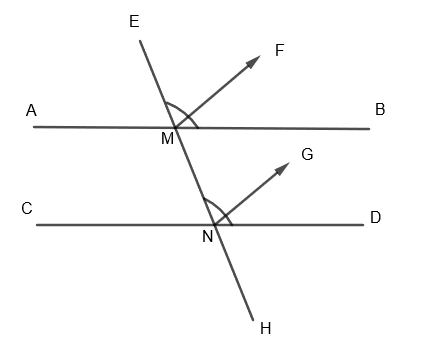
In the above diagram, the transversal EH intersects the two lines AB and CD at points M and N respectively. MF is the bisector of \[\angle EMB\] and NG is the bisector of \[\angle MND\]. We are given that MF and NG are parallel to each other. We have to prove that lines AB and CD are parallel. Here, as MF is the bisector of \[\angle EMB\], so we get,
\[\angle EMF=\dfrac{1}{2}\angle EMB.....\left( i \right)\]
Also, NG is the bisector of \[\angle MND\], so we get,
\[\angle MNG=\dfrac{1}{2}\angle MND.....\left( ii \right)\]
Now by corresponding angle theorem, we know that, if two parallel lines are cut by a transversal, then the pairs of corresponding angles are congruent. So here, since MF and NG are parallel and EH is the transversal, therefore, by corresponding angle theorem, we get,
\[\angle EMF=\angle MNG\]
By substituting the values of \[\angle EMF\] and \[\angle MNG\] from equation (i) and (ii), we get,
\[\angle EMB=\angle MND\]
Now by converse corresponding angle theorem, we know that, if two lines and a transversal form congruent corresponding angles, then the lines are parallel. So here, since corresponding angles \[\angle EMB\] and \[\angle MND\] are equal, So we get,
\[AB||CD\]
Hence we have proved that lines AB and CD are parallel to each other.
Note: Students are advised to remember the corresponding theorem and its converse as it is very useful in questions of geometry. Many students make a mistake while identifying the transversal of two lines and corresponding angles. So they must note that transversal is the line cutting two parallel lines and corresponding angles are angle between lines and transversal on the same side of it.
Complete step-by-step answer:
Here we have to prove that if a transversal intersects two lines such that the bisectors of a pair of corresponding angles are parallel, then prove that the two lines are parallel. Let us represent this situation diagrammatically.
In the above diagram, the transversal EH intersects the two lines AB and CD at points M and N respectively. MF is the bisector of \[\angle EMB\] and NG is the bisector of \[\angle MND\]. We are given that MF and NG are parallel to each other. We have to prove that lines AB and CD are parallel. Here, as MF is the bisector of \[\angle EMB\], so we get,
\[\angle EMF=\dfrac{1}{2}\angle EMB.....\left( i \right)\]
Also, NG is the bisector of \[\angle MND\], so we get,
\[\angle MNG=\dfrac{1}{2}\angle MND.....\left( ii \right)\]
Now by corresponding angle theorem, we know that, if two parallel lines are cut by a transversal, then the pairs of corresponding angles are congruent. So here, since MF and NG are parallel and EH is the transversal, therefore, by corresponding angle theorem, we get,
\[\angle EMF=\angle MNG\]
By substituting the values of \[\angle EMF\] and \[\angle MNG\] from equation (i) and (ii), we get,
\[\angle EMB=\angle MND\]
Now by converse corresponding angle theorem, we know that, if two lines and a transversal form congruent corresponding angles, then the lines are parallel. So here, since corresponding angles \[\angle EMB\] and \[\angle MND\] are equal, So we get,
\[AB||CD\]
Hence we have proved that lines AB and CD are parallel to each other.
Note: Students are advised to remember the corresponding theorem and its converse as it is very useful in questions of geometry. Many students make a mistake while identifying the transversal of two lines and corresponding angles. So they must note that transversal is the line cutting two parallel lines and corresponding angles are angle between lines and transversal on the same side of it.
Recently Updated Pages
Basicity of sulphurous acid and sulphuric acid are

Master Class 11 Business Studies: Engaging Questions & Answers for Success
Master Class 11 Computer Science: Engaging Questions & Answers for Success
Master Class 11 Economics: Engaging Questions & Answers for Success
Master Class 12 English: Engaging Questions & Answers for Success
Master Class 12 Social Science: Engaging Questions & Answers for Success
Trending doubts
Fill the blanks with the suitable prepositions 1 The class 9 english CBSE
Difference Between Plant Cell and Animal Cell
What is the color of ferrous sulphate crystals? How does this color change after heating? Name the products formed on strongly heating ferrous sulphate crystals. What type of chemical reaction occurs in this type of change.
What is the Full Form of ICSE / ISC ?
What is pollution? How many types of pollution? Define it
Explain the importance of pH in everyday life class 9 chemistry CBSE
Fill the blanks with the suitable prepositions 1 The class 9 english CBSE
Difference Between Plant Cell and Animal Cell
What is the color of ferrous sulphate crystals? How does this color change after heating? Name the products formed on strongly heating ferrous sulphate crystals. What type of chemical reaction occurs in this type of change.