




If a tower is 30m high, casts a shadow of $10\sqrt{3}m$ long on the ground, then finds the value of angle of elevation of sun?
Answer
 Verified
631.2k+ views
Hint: The tower, the shadow and the line joining the top of the tower to the end of the shadow constructs a right angled triangle. We know the length of the base and the height of the triangle then using $\tan \theta $, we can find the angle of elevation of the sun.
Complete step-by-step answer:
It is given that the height of the tower is 30m and the length of the shadow is $10\sqrt{3}m$.
The below diagram is showing the height of the tower (AB), the shadow of the tower (BC) and angle of inclination of the sun is given by $\theta $.
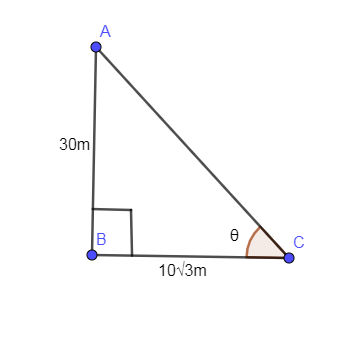
In the above right angled triangle, right angled at B,
$\tan \theta =\dfrac{P}{B}$
In the above formula, “P” stands for perpendicular corresponding to angle $\theta $ and “B” stands for the base corresponding to angle $\theta $ so using this formula in the above triangle.
In the above triangle, $P=30m;B=10\sqrt{3}m$so substituting these values in the above equation we get,
$\begin{align}
& \tan \theta =\dfrac{30}{10\sqrt{3}} \\
& \Rightarrow \tan \theta =\dfrac{3}{\sqrt{3}}=\sqrt{3} \\
\end{align}$
We know that, $\tan \theta =\sqrt{3}$ when $\theta ={{60}^{0}}$ so the above equation is reduced to:
$\theta ={{60}^{0}}$
From the above solution, we have found the angle of elevation of the sun is ${{60}^{0}}$.
Note: The point to be noted here is that the shadow lies on the floor so the shadow in the diagram is BC not AC. You might get confused that the shadow is AC but it is BC and the angle of elevation of the sun is $\angle ACB$ not $\angle BAC$.
Complete step-by-step answer:
It is given that the height of the tower is 30m and the length of the shadow is $10\sqrt{3}m$.
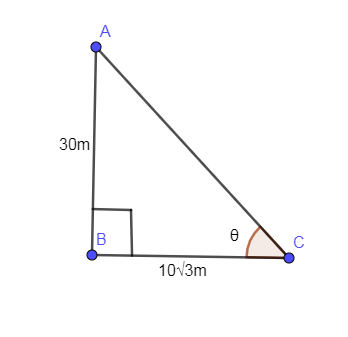
The below diagram is showing the height of the tower (AB), the shadow of the tower (BC) and angle of inclination of the sun is given by $\theta $.
In the above right angled triangle, right angled at B,
$\tan \theta =\dfrac{P}{B}$
In the above formula, “P” stands for perpendicular corresponding to angle $\theta $ and “B” stands for the base corresponding to angle $\theta $ so using this formula in the above triangle.
In the above triangle, $P=30m;B=10\sqrt{3}m$so substituting these values in the above equation we get,
$\begin{align}
& \tan \theta =\dfrac{30}{10\sqrt{3}} \\
& \Rightarrow \tan \theta =\dfrac{3}{\sqrt{3}}=\sqrt{3} \\
\end{align}$
We know that, $\tan \theta =\sqrt{3}$ when $\theta ={{60}^{0}}$ so the above equation is reduced to:
$\theta ={{60}^{0}}$
From the above solution, we have found the angle of elevation of the sun is ${{60}^{0}}$.
Note: The point to be noted here is that the shadow lies on the floor so the shadow in the diagram is BC not AC. You might get confused that the shadow is AC but it is BC and the angle of elevation of the sun is $\angle ACB$ not $\angle BAC$.
Recently Updated Pages
Master Class 11 Social Science: Engaging Questions & Answers for Success

Master Class 11 English: Engaging Questions & Answers for Success
Master Class 11 Maths: Engaging Questions & Answers for Success
Master Class 11 Chemistry: Engaging Questions & Answers for Success
Master Class 11 Biology: Engaging Questions & Answers for Success
Master Class 11 Physics: Engaging Questions & Answers for Success
Trending doubts
One Metric ton is equal to kg A 10000 B 1000 C 100 class 11 physics CBSE
Difference Between Prokaryotic Cells and Eukaryotic Cells
How many of the following diseases can be studied with class 11 biology CBSE
Which of the following enzymes is used for carboxylation class 11 biology CBSE
Draw a diagram of a plant cell and label at least eight class 11 biology CBSE
Two of the body parts which do not appear in MRI are class 11 biology CBSE