




If A, B and C are mutually exclusive and exhaustive events of a random experiment such that \[P\left( B \right)=\dfrac{3}{2}P\left( A \right)\ and\ P\left( C \right)=\dfrac{1}{2}P\left( B \right)\], then \[P\left( A\cup C \right)=\]
A. $\dfrac{3}{13}$
B. $\dfrac{6}{13}$
C. $\dfrac{7}{13}$
D. $\dfrac{10}{13}$
Answer
 Verified
633.3k+ views
Hint: We will first start by using the fact that mutually exclusive and exhaustive events means that if A and B are two such events then $P\left( A \right)+P\left( B \right)=1\ and\ P\left( A\cap B \right)=\phi $. Also, we will use the data given in question to find the value of each event by forming an equation with the help of fact that events are mutually exclusive and exhaustive.
Complete step-by-step answer:
Now, before starting the solution we have to first understand that mutually exclusive and exhaustive events mean that if there are three events A, B and then at least one of them must occur and probability of occurring more than one event is \[\phi \],we can also describe it as that their union must cover all the events within the entire sample space i.e. $A\cup B\cup C=S\ \text{and }P\left( A\cap B \right)=\phi , P\left( B\cap C \right)=\phi ,P\left( C\cap A \right)=\phi $
Now, we have been given three mutually exclusive and exhaustive events A, B, C.
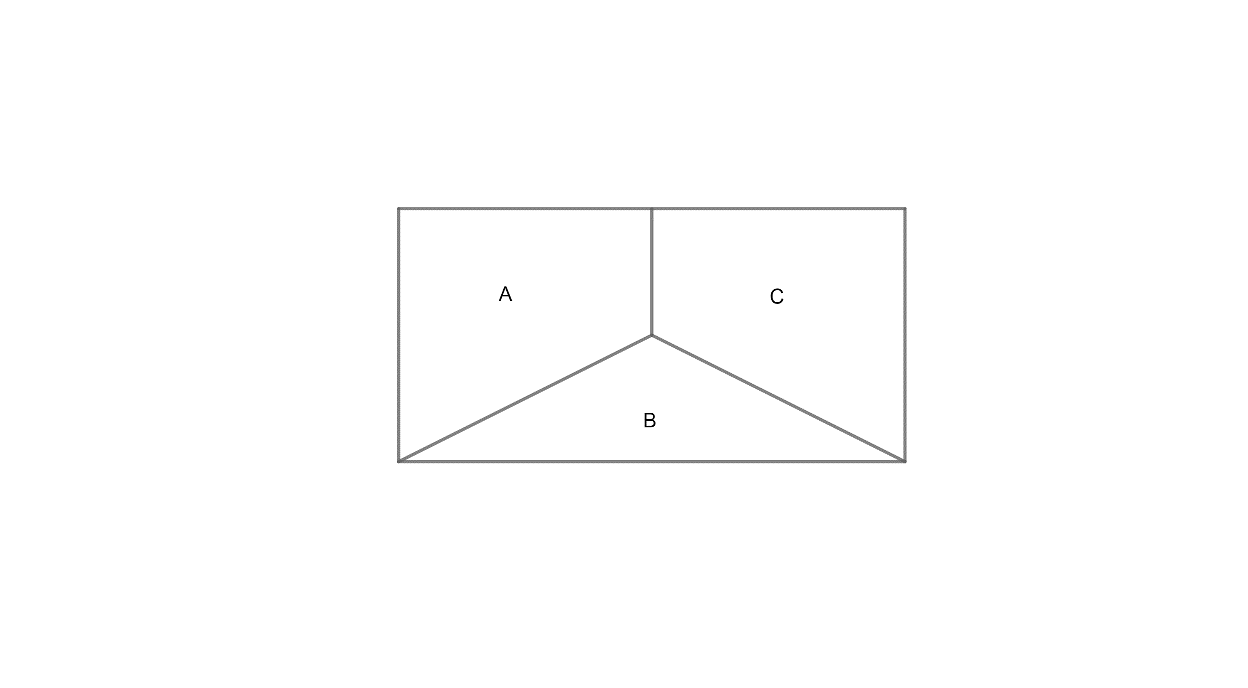
Now, we have given that,
$\begin{align}
& P\left( B \right)=\dfrac{3}{2}P\left( A \right)............\left( 1 \right) \\
& P\left( C \right)=\dfrac{1}{2}P\left( B \right)............\left( 2 \right) \\
\end{align}$
Now, substituting P(B) from (1) in (2) we have;
$\begin{align}
& P\left( C \right)=\dfrac{1}{2}\left( \dfrac{3}{2}P(A) \right) \\
& P\left( C \right)=\dfrac{3}{4}P\left( A \right)............\left( 3 \right) \\
\end{align}$
Now, we know that if A, B, C are mutually exclusive and exhaustive events then,
$P\left( A \right)+P\left( B \right)+P\left( C \right)=1$
Now, using (2) and (3) we have;
$\begin{align}
& P\left( A \right)+\dfrac{3}{2}P\left( A \right)+\dfrac{3}{4}P\left( A \right)=1 \\
& \dfrac{4P\left( A \right)+6P\left( A \right)+3P\left( A \right)}{4}=1 \\
& 13P\left( A \right)=4 \\
& P\left( A \right)=\dfrac{4}{13}...........\left( 4 \right) \\
\end{align}$
Now, we have to find the value of $P\left( A\cup C \right)$. Since, the events are mutually exclusive and exhaustive therefore,
$P\left( A\cup C \right)=P\left( A \right)+P\left( C \right)$
Now, from (3) and (4) we have,
$\begin{align}
& P\left( A\cup C \right)=\dfrac{4}{13}+\dfrac{3}{4}\times \dfrac{4}{13} \\
& =\dfrac{4}{13}+\dfrac{3}{13} \\
& P\left( A\cup C \right)=\dfrac{7}{13} \\
\end{align}$
Hence, the correct option is C.
Note: It is important to note that we have used secular properties of mutually exclusive and exhaustive events. For example, if A, B, C are such events then,
$\begin{align}
& P\left( A+B+C \right)=1 \\
& P\left( A\cap B \right)=P\left( B\cap C \right)=P\left( B\cap A \right)=\phi \\
\end{align}$
Hence, it is important to remember these to solve the question easily.
Complete step-by-step answer:
Now, before starting the solution we have to first understand that mutually exclusive and exhaustive events mean that if there are three events A, B and then at least one of them must occur and probability of occurring more than one event is \[\phi \],we can also describe it as that their union must cover all the events within the entire sample space i.e. $A\cup B\cup C=S\ \text{and }P\left( A\cap B \right)=\phi , P\left( B\cap C \right)=\phi ,P\left( C\cap A \right)=\phi $
Now, we have been given three mutually exclusive and exhaustive events A, B, C.
Now, we have given that,
$\begin{align}
& P\left( B \right)=\dfrac{3}{2}P\left( A \right)............\left( 1 \right) \\
& P\left( C \right)=\dfrac{1}{2}P\left( B \right)............\left( 2 \right) \\
\end{align}$
Now, substituting P(B) from (1) in (2) we have;
$\begin{align}
& P\left( C \right)=\dfrac{1}{2}\left( \dfrac{3}{2}P(A) \right) \\
& P\left( C \right)=\dfrac{3}{4}P\left( A \right)............\left( 3 \right) \\
\end{align}$
Now, we know that if A, B, C are mutually exclusive and exhaustive events then,
$P\left( A \right)+P\left( B \right)+P\left( C \right)=1$
Now, using (2) and (3) we have;
$\begin{align}
& P\left( A \right)+\dfrac{3}{2}P\left( A \right)+\dfrac{3}{4}P\left( A \right)=1 \\
& \dfrac{4P\left( A \right)+6P\left( A \right)+3P\left( A \right)}{4}=1 \\
& 13P\left( A \right)=4 \\
& P\left( A \right)=\dfrac{4}{13}...........\left( 4 \right) \\
\end{align}$
Now, we have to find the value of $P\left( A\cup C \right)$. Since, the events are mutually exclusive and exhaustive therefore,
$P\left( A\cup C \right)=P\left( A \right)+P\left( C \right)$
Now, from (3) and (4) we have,
$\begin{align}
& P\left( A\cup C \right)=\dfrac{4}{13}+\dfrac{3}{4}\times \dfrac{4}{13} \\
& =\dfrac{4}{13}+\dfrac{3}{13} \\
& P\left( A\cup C \right)=\dfrac{7}{13} \\
\end{align}$
Hence, the correct option is C.
Note: It is important to note that we have used secular properties of mutually exclusive and exhaustive events. For example, if A, B, C are such events then,
$\begin{align}
& P\left( A+B+C \right)=1 \\
& P\left( A\cap B \right)=P\left( B\cap C \right)=P\left( B\cap A \right)=\phi \\
\end{align}$
Hence, it is important to remember these to solve the question easily.
Recently Updated Pages
Master Class 12 Business Studies: Engaging Questions & Answers for Success

Master Class 12 Biology: Engaging Questions & Answers for Success
Master Class 12 Chemistry: Engaging Questions & Answers for Success
Class 12 Question and Answer - Your Ultimate Solutions Guide
Master Class 11 Social Science: Engaging Questions & Answers for Success
Master Class 11 English: Engaging Questions & Answers for Success
Trending doubts
Differentiate between insitu conservation and exsitu class 12 biology CBSE
Name the part of the flower which the tassels of the class 12 biology CBSE
Write the difference between chasmogamous and cleistogamous class 12 biology CBSE
What is the structural formula of Aspirin A B C D class 12 chemistry CBSE
Why should a magnesium ribbon be cleaned before burning class 12 chemistry CBSE
Quantisation of charge implies a Charge does not exist class 12 physics CBSE