




Identify the diagram A and B.
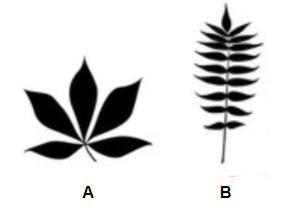
A) A= Palmate compound leaf ,B= Whorled phyllotaxy
B) A=Pinnate compound leaf ,B= Whorled phyllotaxy
C) A= Whorled phyllotaxy, B= Palmately compound leaf
D) None of these
Answer
 Verified
633.9k+ views
Hint: Leaves are classified into different categories based on how their lamina is divided. Lamina is also termed as the blade of the leaf.
Complete answer:
Let us first analyze the structure of the leaves given in the figure to identify them
Figure A: The leaflets of this leaf are radiating outwards from the point where the petiole of the leaf ends. Also, all the leaflets are originating from a single common point. The leaflets are clustered together forming a palm like structure and a joint is found between the leaflet and the point of its attachment. These characteristic features resemble that of a palmate compound leaf.
Figure B: In this figure more than two or three leaves are present at a single node.It shows whorled phyllotaxy leaf arrangement. These kinds of leaves are found in Alstonia plants. Other examples of whorled phyllotaxy include aspergula and nerium.
Option A: This option matches the above description and identification of the leaf in the figures. Therefore, this is the correct option.
Option B and C: These options do not match the above identification of figure A and B. Therefore, this is the incorrect option.
Option D: Since one of the above mentioned options is correct.Therefore, this is the incorrect option.
Thus, the correct answer is option (A) A= Palmate compound leaf, B= Whorled phyllotaxy.
Note:Pinnate compound leaves occur in two rows and no joint is found in them unlike palmate compound leaves. In alternate phyllotaxy, a single leaf is present at each node.
Complete answer:
Let us first analyze the structure of the leaves given in the figure to identify them
Figure A: The leaflets of this leaf are radiating outwards from the point where the petiole of the leaf ends. Also, all the leaflets are originating from a single common point. The leaflets are clustered together forming a palm like structure and a joint is found between the leaflet and the point of its attachment. These characteristic features resemble that of a palmate compound leaf.
Figure B: In this figure more than two or three leaves are present at a single node.It shows whorled phyllotaxy leaf arrangement. These kinds of leaves are found in Alstonia plants. Other examples of whorled phyllotaxy include aspergula and nerium.
Option A: This option matches the above description and identification of the leaf in the figures. Therefore, this is the correct option.
Option B and C: These options do not match the above identification of figure A and B. Therefore, this is the incorrect option.
Option D: Since one of the above mentioned options is correct.Therefore, this is the incorrect option.
Thus, the correct answer is option (A) A= Palmate compound leaf, B= Whorled phyllotaxy.
Note:Pinnate compound leaves occur in two rows and no joint is found in them unlike palmate compound leaves. In alternate phyllotaxy, a single leaf is present at each node.
Recently Updated Pages
If x a + bt + ct2 where x is in meters and t is in class 11 physics CBSE

A car covers the first half distance between two places class 11 physics CBSE
The resultant of two vectors overrightarrow P and overrightarrow class 11 physics CBSE
Find the value of cos 135 class 11 maths CBSE
A mass M is held in place by an applied force F and class 11 physics CBSE
A solution of glucose in water is labelled as 10 dfracwv class 11 chemistry CBSE
Trending doubts
Find the value of the expression given below sin 30circ class 11 maths CBSE
One Metric ton is equal to kg A 10000 B 1000 C 100 class 11 physics CBSE
Draw a diagram of nephron and explain its structur class 11 biology CBSE
10 examples of friction in our daily life
Proton was discovered by A Thomson B Rutherford C Chadwick class 11 chemistry CBSE
Bond order ofO2 O2+ O2 and O22 is in order A O2 langle class 11 chemistry CBSE