



Identify I, Il, and III in the given flow chart and select the correct option.
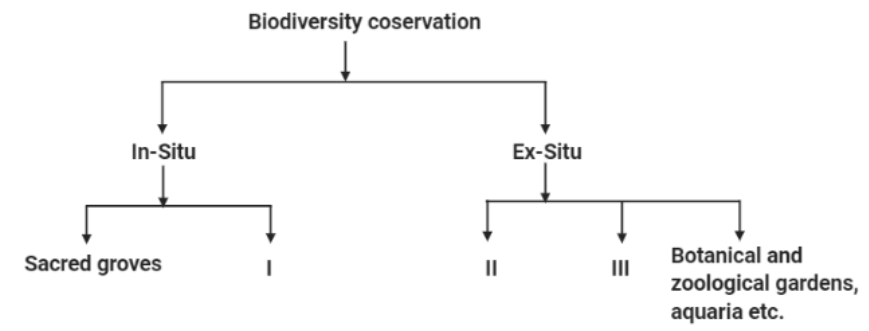
A. I-Biosphere reserve, II-Gene Bank, III- cryopreservation
B. I-Gene Bank, Il-Wildlife sanctuary III-Home gardens
C. I-Biosphere reserve, II-National park, III-Wildlife sanctuary
D. I-cryopreservation, Il-Biosphere reserve, Ill- National park
Answer
 Verified
644.4k+ views
Hint: In-situ approach includes the protection of a group of typical ecosystems through a network of protected areas, which are areas of land and /or sea, specially dedicated to the protection and maintenance of biological diversity. In ex-situ, there is conservation outside their habitats by perpetuating sample populations at different places.
Complete answer:
• Biosphere reserve: These are a special category of protected areas of land and /or coastal environments. Each biosphere reserve has a Natural or core zone (where no human activity is allowed), a buffer zone (where limited human activity), and a transition zone (where human activity is allowed without degradation of ecology).
• Gene bank: DNA of endangered species is conserved in museums, zoos, or herbaria. Their collection of living materials in the form of zoo animals, botanical collections, and seeds, together with DNA collections have been termed gene banks.
• Cryopreservation: It is a method of storage of material at a very low temperature (especially in liquid nitrogen at -196C).
• Botanical garden: Conservation of biodiversity in botanical gardens. There are more than 1500 botanical gardens in the world.
• Sacred forests and sacred Lakes: These are protected by tribal communities due to religious sanctity according to them.
Hence, the correct answer is option (A).
Note: Ex-situ includes gene bank, cryopreservation, and botanical garden, zoo. Whereas In-situ includes sacred grooves, biosphere reserve, national parks.
There are 13 biosphere reserves in India and tourism here is normally not permissible.
In gene banks, they provide the potential to breed the species in captivity and to release it when the conditions are more favourable.
Complete answer:
• Biosphere reserve: These are a special category of protected areas of land and /or coastal environments. Each biosphere reserve has a Natural or core zone (where no human activity is allowed), a buffer zone (where limited human activity), and a transition zone (where human activity is allowed without degradation of ecology).
• Gene bank: DNA of endangered species is conserved in museums, zoos, or herbaria. Their collection of living materials in the form of zoo animals, botanical collections, and seeds, together with DNA collections have been termed gene banks.
• Cryopreservation: It is a method of storage of material at a very low temperature (especially in liquid nitrogen at -196C).
• Botanical garden: Conservation of biodiversity in botanical gardens. There are more than 1500 botanical gardens in the world.
• Sacred forests and sacred Lakes: These are protected by tribal communities due to religious sanctity according to them.
Hence, the correct answer is option (A).
Note: Ex-situ includes gene bank, cryopreservation, and botanical garden, zoo. Whereas In-situ includes sacred grooves, biosphere reserve, national parks.
There are 13 biosphere reserves in India and tourism here is normally not permissible.
In gene banks, they provide the potential to breed the species in captivity and to release it when the conditions are more favourable.
Recently Updated Pages
Master Class 10 Computer Science: Engaging Questions & Answers for Success

Master Class 12 Physics: Engaging Questions & Answers for Success
Master Class 12 Social Science: Engaging Questions & Answers for Success
Master Class 12 English: Engaging Questions & Answers for Success
Master Class 12 Maths: Engaging Questions & Answers for Success
Master Class 12 Business Studies: Engaging Questions & Answers for Success
Trending doubts
What is BLO What is the full form of BLO class 8 social science CBSE
Citizens of India can vote at the age of A 18 years class 8 social science CBSE
Full form of STD, ISD and PCO
What are the methods of reducing friction. Explain
Which qualities do you like in Subhash Chandra Bose class 8 social science CBSE
What is called the brain of a Computer?