




HIV decreases natural immunity of the body by destroying
(A) Erythrocytes
(B) Antibodies
(C) T-lymphocytes
(D) B-lymphocytes
Answer
 Verified
574.5k+ views
Hint: HIV belongs to a group of viruses called retroviruses. Human Immunodeficiency Virus (HIV) has an envelope and RNA genome. After entering the human body, HIV starts attacking different types of WBC. There are varying kinds of WBCs which help in providing immunity (antibody mediated and cell mediated).
Complete answer:
Human Immunodeficiency Virus (HIV) causes AIDS (Acquired ImmunoDeficiency Syndrome). The term AIDS refers to deficiency of the immune system and it is clearly not a congenital disease. AIDS is a sexually transmitted disease. Transmission of HIV infection generally occurs through,
(i) Sexual contact with infected individual,
(ii) Transfusion of contaminated blood,
(iii) Sharing of infected needles, and
(iv) Infected mother to the child through placenta.
After getting access into the human body, the HIV enters into macrophages where the genetic material RNA undergoes reverse transcription to form viral DNA with the help of reverse transcriptase enzyme. The macrophages act as HIV factories because they produce a lot of viral particles. Simultaneously, HIV enters T-lymphocytes as well.
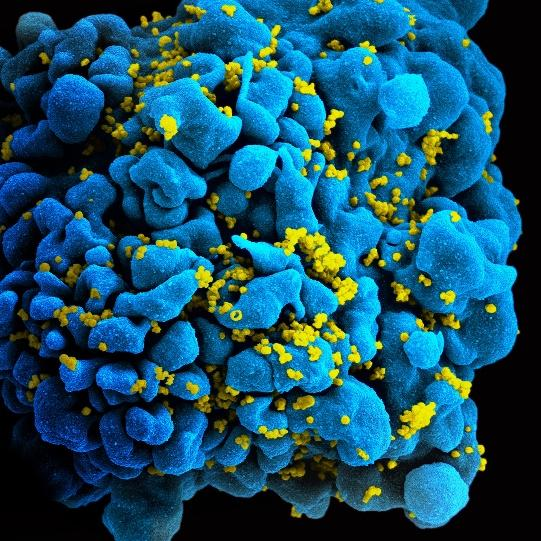
T-lymphocytes are a type of lymphocytes which help in cell mediated immunity. There are two types of T-lymphocytes, namely TH (Helper T-lymphocytes) and TC (Cytotoxic T-lymphocytes). HIV specifically enters Helper T-lymphocytes, replicates and gives rise to progeny viruses. The cycle of attacking Helper T-lymphocytes repeats continuously which leads to the decrease in the number of T-lymphocytes. Since, there is a decrease in the number of TH cells, the natural immunity of the infected person is compromised, leading to various infections that could have been overcome under natural healthy circumstances.
Hence the correct answer is option(C)
Note: HIV first enters into macrophages and replicates within it. That’s why macrophages are considered as HIV factories. The natural immunity of the infected person will decrease only when adequate T-lymphocytes are destroyed. Remember, macrophages are called an HIV factory, but they are not the reason for the decrease in immunity.
Complete answer:
Human Immunodeficiency Virus (HIV) causes AIDS (Acquired ImmunoDeficiency Syndrome). The term AIDS refers to deficiency of the immune system and it is clearly not a congenital disease. AIDS is a sexually transmitted disease. Transmission of HIV infection generally occurs through,
(i) Sexual contact with infected individual,
(ii) Transfusion of contaminated blood,
(iii) Sharing of infected needles, and
(iv) Infected mother to the child through placenta.
After getting access into the human body, the HIV enters into macrophages where the genetic material RNA undergoes reverse transcription to form viral DNA with the help of reverse transcriptase enzyme. The macrophages act as HIV factories because they produce a lot of viral particles. Simultaneously, HIV enters T-lymphocytes as well.
T-lymphocytes are a type of lymphocytes which help in cell mediated immunity. There are two types of T-lymphocytes, namely TH (Helper T-lymphocytes) and TC (Cytotoxic T-lymphocytes). HIV specifically enters Helper T-lymphocytes, replicates and gives rise to progeny viruses. The cycle of attacking Helper T-lymphocytes repeats continuously which leads to the decrease in the number of T-lymphocytes. Since, there is a decrease in the number of TH cells, the natural immunity of the infected person is compromised, leading to various infections that could have been overcome under natural healthy circumstances.
Hence the correct answer is option(C)
Note: HIV first enters into macrophages and replicates within it. That’s why macrophages are considered as HIV factories. The natural immunity of the infected person will decrease only when adequate T-lymphocytes are destroyed. Remember, macrophages are called an HIV factory, but they are not the reason for the decrease in immunity.
Recently Updated Pages
Master Class 12 Economics: Engaging Questions & Answers for Success

Master Class 12 Physics: Engaging Questions & Answers for Success
Master Class 12 English: Engaging Questions & Answers for Success
Master Class 12 Social Science: Engaging Questions & Answers for Success
Master Class 12 Maths: Engaging Questions & Answers for Success
Master Class 12 Business Studies: Engaging Questions & Answers for Success
Trending doubts
Which are the Top 10 Largest Countries of the World?
What are the major means of transport Explain each class 12 social science CBSE
Draw a labelled sketch of the human eye class 12 physics CBSE
What is a transformer Explain the principle construction class 12 physics CBSE
Why cannot DNA pass through cell membranes class 12 biology CBSE
Differentiate between insitu conservation and exsitu class 12 biology CBSE