




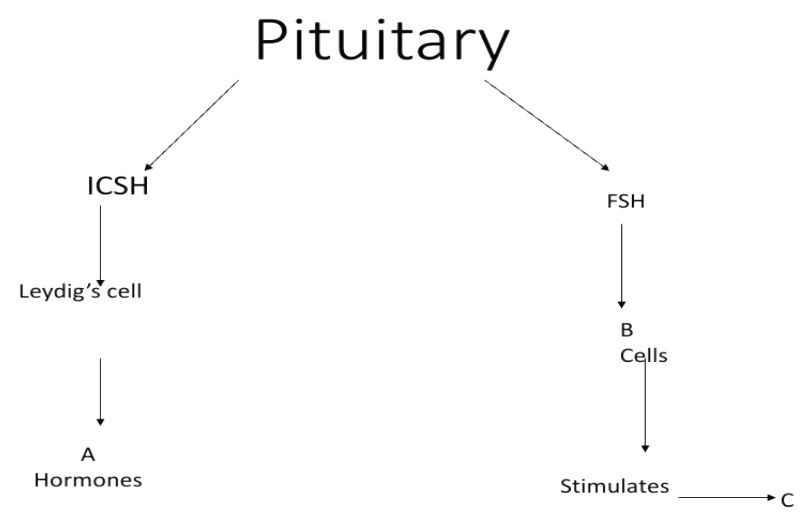
Given above is an incomplete flow chart showing the influence of hormones on gametogenesis in males. Observe the flow chart carefully and identity A, B, and C.
a. A- Progesterone, B- Follicular, C- Spermatogenesis
b. A- GnRH, B- Follicular, C- Spermatogenesis
c. A- GnRH, B- Sertoli, C- Spermatogenesis
d. A- Androgens, B- Sertoli, C-Spermatogenesis
Answer
 Verified
590.7k+ views
Hint: Gametogenesis is a biological process in which cells perform meiotic division and form gametes. Hormones play a significant role in the process of gametogenesis. FSH and LH are the two hormones which influence gametogenesis. Gametogenesis is an important part of reproduction in mammals by which germ cells perform cell division and form matured gametes, the oocytes, and the spermatozoa.
Complete answer:
• A significant increase in the secretion of Gonadotropin-releasing hormone results in spermatogenesis.
• GnRH further stimulates the secretion of FSH(Follicle-stimulating hormone) and LH(Luteinising Hormone).
• Luteinizing hormone acts on Leydig cells and initiates synthesis and secretion of hormone androgens.
• The follicle-stimulating hormone acts on Sertoli cells and then further increases spermatogenesis.
• Progesterone is a female steroid hormone secreted by the ovaries.
Hence, the correct answer is option (D).
Additional information:
• Androgens are present both in males and females, and have a significant role in male traits and reproduction.
• Sertoli cells are the nurse cells that play a role in the process of spermatogenesis.
• The process of development of spermatozoa from germ cells is known as Spermatogenesis.
• FSH and LH are formed by the pituitary gland.
Note: Gametogenesis is the production of gametes i.e eggs and sperms. Formation of gametes occurs in the testis(in males) and ovaries(in females) from the germ cells. Hormones that regulate gametogenesis are called a gonadotropin. FSH regulates gametogenesis by acting on the gamete producing cells. Secretion of steroid sex hormones is stimulated by hormone-producing cells on which LH acts.
Complete answer:
• A significant increase in the secretion of Gonadotropin-releasing hormone results in spermatogenesis.
• GnRH further stimulates the secretion of FSH(Follicle-stimulating hormone) and LH(Luteinising Hormone).
• Luteinizing hormone acts on Leydig cells and initiates synthesis and secretion of hormone androgens.
• The follicle-stimulating hormone acts on Sertoli cells and then further increases spermatogenesis.
• Progesterone is a female steroid hormone secreted by the ovaries.
Hence, the correct answer is option (D).
Additional information:
• Androgens are present both in males and females, and have a significant role in male traits and reproduction.
• Sertoli cells are the nurse cells that play a role in the process of spermatogenesis.
• The process of development of spermatozoa from germ cells is known as Spermatogenesis.
• FSH and LH are formed by the pituitary gland.
Note: Gametogenesis is the production of gametes i.e eggs and sperms. Formation of gametes occurs in the testis(in males) and ovaries(in females) from the germ cells. Hormones that regulate gametogenesis are called a gonadotropin. FSH regulates gametogenesis by acting on the gamete producing cells. Secretion of steroid sex hormones is stimulated by hormone-producing cells on which LH acts.
Recently Updated Pages
Master Class 12 Business Studies: Engaging Questions & Answers for Success

Master Class 12 Biology: Engaging Questions & Answers for Success
Master Class 12 Chemistry: Engaging Questions & Answers for Success
Class 12 Question and Answer - Your Ultimate Solutions Guide
Master Class 11 Social Science: Engaging Questions & Answers for Success
Master Class 11 English: Engaging Questions & Answers for Success
Trending doubts
Which are the Top 10 Largest Countries of the World?
Draw a labelled sketch of the human eye class 12 physics CBSE
Differentiate between homogeneous and heterogeneous class 12 chemistry CBSE
Sulphuric acid is known as the king of acids State class 12 chemistry CBSE
Why is the cell called the structural and functional class 12 biology CBSE
Which is the correct genotypic ratio of mendel dihybrid class 12 biology CBSE