




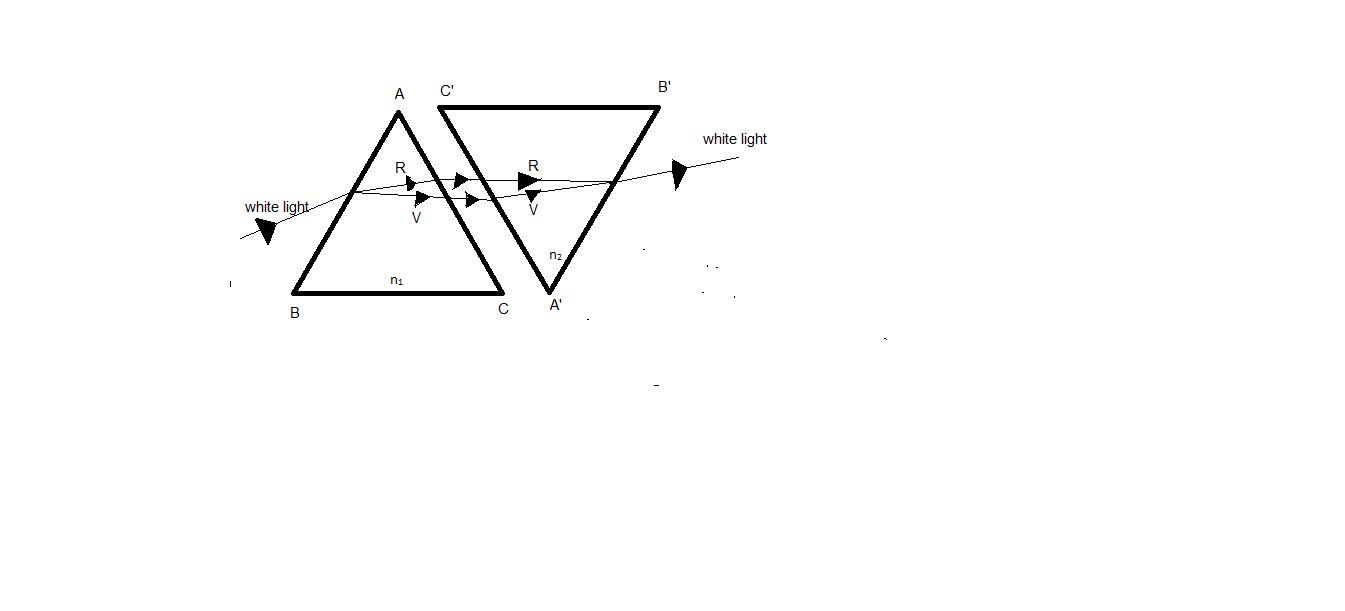
Given a ray diagram shows the recombination of the spectrum of white light by using glass prisms. White light if $ n $ and $ n $ , are their respective indices while $ A $ and $ A' $ are respective angles of prism, then which of the following conditions is correct for the occurrence of recombination of white light?
$ \left( A \right){n_1} = {n_2};\angle A < \angle A' \\
\left( B \right){n_1} = {n_2};\angle A = \angle A' \\
\left( C \right){n_1} > {n_2};\angle A = \angle A' \\
\left( D \right){n_1} = {n_2};\angle A > \angle A' \\ $
Answer
 Verified
553.8k+ views
Hint :In order to solve this question, we are going to first find the condition for the recombination of the two refracted rays, by taking the angle of deviation for the two prisms and also the angles of emergence conditions for the case of recombination of the rays. Then by putting the values for both the prisms, the relation between $ {n_1} $ , $ {n_2} $ , $ \angle A $ and $ \angle A' $ .
The angle of deviation is given by the formula
$ \delta = \left( {\mu - 1} \right)A $
Where $ A $ the angle of prism is, $ \mu $ is the refractive index.
If $ \theta $ is the angle of emergence, then we know that
$ \theta = \left( {{\mu _V} - {\mu _R}} \right)A $
Complete Step By Step Answer:
As we know that the angle of deviation is given by the formula
$ \delta = \left( {\mu - 1} \right)A $
Where $ A $ is the angle of the prism
Now, for the recombination of the lights, the sum of the two angle of deviations must not be equal to zero, i.e.
$ {\delta _1} + {\delta _2} \ne 0 $
If $ \theta $ is the angle of emergence, then we know that
$ \theta = ({\mu_{V}}-{\mu_{R}})A $
Where $ {\mu _V} $ and $ {\mu _R} $ are the refractive indices for the violet and red colours
For there is no dispersion, $ {\theta _1} + {\theta _2} = 0 $
Putting the values for $ {\theta _1} $ and $ {\theta _2} $
$ \left( {{\mu _V} - {\mu _R}} \right)A + \left( {{\mu _V}' - {\mu _R}'} \right)A' = 0 $
Thus, the ratio of the angles of the prism
$ \dfrac{{A'}}{A} = \dfrac{{\left( {{\mu _V} - {\mu _R}} \right)}}{{\left( {{\mu _V}' - {\mu _R}'} \right)}} $
The difference of the refractive indices of colours violet and red is equal to the value $ n $ i.e. refractive index of the prism.
$ \dfrac{{A'}}{A} = \dfrac{{{n_1}}}{{{n_2}}} $
Thus, option $ \left( B \right){n_1} = {n_2};\angle A = \angle A' $ is the correct answer.
Note :
These are two identical prisms in which one is kept upside down, the reverse refraction of the rays from the second prism causes the rays that are refracted to recombine and produce the white light.
The refracting sides of the second prism are parallel to that of the refracting sides of the first prism.
The angle of deviation is given by the formula
$ \delta = \left( {\mu - 1} \right)A $
Where $ A $ the angle of prism is, $ \mu $ is the refractive index.
If $ \theta $ is the angle of emergence, then we know that
$ \theta = \left( {{\mu _V} - {\mu _R}} \right)A $
Complete Step By Step Answer:
As we know that the angle of deviation is given by the formula
$ \delta = \left( {\mu - 1} \right)A $
Where $ A $ is the angle of the prism
Now, for the recombination of the lights, the sum of the two angle of deviations must not be equal to zero, i.e.
$ {\delta _1} + {\delta _2} \ne 0 $
If $ \theta $ is the angle of emergence, then we know that
$ \theta = ({\mu_{V}}-{\mu_{R}})A $
Where $ {\mu _V} $ and $ {\mu _R} $ are the refractive indices for the violet and red colours
For there is no dispersion, $ {\theta _1} + {\theta _2} = 0 $
Putting the values for $ {\theta _1} $ and $ {\theta _2} $
$ \left( {{\mu _V} - {\mu _R}} \right)A + \left( {{\mu _V}' - {\mu _R}'} \right)A' = 0 $
Thus, the ratio of the angles of the prism
$ \dfrac{{A'}}{A} = \dfrac{{\left( {{\mu _V} - {\mu _R}} \right)}}{{\left( {{\mu _V}' - {\mu _R}'} \right)}} $
The difference of the refractive indices of colours violet and red is equal to the value $ n $ i.e. refractive index of the prism.
$ \dfrac{{A'}}{A} = \dfrac{{{n_1}}}{{{n_2}}} $
Thus, option $ \left( B \right){n_1} = {n_2};\angle A = \angle A' $ is the correct answer.
Note :
These are two identical prisms in which one is kept upside down, the reverse refraction of the rays from the second prism causes the rays that are refracted to recombine and produce the white light.
The refracting sides of the second prism are parallel to that of the refracting sides of the first prism.
Recently Updated Pages
How is Abiogenesis Theory Disproved Experimentally?

In a plane electromagnetic wave the electric field class 12 physics CBSE
A plane electromagnetic wave travels in vacuum along class 12 physics CBSE
The branch of science which deals with nature and natural class 10 physics CBSE
Understanding the Sun's Density: Exploring the Mass Density of a Hot Plasma - FAQs and Data Analysis
Where is the Centre for Environmental Education Located?
Trending doubts
Which are the Top 10 Largest Countries of the World?
Draw a labelled sketch of the human eye class 12 physics CBSE
Which state in the country is at the forefront in controlling class 12 social science CBSE
Mention the role of cyanobacteria as a biofertiliz class 12 biology ICSE
Where is the largest hydroelectric power station located class 12 biology CBSE
An example of C4 plant is A Maize B Rice C Wheat D class 12 biology CBSE