




Give the general characteristics of class Reptilia?
Answer
 Verified
663.6k+ views
Hint: The term reptilia is taken from the Latin word Repere which means to crawl. These are generally terrestrial animals but some live in freshwater or in marine water.
Complete answer: Reptiles are believed to evolve from amphibians and were the first organisms to adapt to life on land. There are 10000 different species of reptiles on earth.
1. They are cold-blooded animals and belong to the phylum Chordata of the Animal kingdom.
2. These are burrowing and creeping terrestrial animals with scales on their whole body. They are found in most of the warmer regions of the world with dry and rough skin and no glands.
3. The whole body is divided into head, neck, trunk, and tail. Few reptiles shed the scales on their skin as skin cast and respire through the lungs. The skull is monocondylic.
4. They have two pairs of pentadactyl limbs, each bearing claws, but Snakes are an exception. 5. Their heart is 3 chambered, However, crocodiles have a 4-chambered heart.
6. The nervous system of reptiles comprises 12 pairs of cranial nerves and there is no lateral line system.
7. All the reptiles have well-developed ears except the snakes.
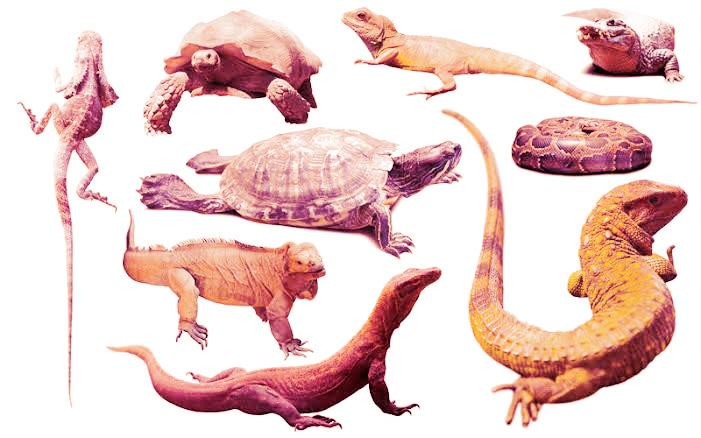
8. Fertilization takes place internally. They exhibit a meroblastic segmentation. They are oviparous animals as they give birth to their offsprings by laying eggs. Eg., Snakes, Turtles, Lizards, Crocodiles.
Notes:
1. Around 320 million years ago, the first reptiles were believed to have evolved.
2. The size of the reptile’s brain is relative to its body and is much smaller than that of mammals.
3. Reptiles use a variety of methods to defend themselves from dangerous situations, such as avoidance, camouflage, hissing, and biting.
Complete answer: Reptiles are believed to evolve from amphibians and were the first organisms to adapt to life on land. There are 10000 different species of reptiles on earth.
1. They are cold-blooded animals and belong to the phylum Chordata of the Animal kingdom.
2. These are burrowing and creeping terrestrial animals with scales on their whole body. They are found in most of the warmer regions of the world with dry and rough skin and no glands.
3. The whole body is divided into head, neck, trunk, and tail. Few reptiles shed the scales on their skin as skin cast and respire through the lungs. The skull is monocondylic.
4. They have two pairs of pentadactyl limbs, each bearing claws, but Snakes are an exception. 5. Their heart is 3 chambered, However, crocodiles have a 4-chambered heart.
6. The nervous system of reptiles comprises 12 pairs of cranial nerves and there is no lateral line system.
7. All the reptiles have well-developed ears except the snakes.
8. Fertilization takes place internally. They exhibit a meroblastic segmentation. They are oviparous animals as they give birth to their offsprings by laying eggs. Eg., Snakes, Turtles, Lizards, Crocodiles.
Notes:
1. Around 320 million years ago, the first reptiles were believed to have evolved.
2. The size of the reptile’s brain is relative to its body and is much smaller than that of mammals.
3. Reptiles use a variety of methods to defend themselves from dangerous situations, such as avoidance, camouflage, hissing, and biting.
Recently Updated Pages
If x a + bt + ct2 where x is in meters and t is in class 11 physics CBSE

A car covers the first half distance between two places class 11 physics CBSE
The resultant of two vectors overrightarrow P and overrightarrow class 11 physics CBSE
Find the value of cos 135 class 11 maths CBSE
A mass M is held in place by an applied force F and class 11 physics CBSE
A solution of glucose in water is labelled as 10 dfracwv class 11 chemistry CBSE
Trending doubts
One Metric ton is equal to kg A 10000 B 1000 C 100 class 11 physics CBSE
Find the value of the expression given below sin 30circ class 11 maths CBSE
Draw a diagram of nephron and explain its structur class 11 biology CBSE
10 examples of friction in our daily life
Proton was discovered by A Thomson B Rutherford C Chadwick class 11 chemistry CBSE
Bond order ofO2 O2+ O2 and O22 is in order A O2 langle class 11 chemistry CBSE