




From the top of a tower h metre high, the angle of depression of two objects, which are in the line with the foot of the tower are $\alpha $ and $\beta $ ($\beta $ > $\alpha $). Find the distance between the two objects.
Answer
 Verified
609.6k+ views
Hint:We will use the concept of depression to draw the diagram and we will use the trigonometric angular formulas to find the required distance. One of the formulas that we will use here is given by $\tan \left( \theta \right)=\dfrac{\text{perpendicular}}{\text{Base}}$.
Complete step-by-step answer:
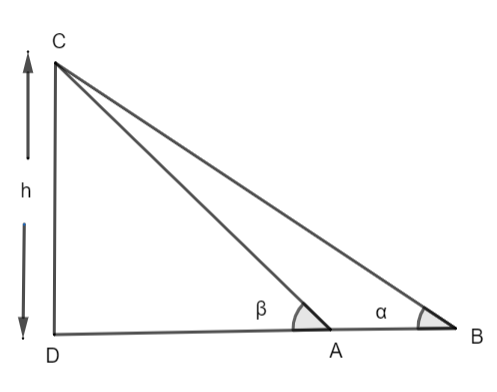
From the figure we get to know that CD represents the tower with height h meter. There are two depressions at point A and B. The angle CAD is angle $\beta $ and angle CBD is the angle $\alpha $.
Here, $\beta $ > $\alpha $ in the figure.
Now, we will apply the formula of trigonometry to find the distance between A and B.
By the formula $\tan \left( \theta \right)=\dfrac{\text{perpendicular}}{\text{Base}}$ we have $\tan \left( \alpha \right)=\dfrac{CD}{BD}$ and $\tan \left( \beta \right)=\dfrac{CD}{AD}$. As we know that CD = h meters.
Therefore, we have $\tan \left( \alpha \right)=\dfrac{h}{BD}$ and $\tan \left( \beta \right)=\dfrac{h}{AD}$.
Also, as BD = AD + BA.
Thus, we get $\tan \left( \alpha \right)=\dfrac{h}{AD+BA}$ and $\tan \left( \beta \right)=\dfrac{h}{AD}$.
Now, we will consider $\tan \left( \alpha \right)=\dfrac{h}{AD+BA}$ which actually results into $\left( AD+BA \right)\tan \left( \alpha \right)=h...(i)$ and $\tan \left( \beta \right)=\dfrac{h}{AD}$ results into $AD\tan \left( \beta \right)=h...(ii)$.
By substituting equation (i) and (ii) we get a new expression as,
$\begin{align}
& \left( AD+BA \right)\tan \left( \alpha \right)=AD\tan \left( \beta \right) \\
& \Rightarrow AD\tan \left( \alpha \right)+BA\tan \left( \alpha \right)=AD\tan \left( \beta \right) \\
& \Rightarrow BA\tan \left( \alpha \right)=AD\tan \left( \beta \right)-AD\tan \left( \alpha \right) \\
& \Rightarrow BA=\dfrac{AD\tan \left( \beta \right)-AD\tan \left( \alpha \right)}{\tan \left( \alpha \right)}...(iii) \\
\end{align}$
By equation (ii) we get the value of $AD=\dfrac{h}{\tan \left( \beta \right)}$. Now, we will substitute this value in equation (iii).
Therefore we have
$\begin{align}
& \Rightarrow BA=\dfrac{AD\tan \left( \beta \right)-AD\tan \left( \alpha \right)}{\tan \left( \alpha \right)} \\
& \Rightarrow BA=\dfrac{AD\left( \tan \left( \beta \right)-\tan \left( \alpha \right) \right)}{\tan \left( \alpha \right)} \\
& \Rightarrow BA=\left( \dfrac{h}{\tan \left( \beta \right)} \right)\dfrac{\left( \tan \left( \beta \right)-\tan \left( \alpha \right) \right)}{\tan \left( \alpha \right)} \\
& \Rightarrow BA=\dfrac{h\left( \tan \left( \beta \right)-\tan \left( \alpha \right) \right)}{\tan \left( \alpha \right)\tan \left( \beta \right)} \\
\end{align}$
Hence, the distance between the two depressions A and B from the tower is $BA=\dfrac{h\left( \tan \left( \beta \right)-\tan \left( \alpha \right) \right)}{\tan \left( \alpha \right)\tan \left( \beta \right)}$.
Note: We could have also equated the value of h from equation (i). But this would have converted the simple solution into a complex one. In case we need to find out the value of the distance in terms of $\cot \left( \theta \right)$ then, we would have used the substitution $\tan \left( \theta \right)=\dfrac{1}{\cot \left( \theta \right)}$ in the answer and get the required new answer. But this is only when it is asked in the question.
Complete step-by-step answer:
From the figure we get to know that CD represents the tower with height h meter. There are two depressions at point A and B. The angle CAD is angle $\beta $ and angle CBD is the angle $\alpha $.
Here, $\beta $ > $\alpha $ in the figure.
Now, we will apply the formula of trigonometry to find the distance between A and B.
By the formula $\tan \left( \theta \right)=\dfrac{\text{perpendicular}}{\text{Base}}$ we have $\tan \left( \alpha \right)=\dfrac{CD}{BD}$ and $\tan \left( \beta \right)=\dfrac{CD}{AD}$. As we know that CD = h meters.
Therefore, we have $\tan \left( \alpha \right)=\dfrac{h}{BD}$ and $\tan \left( \beta \right)=\dfrac{h}{AD}$.
Also, as BD = AD + BA.
Thus, we get $\tan \left( \alpha \right)=\dfrac{h}{AD+BA}$ and $\tan \left( \beta \right)=\dfrac{h}{AD}$.
Now, we will consider $\tan \left( \alpha \right)=\dfrac{h}{AD+BA}$ which actually results into $\left( AD+BA \right)\tan \left( \alpha \right)=h...(i)$ and $\tan \left( \beta \right)=\dfrac{h}{AD}$ results into $AD\tan \left( \beta \right)=h...(ii)$.
By substituting equation (i) and (ii) we get a new expression as,
$\begin{align}
& \left( AD+BA \right)\tan \left( \alpha \right)=AD\tan \left( \beta \right) \\
& \Rightarrow AD\tan \left( \alpha \right)+BA\tan \left( \alpha \right)=AD\tan \left( \beta \right) \\
& \Rightarrow BA\tan \left( \alpha \right)=AD\tan \left( \beta \right)-AD\tan \left( \alpha \right) \\
& \Rightarrow BA=\dfrac{AD\tan \left( \beta \right)-AD\tan \left( \alpha \right)}{\tan \left( \alpha \right)}...(iii) \\
\end{align}$
By equation (ii) we get the value of $AD=\dfrac{h}{\tan \left( \beta \right)}$. Now, we will substitute this value in equation (iii).
Therefore we have
$\begin{align}
& \Rightarrow BA=\dfrac{AD\tan \left( \beta \right)-AD\tan \left( \alpha \right)}{\tan \left( \alpha \right)} \\
& \Rightarrow BA=\dfrac{AD\left( \tan \left( \beta \right)-\tan \left( \alpha \right) \right)}{\tan \left( \alpha \right)} \\
& \Rightarrow BA=\left( \dfrac{h}{\tan \left( \beta \right)} \right)\dfrac{\left( \tan \left( \beta \right)-\tan \left( \alpha \right) \right)}{\tan \left( \alpha \right)} \\
& \Rightarrow BA=\dfrac{h\left( \tan \left( \beta \right)-\tan \left( \alpha \right) \right)}{\tan \left( \alpha \right)\tan \left( \beta \right)} \\
\end{align}$
Hence, the distance between the two depressions A and B from the tower is $BA=\dfrac{h\left( \tan \left( \beta \right)-\tan \left( \alpha \right) \right)}{\tan \left( \alpha \right)\tan \left( \beta \right)}$.
Note: We could have also equated the value of h from equation (i). But this would have converted the simple solution into a complex one. In case we need to find out the value of the distance in terms of $\cot \left( \theta \right)$ then, we would have used the substitution $\tan \left( \theta \right)=\dfrac{1}{\cot \left( \theta \right)}$ in the answer and get the required new answer. But this is only when it is asked in the question.
Recently Updated Pages
Master Class 12 Economics: Engaging Questions & Answers for Success

Master Class 12 Physics: Engaging Questions & Answers for Success
Master Class 12 English: Engaging Questions & Answers for Success
Master Class 12 Social Science: Engaging Questions & Answers for Success
Master Class 12 Maths: Engaging Questions & Answers for Success
Master Class 12 Business Studies: Engaging Questions & Answers for Success
Trending doubts
Which are the Top 10 Largest Countries of the World?
What are the major means of transport Explain each class 12 social science CBSE
Draw a labelled sketch of the human eye class 12 physics CBSE
What is a transformer Explain the principle construction class 12 physics CBSE
Why cannot DNA pass through cell membranes class 12 biology CBSE
Differentiate between insitu conservation and exsitu class 12 biology CBSE