




Formula of the bleaching powder is:
A. \[Ca{{(OH)}_{2}}\]
B. \[CHC{{l}_{3}}\]
C. \[CC{{l}_{3}}CHO\]
D. \[CaOC{{l}_{2}}\]
Answer
 Verified
654k+ views
Hint: Bleaching powder contains two chlorine atoms. Out of two chlorine atoms one is bonded to the calcium atoms and the other bonded to the oxygen atom. The molecular mass of bleaching powder is 142.98 g/mol.
Bleaching powder is called chloride of lime or chlorinated lime.
Complete step by step answer:
(I)Calcium hypochlorite is the chemical name of bleaching powder.
(II)The chemical formula of bleaching powder is \[CaOC{{l}_{2}}\].
(III)The structure of bleaching powder is as follows.
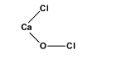
Hence, the correct answer is option D.
Additional Information
(i)Bleaching powder is pale yellow in color and exhibits a strong odor of chlorine.
(ii)Bleaching powder is soluble in water but due to the existence of impurities, we cannot observe a clear solution.
(iii)Bleaching powder used as a bleaching agent in textile industries after dissolving in water.
(iv)Bleaching powder is used as disinfectant in many industries due to its oxidizing property.
(v)Bleaching powder is synthesized by the reaction of chlorine gas with dry slaked lime (calcium hydroxide).
\[Ca{{(OH)}_{2}}+C{{l}_{2}}\to CaOC{{l}_{2}}+{{H}_{2}}O\]
In the above reaction calcium hydroxide reacts with chlorine gas and forms calcium hypochlorite (nothing but Bleaching powder) and water as a side product.
(vi)Bleaching powder is used for disinfecting water to make water suitable for drinking purposes called potable water.
(vii)It is used for bleaching muddy clothes in the laundry.
Note:
Hypochlorite is used in bleaching purposes because it is a very powerful oxidizing agent. Bleaching powder has two types of chlorine atoms. One chlorine has an oxidation number of + 1 and another chlorine atom has oxidation number of -1.
Bleaching powder is called chloride of lime or chlorinated lime.
Complete step by step answer:
(I)Calcium hypochlorite is the chemical name of bleaching powder.
(II)The chemical formula of bleaching powder is \[CaOC{{l}_{2}}\].
(III)The structure of bleaching powder is as follows.
Hence, the correct answer is option D.
Additional Information
(i)Bleaching powder is pale yellow in color and exhibits a strong odor of chlorine.
(ii)Bleaching powder is soluble in water but due to the existence of impurities, we cannot observe a clear solution.
(iii)Bleaching powder used as a bleaching agent in textile industries after dissolving in water.
(iv)Bleaching powder is used as disinfectant in many industries due to its oxidizing property.
(v)Bleaching powder is synthesized by the reaction of chlorine gas with dry slaked lime (calcium hydroxide).
\[Ca{{(OH)}_{2}}+C{{l}_{2}}\to CaOC{{l}_{2}}+{{H}_{2}}O\]
In the above reaction calcium hydroxide reacts with chlorine gas and forms calcium hypochlorite (nothing but Bleaching powder) and water as a side product.
(vi)Bleaching powder is used for disinfecting water to make water suitable for drinking purposes called potable water.
(vii)It is used for bleaching muddy clothes in the laundry.
Note:
Hypochlorite is used in bleaching purposes because it is a very powerful oxidizing agent. Bleaching powder has two types of chlorine atoms. One chlorine has an oxidation number of + 1 and another chlorine atom has oxidation number of -1.
Recently Updated Pages
Which will be the least stable resonating structure class 11 chemistry CBSE

How many 5 digit telephone numbers can be construc-class-11-maths-CBSE
How do you find the angle of the resultant vector class 11 physics CBSE
Draw labelled diagram of the following i Gram seed class 11 biology CBSE
1 Quintal is equal to a 110 kg b 10 kg c 100kg d 1000 class 11 physics CBSE
What is the need and importance of classification class 11 biology CBSE
Trending doubts
One Metric ton is equal to kg A 10000 B 1000 C 100 class 11 physics CBSE
Find the value of the expression given below sin 30circ class 11 maths CBSE
Draw a diagram of nephron and explain its structur class 11 biology CBSE
10 examples of friction in our daily life
Proton was discovered by A Thomson B Rutherford C Chadwick class 11 chemistry CBSE
The teeth used for biting and cutting food are called class 11 biology CBSE