




What is the formula mass of the iodine molecule?
Answer
 Verified
572.4k+ views
Hint :Iodine has a chemical symbol ‘ $ I $ ’. It has atomic number 53 which is denoted by the symbol ‘Z’. It is a non- metal which is present in the p- block of the periodic table. It exists in the molecular form as $ {I_2} $ which is known as the Iodine molecule. Molecular weight of any molecule is calculated by multiplying the atomic mass of one atom by the total number of atoms in the molecule.
Complete Step By Step Answer:
Iodine is a non-metal present in the p-block of the periodic table. It is denoted by the chemical symbol ‘ $ I $ ’. It has atomic number 53 which is denoted by the symbol ‘Z’.
Now, we will see the period table:-
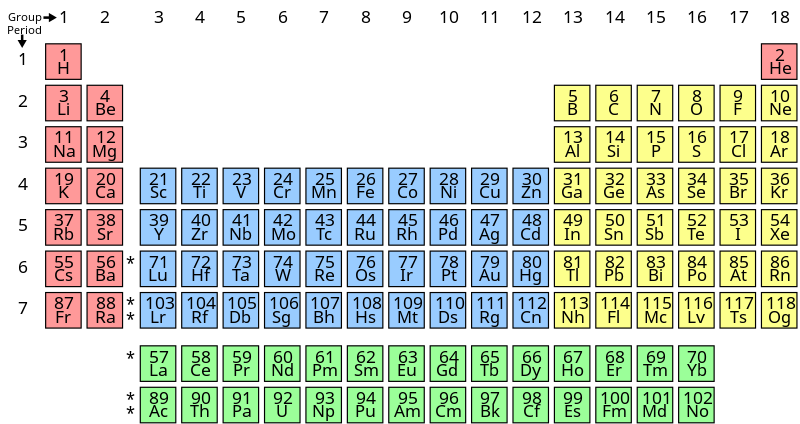
In the above periodic table, The elements in the yellow coloured boxes from group $ 13 $ to group $ 18 $ are known as p-block elements or main-group elements. Their general electronic configuration is $ n{s^2}n{p^{1 - 6}} $ .
The Iodine element is present in the fifth period and seventeenth group of the periodic table. It is a member of the halogen family.
Iodine exists as a $ {I_2} $ molecule in the molecular form. Hence, there are two iodine atoms in the molecule of iodine. Molecular weight ( which is also known as formula mass)of any molecule is calculated by multiplying the atomic mass of one atom by the total number of atoms in the molecule.
Atomic mass is denoted by A. Atomic mass of Iodine is $ 126.9gmo{l^{ - 1}} $ .
An iodine molecule contains two iodine atom and hence, we can calculate Formula mass of iodine molecule as:
$ = (126.9 \times 2)gmo{l^{ - 1}} $
$ = 253.8gmo{l^{ - 1}} $
Therefore, the formula mass of an iodine molecule is $ 253.8gmo{l^{ - 1}} $ .
Note :
Iodine has many applications in our lives. Iodine is used in disinfectants, dyes, pharmaceuticals, catalysts and animal food. It is also used to make polarising filters for LCD displays. Iodine deficiency can affect the thyroid gland and hence it is added in small amounts to table salt, so that we can intake it.
Complete Step By Step Answer:
Iodine is a non-metal present in the p-block of the periodic table. It is denoted by the chemical symbol ‘ $ I $ ’. It has atomic number 53 which is denoted by the symbol ‘Z’.
Now, we will see the period table:-
In the above periodic table, The elements in the yellow coloured boxes from group $ 13 $ to group $ 18 $ are known as p-block elements or main-group elements. Their general electronic configuration is $ n{s^2}n{p^{1 - 6}} $ .
The Iodine element is present in the fifth period and seventeenth group of the periodic table. It is a member of the halogen family.
Iodine exists as a $ {I_2} $ molecule in the molecular form. Hence, there are two iodine atoms in the molecule of iodine. Molecular weight ( which is also known as formula mass)of any molecule is calculated by multiplying the atomic mass of one atom by the total number of atoms in the molecule.
Atomic mass is denoted by A. Atomic mass of Iodine is $ 126.9gmo{l^{ - 1}} $ .
An iodine molecule contains two iodine atom and hence, we can calculate Formula mass of iodine molecule as:
$ = (126.9 \times 2)gmo{l^{ - 1}} $
$ = 253.8gmo{l^{ - 1}} $
Therefore, the formula mass of an iodine molecule is $ 253.8gmo{l^{ - 1}} $ .
Note :
Iodine has many applications in our lives. Iodine is used in disinfectants, dyes, pharmaceuticals, catalysts and animal food. It is also used to make polarising filters for LCD displays. Iodine deficiency can affect the thyroid gland and hence it is added in small amounts to table salt, so that we can intake it.
Recently Updated Pages
Which will be the least stable resonating structure class 11 chemistry CBSE

How many 5 digit telephone numbers can be construc-class-11-maths-CBSE
How do you find the angle of the resultant vector class 11 physics CBSE
Draw labelled diagram of the following i Gram seed class 11 biology CBSE
1 Quintal is equal to a 110 kg b 10 kg c 100kg d 1000 class 11 physics CBSE
What is the need and importance of classification class 11 biology CBSE
Trending doubts
One Metric ton is equal to kg A 10000 B 1000 C 100 class 11 physics CBSE
Find the value of the expression given below sin 30circ class 11 maths CBSE
Draw a diagram of nephron and explain its structur class 11 biology CBSE
10 examples of friction in our daily life
Proton was discovered by A Thomson B Rutherford C Chadwick class 11 chemistry CBSE
How many kilometers are there in 100 meters class 11 maths CBSE