




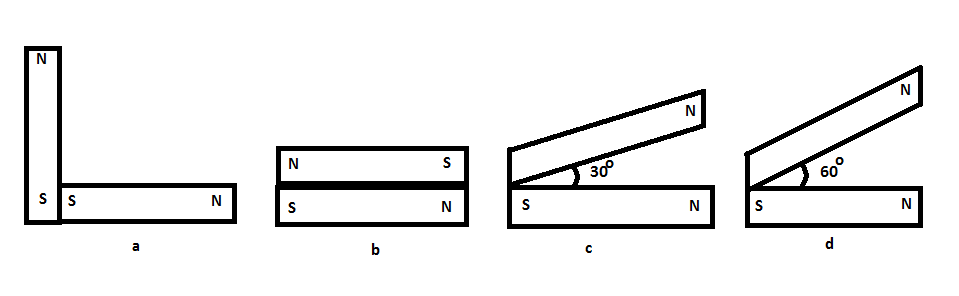
Following figures show the arrangement of bar magnets in different configurations. Each magnet has a magnetic dipole moment \[\vec{m}\]. Which configuration has the highest net magnetic dipole moment?
A \[a\]
B \[b\]
C \[c\]
D \[d\]
Answer
 Verified
619.8k+ views
Hint: Here, each bar magnet has a magnetic dipole moment as \[\vec{m}\]. Since magnetic dipole moment is a vector quantity, we can find the resultant magnetic dipole moment using the formula for finding magnitude of a vector quantity. Thus
we can determine which configuration has the highest net magnetic moment.
Formula used:
\[{{m}_{net}}=\sqrt{{{m}_{1}}^{2}+{{m}_{2}}^{2}+2{{m}_{1}}{{m}_{2}}cos\theta }\]
Complete step-by-step solution:
Given that, each bar magnet has a magnetic dipole moment \[\vec{m}\]. Magnetic dipole moment has its direction from north to south. Now let’s find out the net magnetic dipole moment of each configuration using a vector diagram.
In the first configuration, bar magnets have an angle \[{{90}^{0}}\] between them. The resultant vector will be in a \[{{45}^{0}}\] angle with both the magnets.
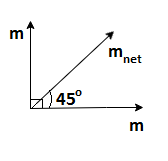
Magnitude of a vector m can be found using the formula,
\[{{m}_{net}}=\sqrt{{{m}_{1}}^{2}+{{m}_{2}}^{2}+2{{m}_{1}}{{m}_{2}}cos\theta }\]
Then,
\[{{m}_{net}}=\sqrt{{{m}^{2}}+{{m}^{2}}+2{{m}^{2}}\cos 90}=\sqrt{2}m\]
In the second configuration, the bar magnets are parallel to each other.
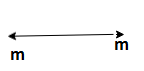
Hence,
\[{{m}_{net}}=m-m=0\]
In the third configuration, magnets have a \[30{}^\circ \] angle between them.
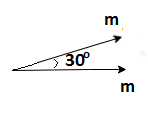
\[{{m}_{net}}=\sqrt{{{m}^{2}}+{{m}^{2}}+2{{m}^{2}}\cos
30}=m\sqrt{3.732}=1.93m\]
In the fourth configuration, magnets have \[60{}^\circ \] angle between them.
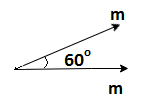
\[{{m}_{net}}=\sqrt{{{m}^{2}}+{{m}^{2}}+2{{m}^{2}}\cos
60}=m\sqrt{3}=1.732m\]
Hence, configuration \[c\] has the highest net magnetic dipole moment. Answer is option C
Additional information:
Consider a magnetic dipole with two equal and opposite magnetic charges of strengths \[+m\] and \[-m\] and separated by a distance \[2l\]. Then, its magnetic dipole moment can be given by, \[M=m\times 2l\]
Note: A bar magnet is usually considered as a dipole with dipole moment\[\vec{m}\]. Magnetic dipole moment is a vector quantity and has direction from \[-m\] to \[+m\]. Its S.I unit is \[\text{Ampere }{{\text{m}}^{\text{2}}}\].
we can determine which configuration has the highest net magnetic moment.
Formula used:
\[{{m}_{net}}=\sqrt{{{m}_{1}}^{2}+{{m}_{2}}^{2}+2{{m}_{1}}{{m}_{2}}cos\theta }\]
Complete step-by-step solution:
Given that, each bar magnet has a magnetic dipole moment \[\vec{m}\]. Magnetic dipole moment has its direction from north to south. Now let’s find out the net magnetic dipole moment of each configuration using a vector diagram.
In the first configuration, bar magnets have an angle \[{{90}^{0}}\] between them. The resultant vector will be in a \[{{45}^{0}}\] angle with both the magnets.
Magnitude of a vector m can be found using the formula,
\[{{m}_{net}}=\sqrt{{{m}_{1}}^{2}+{{m}_{2}}^{2}+2{{m}_{1}}{{m}_{2}}cos\theta }\]
Then,
\[{{m}_{net}}=\sqrt{{{m}^{2}}+{{m}^{2}}+2{{m}^{2}}\cos 90}=\sqrt{2}m\]
In the second configuration, the bar magnets are parallel to each other.
Hence,
\[{{m}_{net}}=m-m=0\]
In the third configuration, magnets have a \[30{}^\circ \] angle between them.
\[{{m}_{net}}=\sqrt{{{m}^{2}}+{{m}^{2}}+2{{m}^{2}}\cos
30}=m\sqrt{3.732}=1.93m\]
In the fourth configuration, magnets have \[60{}^\circ \] angle between them.
\[{{m}_{net}}=\sqrt{{{m}^{2}}+{{m}^{2}}+2{{m}^{2}}\cos
60}=m\sqrt{3}=1.732m\]
Hence, configuration \[c\] has the highest net magnetic dipole moment. Answer is option C
Additional information:
Consider a magnetic dipole with two equal and opposite magnetic charges of strengths \[+m\] and \[-m\] and separated by a distance \[2l\]. Then, its magnetic dipole moment can be given by, \[M=m\times 2l\]
Note: A bar magnet is usually considered as a dipole with dipole moment\[\vec{m}\]. Magnetic dipole moment is a vector quantity and has direction from \[-m\] to \[+m\]. Its S.I unit is \[\text{Ampere }{{\text{m}}^{\text{2}}}\].
Recently Updated Pages
Basicity of sulphurous acid and sulphuric acid are

Master Class 12 Economics: Engaging Questions & Answers for Success
Master Class 12 Biology: Engaging Questions & Answers for Success
Master Class 11 English: Engaging Questions & Answers for Success
Master Class 11 Physics: Engaging Questions & Answers for Success
Master Class 11 Computer Science: Engaging Questions & Answers for Success
Trending doubts
Draw a labelled sketch of the human eye class 12 physics CBSE
The chemical formula of tear gas is A CO Cl 2 B C 10 class 12 chemistry CBSE
Draw ray diagrams each showing i myopic eye and ii class 12 physics CBSE
Which are the Top 10 Largest Countries of the World?
Differentiate between homogeneous and heterogeneous class 12 chemistry CBSE
Which is the correct genotypic ratio of mendel dihybrid class 12 biology CBSE