



How to find the volume of a sphere using integration?
Answer
 Verified
593.4k+ views
Hint: We will draw a rough figure representing a sphere. We will consider a disc of a certain radius about the y-axis. Then we will find the value of the radius in terms of its height from the centre of the sphere and the radius of the sphere. We will integrate the area of this disc along the y-axis where the limits for integration will be the points where the height of the sphere is maximum and minimum.
Complete step-by-step solution:
The rough diagram of the sphere looks like the following,
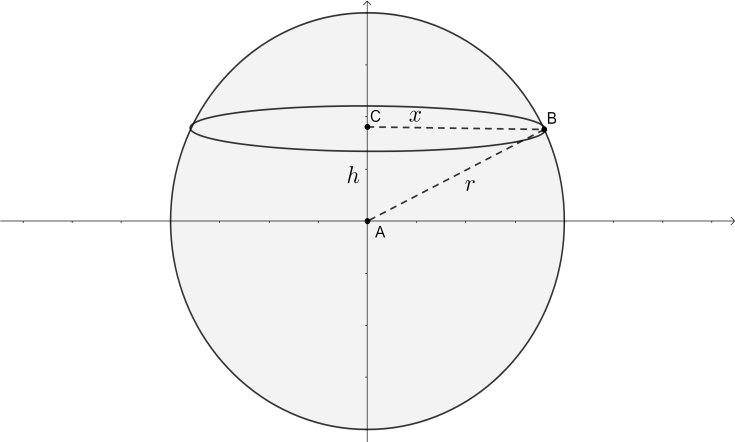
We have to find the volume of this sphere using integration. We have a sphere centered at the origin with radius $r$. Let us consider a disc about the y-axis at a height $h$ and having radius as $x$. The radius of the disc is $x$. Now, from the figure, we can see that $\Delta ACB$ is a right angled triangle with the hypotenuse AB. So, using the Pythagoras theorem in this triangle, we get the following,
$\begin{align}
& A{{B}^{2}}=A{{C}^{2}}+B{{C}^{2}} \\
& \Rightarrow {{r}^{2}}={{h}^{2}}+{{x}^{2}} \\
& \Rightarrow {{x}^{2}}={{r}^{2}}-{{h}^{2}} \\
& \therefore x=\sqrt{{{r}^{2}}-{{h}^{2}}} \\
\end{align}$
The area of this disc is ${{A}_{Disc}}=\pi {{x}^{2}}$. Substituting the value of $x$ in this formula, we get
${{A}_{Disc}}=\pi \left( {{r}^{2}}-{{h}^{2}} \right)$
The discs from the lowest height of the sphere to the highest height of the sphere will fill up the sphere. So, we can calculate the volume of the sphere by integrating the areas of the discs from the lowest height of the sphere to the highest height of the sphere. The lowest height is $-r$ and the highest height of the sphere is $r$. So, we have the following integral,
${{V}_{sphere}}=\int\limits_{-r}^{r}{\pi \left( {{r}^{2}}-{{h}^{2}} \right)dh}$
Integrating the above expression, we get
\[{{V}_{sphere}}=\left. \pi \left( h{{r}^{2}}-\dfrac{{{h}^{3}}}{3} \right) \right|_{-r}^{r}\]
Substituting the limits, we get the following,
\[{{V}_{sphere}}=\pi \left( r\cdot {{r}^{2}}-\dfrac{{{r}^{3}}}{3} \right)-\pi \left( -r\cdot {{r}^{2}}-\dfrac{{{\left( -r \right)}^{3}}}{3} \right)\]
Simplifying the above equation, we get
\[\begin{align}
& {{V}_{sphere}}=\pi \left( \dfrac{2{{r}^{3}}}{3} \right)-\pi \left( -\dfrac{2{{r}^{3}}}{3} \right) \\
& \Rightarrow {{V}_{sphere}}=\pi \left( \dfrac{2{{r}^{3}}}{3}-\left( -\dfrac{2{{r}^{3}}}{3} \right) \right) \\
& \therefore {{V}_{sphere}}=\dfrac{4\pi {{r}^{3}}}{3} \\
\end{align}\]
Thus, we have derived the formula for the volume of the sphere.
Note: The infinitesimal we used in the integration is $dh$ because we are integrating from the lowest height of the sphere to the highest height of the sphere. We can use the y-coordinate instead of the height variable. We should be careful with the signs while opening the brackets, so that we can avoid making errors in the calculations.
Complete step-by-step solution:
The rough diagram of the sphere looks like the following,
We have to find the volume of this sphere using integration. We have a sphere centered at the origin with radius $r$. Let us consider a disc about the y-axis at a height $h$ and having radius as $x$. The radius of the disc is $x$. Now, from the figure, we can see that $\Delta ACB$ is a right angled triangle with the hypotenuse AB. So, using the Pythagoras theorem in this triangle, we get the following,
$\begin{align}
& A{{B}^{2}}=A{{C}^{2}}+B{{C}^{2}} \\
& \Rightarrow {{r}^{2}}={{h}^{2}}+{{x}^{2}} \\
& \Rightarrow {{x}^{2}}={{r}^{2}}-{{h}^{2}} \\
& \therefore x=\sqrt{{{r}^{2}}-{{h}^{2}}} \\
\end{align}$
The area of this disc is ${{A}_{Disc}}=\pi {{x}^{2}}$. Substituting the value of $x$ in this formula, we get
${{A}_{Disc}}=\pi \left( {{r}^{2}}-{{h}^{2}} \right)$
The discs from the lowest height of the sphere to the highest height of the sphere will fill up the sphere. So, we can calculate the volume of the sphere by integrating the areas of the discs from the lowest height of the sphere to the highest height of the sphere. The lowest height is $-r$ and the highest height of the sphere is $r$. So, we have the following integral,
${{V}_{sphere}}=\int\limits_{-r}^{r}{\pi \left( {{r}^{2}}-{{h}^{2}} \right)dh}$
Integrating the above expression, we get
\[{{V}_{sphere}}=\left. \pi \left( h{{r}^{2}}-\dfrac{{{h}^{3}}}{3} \right) \right|_{-r}^{r}\]
Substituting the limits, we get the following,
\[{{V}_{sphere}}=\pi \left( r\cdot {{r}^{2}}-\dfrac{{{r}^{3}}}{3} \right)-\pi \left( -r\cdot {{r}^{2}}-\dfrac{{{\left( -r \right)}^{3}}}{3} \right)\]
Simplifying the above equation, we get
\[\begin{align}
& {{V}_{sphere}}=\pi \left( \dfrac{2{{r}^{3}}}{3} \right)-\pi \left( -\dfrac{2{{r}^{3}}}{3} \right) \\
& \Rightarrow {{V}_{sphere}}=\pi \left( \dfrac{2{{r}^{3}}}{3}-\left( -\dfrac{2{{r}^{3}}}{3} \right) \right) \\
& \therefore {{V}_{sphere}}=\dfrac{4\pi {{r}^{3}}}{3} \\
\end{align}\]
Thus, we have derived the formula for the volume of the sphere.
Note: The infinitesimal we used in the integration is $dh$ because we are integrating from the lowest height of the sphere to the highest height of the sphere. We can use the y-coordinate instead of the height variable. We should be careful with the signs while opening the brackets, so that we can avoid making errors in the calculations.
Recently Updated Pages
Master Class 12 Business Studies: Engaging Questions & Answers for Success

Master Class 12 Biology: Engaging Questions & Answers for Success
Master Class 12 Chemistry: Engaging Questions & Answers for Success
Class 12 Question and Answer - Your Ultimate Solutions Guide
Master Class 11 English: Engaging Questions & Answers for Success
Master Class 11 Social Science: Engaging Questions & Answers for Success
Trending doubts
Which are the Top 10 Largest Countries of the World?
Draw a labelled sketch of the human eye class 12 physics CBSE
Differentiate between homogeneous and heterogeneous class 12 chemistry CBSE
Why is the cell called the structural and functional class 12 biology CBSE
Draw ray diagrams each showing i myopic eye and ii class 12 physics CBSE
Which is the correct genotypic ratio of mendel dihybrid class 12 biology CBSE